
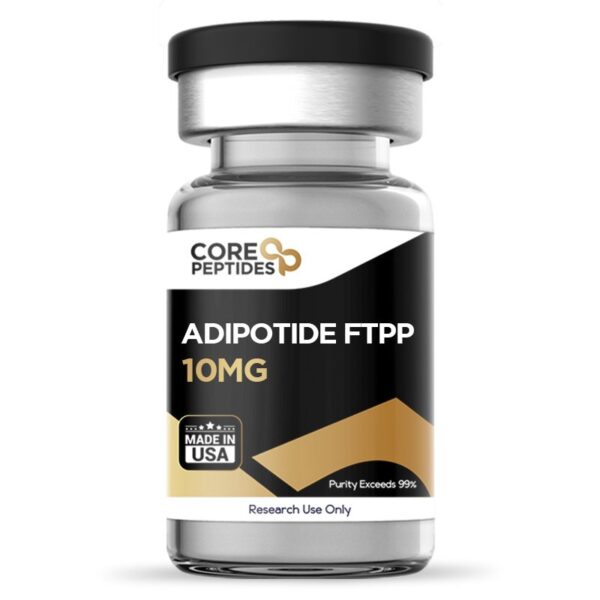
Adipotide (FTPP) – 10MG
CHF 70.20
Adipotide (FTPP, Fat-Targeted Proapoptotic Peptide) is a synthetic peptidomimetic composed of a vascular homing domain (CKGGRAKDC) linked to a proapoptotic sequence D(KLAKLAK)₂. This 10mg research compound is designed to selectively target prohibitin-expressing vasculature of white adipose tissue, triggering endothelial apoptosis and vascular ablation. Researchers studying adipose tissue biology, metabolic regulation, and vascular-targeting mechanisms may find Adipotide a valuable tool for laboratory investigation. Buy Adipotide 10mg in Switzerland from Core Peptides for your research needs.
What Is Adipotide and Why Buy It for Research?
Buy Adipotide 10mg in Switzerland for research into adipose tissue vasculature, metabolic regulation, and targeted proapoptotic mechanisms. Specifically, Adipotide (also known as FTPP, Fat-Targeted Proapoptotic Peptide, HKPao, or Prohibitin-Targeting Peptide-1) is a synthetic peptidomimetic compound engineered as a bipartite molecule. Structurally, it consists of a vascular homing domain with the sequence CKGGRAKDC linked via a glycine-glycine spacer to a proapoptotic effector domain D(KLAKLAK)₂.
In scientific research, Adipotide serves as a molecular tool for studying ligand-directed vascular targeting and endothelial cell apoptosis. Researchers consider this peptidomimetic particularly valuable for investigating prohibitin-mediated receptor interactions and their role in adipose tissue biology. Furthermore, Core Peptides supplies Adipotide as a lyophilized powder in a 10mg format exclusively for laboratory use. Therefore, researchers seeking to source this compound for their work will find it readily available through trusted suppliers.
Adipotide Research Overview: Buy Adipotide 10mg in Switzerland for Vascular Targeting Studies
Centrally, research into Adipotide has focused on its function as a proapoptotic peptidomimetic that homes to prohibitin on white adipose vasculature. Endogenously, prohibitin (PHB) is a multifunctional protein that is differentially expressed on the surface of endothelial cells in white adipose tissue vasculature. Adipotide disrupts this vascular supply by binding to the PHB-annexin A2 (ANXA2) complex on endothelial cells, thereby triggering mitochondrial disruption and programmed cell death.
Notably, this vascular ablation starves fat depots of blood supply, leading to adipocyte ischemia and subsequent reabsorption of dead adipose tissue. Investigators have studied this peptidomimetic in various research contexts, including preclinical models of obesity, metabolic dysfunction, and angiogenesis. Accordingly, researchers can buy Adipotide 10mg in Switzerland from Core Peptides to support their investigations into adipose vasculature and metabolic regulation pathways.
How Does Adipotide Work in Research?
Mechanistically, Adipotide’s proposed action involves functioning as a ligand-directed peptidomimetic that selectively targets the vasculature of white adipose tissue. The N-terminal homing domain CKGGRAKDC adopts a cyclic conformation stabilized by an intramolecular disulfide bond between the two terminal cysteine residues. This cyclic structure provides enhanced binding stability and confers resistance to proteolytic degradation. Furthermore, the homing domain recognizes and binds to the PHB-ANXA2 complex present on the surface of endothelial cells supplying white adipose tissue.
Following receptor-mediated internalization, the C-terminal proapoptotic domain D(KLAKLAK)₂ becomes active. This amphipathic peptide adopts an alpha-helical conformation with one hydrophobic face and one positively charged face. Importantly, the domain is synthesized using D-amino acids, which are mirror-image enantiomers of naturally occurring L-amino acids. This critical design feature makes D-peptides resistant to degradation by natural proteases, thereby extending the functional lifetime of the proapoptotic domain after internalization.
Experimental studies demonstrate that the proapoptotic domain induces the formation of transient pores in mitochondrial membranes, permitting the efflux of entrapped cytochrome c. Consequently, this mitochondrial disruption triggers apoptosis in the targeted endothelial cells, leading to vessel regression and shutdown of microvasculature within adipose tissue regions. Without adequate blood flow, adipocytes undergo ischemic injury and die, after which the immune system reabsorbs and clears the dead adipose cells.
Why Is Adipotide Studied in Switzerland?
Primarily, researchers study Adipotide because it represents a well-characterized peptidomimetic that enables investigation of vascular targeting, endothelial apoptosis, and adipose tissue biology. In fact, this compound offers a focused tool for studying the molecular mechanisms of ligand-directed cell death and tissue-specific vascular ablation.
Preclinical studies have demonstrated robust weight loss in rodent and primate models. For example, in a 2011 study published in Science Translational Medicine, spontaneously obese rhesus monkeys treated with Adipotide for 28 days showed a 7 to 15% weight loss, a 38% reduction in total body fat, and a 27% reduction in abdominal fat. Furthermore, the study also reported improved insulin resistance and decreased abdominal circumference. Notably, lean animals showed no weight loss, suggesting specificity for adipose tissue. Ultimately, researchers can buy Adipotide 10mg in Switzerland to access a research tool that may help uncover mechanisms underlying adipose tissue regulation and metabolic homeostasis.
Adipotide Research Areas in Laboratory Studies
| Research Area | Focus | Evidence Level |
|---|---|---|
| Adipose Vasculature Targeting | Prohibitin binding, endothelial apoptosis, vascular ablation | Mechanistic / In Vitro |
| Obesity and Adiposity Research | White adipose tissue reduction, subcutaneous and visceral fat | Animal / Preclinical |
| Metabolic Regulation | Insulin sensitivity, glucose tolerance, lipid metabolism | Animal / Preclinical |
| Angiogenesis and Vascular Biology | Endothelial cell signaling, vessel regression | Mechanistic / In Vitro |
| Receptor-Ligand Interactions | PHB-ANXA2 complex, CD36 fatty acid transport | Mechanistic / In Vitro |
| Oncology Research | Tumor vasculature targeting, prohibitin expression in cancers | Emerging Research |
Adipotide Compared With Related Research Compounds
| Compound | Research Focus | Mechanism / Target | Key Difference |
|---|---|---|---|
| Adipotide (FTPP) | Adipose vascular ablation, weight loss | Prohibitin-targeted apoptosis | Dual-domain peptidomimetic; D-amino acid proapoptotic domain |
| BPC-157 | Tissue healing, angiogenesis | Growth factor modulation | Different mechanism; promotes healing rather than ablation |
| GHK-Cu | Skin regeneration, wound healing | Copper-binding, ECM signaling | Different target; no vascular ablation mechanism |
| TB-500 | Tissue repair, wound healing | Actin binding, cell migration | Different mechanism; promotes cell motility |
Comparatively, Adipotide differs from other research peptides in its mechanism and research applications. On the one hand, Adipotide acts as a vascular-targeting proapoptotic agent that ablates adipose tissue vasculature through prohibitin-mediated apoptosis. On the other hand, BPC-157, GHK-Cu, and TB-500 are studied primarily for their roles in tissue healing, regeneration, and repair mechanisms. In contrast, Adipotide’s unique dual-domain architecture and D-amino acid proapoptotic sequence make it a distinct tool for studying targeted cell death and vascular biology.
Research Applications for Adipotide in Switzerland
Scientists have investigated Adipotide across several research domains:
- Adipose Tissue Biology: Researchers use Adipotide to study white adipose tissue vasculature, adipocyte metabolism, and the differential roles of fat subtypes in energy homeostasis.
- Metabolic Regulation Studies: Investigations have explored Adipotide’s effects on insulin sensitivity, glucose tolerance, and lipid metabolism in obese research models.
- Vascular Targeting Research: Adipotide serves as a model compound for studying ligand-directed endothelial apoptosis and tissue-specific vascular ablation.
- Receptor-Ligand Interaction Studies: The compound is used to investigate prohibitin-annexin A2 interactions and their role in fatty acid transport via CD36.
- Oncology Research: Adipotide’s vascular targeting mechanism has implications for tumor vasculature research, where prohibitin expression is implicated in various cancers.
Evidently, researchers can buy Adipotide 10mg in Switzerland for these applications, as it is a valuable addition to any laboratory toolkit focused on adipose tissue biology and vascular targeting research.
Adipotide Product Specifications
| Specification | Details |
|---|---|
| Product Name | Adipotide (FTPP) |
| Alternative Names | FTPP, HKPao, Prohibitin-Targeting Peptide-1, TP01 |
| Amount | 10mg |
| Form | Lyophilized powder |
| Purity | Not verified |
| Amino Acid Sequence | CKGGRAKDC-GG-D(KLAKLAK)₂ (25-mer) |
| Homing Domain | CKGGRAKDC (cyclic, disulfide bond) |
| Proapoptotic Domain | D(KLAKLAK)₂ (D-amino acids) |
| Linker | Gly-Gly (GG) |
| Molecular Formula | C₁₁₁H₂₀₆N₃₆O₂₈S₂ (varies by source) |
| Molecular Weight | Approx. 2,557 Da (varies by salt form) |
| CAS Number | 859216-15-2 (varies by source) |
| Research Category | Weight Management & Metabolism |
| Research Use | Laboratory research use only |
| CoA | Available upon request (not verified) |
| Storage | Lyophilized powder should be stored desiccated at -20°C or below |
How to Evaluate Adipotide Quality for Research
When sourcing Adipotide peptidomimetic for laboratory research, researchers should consider several quality indicators:
- Identity Confirmation: Analytical techniques such as mass spectrometry should confirm the compound’s molecular weight and sequence (CKGGRAKDC-GG-D(KLAKLAK)₂).
- Purity Assessment: High-performance liquid chromatography (HPLC) can provide information about peptidomimetic purity.
- Batch Traceability: Lot numbers and batch information enable researchers to track specific production runs.
- Certificate of Analysis: A CoA should accompany the product, detailing analytical testing results.
- Labeling Accuracy: Proper labeling should clearly indicate the product name, amount, sequence, and storage recommendations.
- Storage Conditions: Appropriate storage at -20°C or below in desiccated conditions helps maintain compound stability.
Understanding the Certificate of Analysis
Typically, a Certificate of Analysis (CoA) accompanies research peptidomimetics and provides information about the specific batch’s analytical testing. For example, a CoA may include product identity confirmation, purity percentage as determined by HPLC, batch or lot number for traceability, analytical methods used (e.g., mass spectrometry, HPLC), and a physical description of the product.
Nevertheless, it is important to note that a CoA does not establish safety, efficacy, therapeutic effectiveness, or suitability for human use. Instead, it serves as a quality control document that helps researchers verify the identity and purity of the compound they are using in their laboratory investigations.
Storage and Stability of Adipotide
Core Peptides supplies Adipotide as a lyophilized (freeze-dried) powder. To maintain stability and integrity:
- Store the lyophilized powder desiccated at -20°C or below
- Avoid repeated freeze-thaw cycles
- Reconstitute only immediately before use with appropriate sterile solvents
- Gently swirl to dissolve; do not vortex
- Filter sterilize if required (e.g., 0.22 µm) immediately prior to use
- Aliquot and store reconstituted solutions at -20°C (or lower)
- Protect from light and moisture
Frequently Asked Questions About Buying Adipotide 10mg in Switzerland
What is Adipotide?
Specifically, Adipotide (FTPP) is a synthetic peptidomimetic composed of a vascular homing domain (CKGGRAKDC) linked via a glycine-glycine spacer to a proapoptotic domain D(KLAKLAK)₂.
What is Adipotide researched for?
Primarily, researchers study Adipotide for its role as a prohibitin-targeting proapoptotic agent that ablates white adipose tissue vasculature. Studies have investigated its effects on adipose tissue reduction, metabolic regulation, and vascular targeting mechanisms.
How does Adipotide work?
Mechanistically, Adipotide functions by binding to the PHB-ANXA2 complex on endothelial cells of white adipose tissue vasculature. Following internalization, the proapoptotic domain D(KLAKLAK)₂ disrupts mitochondrial membranes, thereby triggering apoptosis and subsequent vascular ablation.
What is the amino acid sequence of Adipotide?
The full sequence is CKGGRAKDC-GG-D(KLAKLAK)₂, where D(KLAKLAK)₂ indicates the use of D-amino acids.
What is the molecular weight of Adipotide?
Not verified. The molecular weight varies by source and salt form, with reported values ranging from approximately 2,460 Da to 2,694 Da.
What is the CAS number of Adipotide?
Not verified. Reported CAS numbers include 859216-15-2 and 1024828-77-0.
Is Adipotide synthetic?
Yes, Adipotide is a synthetic peptidomimetic compound produced through solid-phase peptide synthesis.
What research exists on Adipotide?
Research on Adipotide includes preclinical studies in rodents and non-human primates, with a 2011 study in Science Translational Medicine demonstrating significant weight loss and improved insulin resistance in obese rhesus monkeys. A Phase 1 clinical trial was announced in 2012 but produced no peer-reviewed published results.
What is the difference between Adipotide and other weight loss research compounds?
Adipotide directly targets adipose tissue vasculature through prohibitin-mediated apoptosis, whereas other compounds typically act through appetite control, fat absorption inhibition, or metabolic enhancement.
Is Adipotide approved as a medicine?
No. Regulatory authorities have not approved Adipotide as a medicine, pharmaceutical, or therapeutic agent.
Is Adipotide intended for human use?
No. Adipotide is intended for laboratory research use only and is not for human consumption, injection, or therapeutic application.
Where can I buy Adipotide 10mg in Switzerland?
You can buy Adipotide 10mg in Switzerland from Core Peptides, a trusted research peptide supplier serving the Swiss scientific community.
How should researchers evaluate Adipotide quality?
Researchers should look for identity confirmation via mass spectrometry, purity data from HPLC, batch traceability, and a Certificate of Analysis.
Related Research Compounds
Researchers interested in Adipotide may also find the following related compounds relevant to their work:
- BPC-157 — A peptide researched for tissue healing, gastrointestinal health, and angiogenesis.
- TB-500 — A Thymosin Beta 4 fragment researched for tissue repair and wound healing.
- GHK-Cu — A copper-binding peptide researched for skin regeneration, wound healing, and anti-aging applications.
- AOD-9604 — A peptide researched for weight management and metabolic regulation.
Explore Weight Management & Metabolism
Adipotide belongs to the Weight Management & Metabolism category of research compounds. Weight Management & Metabolism products are studied for their potential roles in adipose tissue regulation, metabolic homeostasis, and energy balance. Generally, researchers who buy Adipotide 10mg in Switzerland often pair it with related compounds in this category to explore complementary pathways in metabolic research and adipose biology.
Explore Healing & Regeneration
Researchers studying vascular biology and tissue remodeling may also find relevant compounds in the Healing & Regeneration category. While Adipotide focuses on vascular ablation, compounds in this category are studied for their roles in tissue repair, angiogenesis, and regenerative mechanisms.
Further Research
For researchers seeking to deepen their understanding of Adipotide and its research applications, the following areas may warrant further investigation:
- The relationship between Adipotide-mediated prohibitin targeting and specific downstream apoptotic signaling pathways
- Comparative studies between Adipotide and other vascular-targeting peptidomimetics in various research models
- The potential role of Adipotide in modulating fatty acid transport via the PHB-ANXA2-CD36 network
- Mechanistic studies on Adipotide’s interaction with prohibitin and annexin A2 in different cell types
- Exploration of Adipotide’s effects on different adipose depots and tissue systems
Research Disclaimer
Adipotide is a research compound supplied for laboratory research use only. Researchers must not use it for human consumption, injection, or any form of therapeutic application. Moreover, this product is not a medicine, pharmaceutical, or medical device. Furthermore, Swissmedic, the FDA, EMA, or any other regulatory authority have not approved it for human use. Researchers should consult Swissmedic for applicable regulations and guidance on research compound handling in Switzerland.
Generally, the information provided on this page is for educational and scientific reference purposes only. Therefore, it does not constitute medical advice, treatment recommendations, or dosing instructions. Ultimately, researchers bear the responsibility for ensuring that their use of this product complies with all applicable laws, regulations, and institutional guidelines.
Finally, all research involving peptidomimetics should be conducted by qualified personnel in appropriate laboratory settings with proper safety protocols.
Schreiben Sie die erste Rezension für «Adipotide (FTPP) – 10MG»
Sie müssen angemeldet sein, um eine Rezension veröffentlichen zu können.
Ähnliche Produkte
Weight Management & Metabolism Peptides
Cellular Research & Signaling
Weight Management & Metabolism Peptides
Weight Management & Metabolism Peptides
Weight Management & Metabolism Peptides
Rezensionen
Es gibt noch keine Rezensionen.