
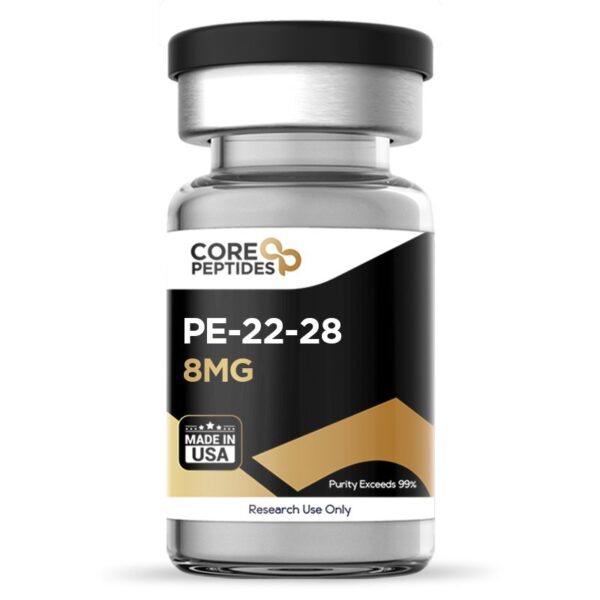
PE-22-28 (8MG)
CHF 48.60
PE-22-28 is a synthetic heptapeptide (Gly-Val-Ser-Trp-Gly-Leu-Arg, GVSWGLR) derived from spadin, a naturally occurring peptide fragment of the sortilin propeptide. Researchers investigate PE-22-28 for its potent and selective inhibition of the TREK-1 potassium channel (IC50 = 0.12 nM) approximately 300 times more potent than spadin. Studies have demonstrated that PE-22-28 induces neurogenesis within 4 days and enhances synaptogenesis in cortical neurons. Available for laboratory research purposes only. Buy PE-22-28 in Switzerland from Core Peptides, a trusted research peptide supplier.
What Is PE-22-28?
PE-22-28 is a synthetic heptapeptide—a peptide composed of seven amino acids—with the sequence Gly-Val-Ser-Trp-Gly-Leu-Arg (GVSWGLR). It originates from spadin, a naturally occurring 17-residue peptide cleaved from the propeptide of sortilin, a sorting receptor encoded by the SORT1 gene. Researchers designed PE-22-28 as a shortened analog of spadin, corresponding to positions 22–28 of the original spadin sequence—hence the name PE-22-28.
As a member of the spadin analog family, PE-22-28 has attracted considerable research interest for its potent and selective inhibition of the TREK-1 potassium channel (also known as K2P2.1). TREK-1 is a two-pore domain potassium channel primarily found in brain regions such as the prefrontal cortex and hippocampus—areas governing mood, memory, and learning. For those looking to buy PE-22-28 in Switzerland, Core Peptides offers high-quality research-grade material for laboratory applications.
PE-22-28 Research Overview
PE-22-28 represents a significant advancement in the spadin analog research program. The original spadin peptide (PE 12-28) demonstrated antidepressant-like activity through specific TREK-1 channel blockade. However, spadin presented practical limitations: a short plasma half-life of approximately seven hours and relatively modest potency. Consequently, researchers screened spadin analogs and derivatives to improve in vivo stability and bioavailability.
From the study of spadin blood degradation products, researchers designed the 7-amino-acid peptide PE-22-28. In vitro studies using patch-clamp techniques on hTREK-1/HEK cells demonstrated that PE-22-28 displays superior specificity and affinity for the TREK-1 channel compared to spadin, with an IC50 of 0.12 nM versus 40–60 nM for spadin—representing a greater than 300-fold increase in potency.
Furthermore, PE-22-28 exhibits a substantially improved duration of action, with in vivo stability extending up to 23 hours compared to spadin’s 7 hours. This extended action duration enables researchers to design experimental protocols with once-daily dosing and reproducible neurogenesis assays within 4 days. When researchers choose to buy PE-22-28 in Switzerland for laboratory studies, they gain access to a compound that may help elucidate mechanisms of neuroplasticity, neurogenesis, and synaptic remodeling at the molecular level.
How Does PE-22-28 Work?
The proposed mechanism of PE-22-28 involves selective inhibition of the TREK-1 potassium channel. TREK-1 (TWIK-related potassium channel) is a two-pore domain potassium channel that regulates neuronal excitability. By blocking TREK-1 activity, PE-22-28 increases neuronal excitability, which in turn promotes neurogenesis and synaptogenesis.
TREK-1 Channel Inhibition
PE-22-28 acts as a direct channel blocker with exceptional specificity and affinity for TREK-1. In vitro studies using patch-clamp techniques on hTREK-1/HEK cells demonstrated that PE-22-28 displays an IC50 of 0.12 nM—approximately 300 times more potent than spadin. This high potency makes PE-22-28 one of the most selective and effective TREK-1 inhibitors identified to date.
Research has also shown that different modifications of PE-22-28’s N or C-terminal ends can maintain or abolish TREK-1 channel activity without affecting the peptide’s affinity, providing valuable structure-activity relationship data for researchers.
Neurogenesis and Synaptogenesis
PE-22-28 and its analogs induce neurogenesis after only a 4-day treatment, with a prominent effect observed for the G/A-PE-22-28 derivative. On mouse cortical neurons, PE-22-28 and its derivatives enhance synaptogenesis, measured by the increase in PSD-95 expression level. PSD-95 (Postsynaptic Density Protein 95) is a key scaffolding protein at excitatory synapses, and its increased expression indicates enhanced synaptic formation and plasticity.
Researchers who buy PE-22-28 in Switzerland for research purposes can investigate these mechanisms across diverse experimental models of neuroplasticity and cognitive function.
Why Is PE-22-28 Studied?
Researchers study PE-22-28 primarily for its potential relevance to neurogenesis, synaptic plasticity, and mood regulation. The peptide’s potent and selective TREK-1 inhibition makes it a valuable tool for understanding the molecular basis of neuroplasticity and the role of potassium channels in brain function.
The peptide’s connection to spadin and the sortilin propeptide has made it a focus of neuroscience and depression research. Preclinical studies have explored PE-22-28’s effects on neurogenesis, synaptogenesis, and behavioral outcomes in various experimental models, including the forced swimming test and novelty-suppressed feeding test.
Moreover, researchers study PE-22-28 in the context of cognitive function and age-related cognitive decline. As neurogenesis and synaptic plasticity decline with age, understanding mechanisms that support these processes has become increasingly important. PE-22-28 represents one promising avenue of research inquiry in this area.
Researchers who buy PE-22-28 in Switzerland from Core Peptides can incorporate this peptide into their studies on TREK-1 channel biology, neurogenesis, synaptogenesis, and cognitive function.
PE-22-28 Research Areas
| Research Area | Description |
|---|---|
| TREK-1 Channel Inhibition | Investigating PE-22-28’s potent and selective blockade of the TREK-1 potassium channel (IC50 = 0.12 nM) |
| Neurogenesis | Studying PE-22-28’s ability to induce hippocampal neurogenesis within 4 days of treatment |
| Synaptogenesis | Examining PE-22-28’s effects on synaptic formation and PSD-95 expression in cortical neurons |
| Antidepressant Mechanisms | Preclinical research into PE-22-28’s behavioral effects in models of depression |
| Synaptic Plasticity | Exploring PE-22-28’s influence on synaptic remodeling and neuronal connectivity |
| Neuroprotection | Investigating PE-22-28’s potential to protect neurons from damage and degeneration |
| Cognitive Function | Studying PE-22-28’s effects on learning, memory, and cognitive performance |
| Post-Stroke Depression Research | Exploring PE-22-28’s potential relevance to mood disorders following ischemic events |
Scientific Research on PE-22-28
Researchers have conducted scientific studies on PE-22-28 primarily in preclinical settings, deriving evidence from in vitro cell cultures, ex vivo tissue samples, and in vivo rodent models. The peptide originates from the spadin research program, which identified sortilin-derived peptides as modulators of TREK-1 channel activity.
In Vitro Evidence
In vitro studies using patch-clamp techniques on hTREK-1/HEK cells demonstrated that PE-22-28 displays superior specificity and affinity for the TREK-1 channel compared to spadin, with an IC50 of 0.12 nM versus 40–60 nM for spadin. This represents a greater than 300-fold increase in potency. On mouse cortical neurons, PE-22-28 and its derivatives enhanced synaptogenesis, measured by the increase in PSD-95 expression level.
Preclinical Animal Studies
In vivo, researchers demonstrated the antidepressant properties of PE-22-28 and its derivatives in behavioral models of depression, such as the forced swimming test. Mice treated with spadin analogs showed a significant reduction in immobility time. Moreover, in the novelty-suppressed feeding test after a 4-day sub-chronic treatment, PE-22-28 significantly reduced the latency to eat the food pellet.
PE-22-28 and its analogs induced neurogenesis after only a 4-day treatment, with a prominent effect observed for the G/A-PE-22-28 derivative. The action duration of PE-22-28 and its analogs was largely improved compared to spadin, extending up to 23 hours instead of 7 hours.
Origin and Discovery
PE-22-28 traces its lineage to a 2010 paper in PLoS Biology that identified spadin, a 17-residue fragment cleaved from the propeptide of sortilin during its processing in the Golgi apparatus. Spadin’s discovery established TREK-1 as a research target for mood regulation. A 2012 paper in Neuropharmacology demonstrated that spadin lacks the epileptogenic and cardiac side effects observed with broader TREK-1 modulators. A 2014 paper in Psychopharmacology showed that retro-inverso analogs of spadin produced stronger antidepressant effects and enhanced hippocampal neurogenesis—the first step of the optimization campaign that led to PE-22-28.
Nevertheless, researchers should note that PE-22-28 has no completed human clinical trials as of April 2026. All evidence currently derives from preclinical models, primarily rodent studies. Findings should be interpreted as experimental rather than established. Scientists who buy PE-22-28 in Switzerland should remain aware of these evidence considerations.
PE-22-28 Compared With Related Peptides
| Peptide | Relationship to PE-22-28 | Key Differences |
|---|---|---|
| Spadin (PE 12-28) | PE-22-28 is a shortened analog of spadin | Spadin has 17 amino acids, IC50 40–60 nM, 7-hour duration; PE-22-28 has 7 amino acids, IC50 0.12 nM, 23-hour duration |
| Semax | Both studied for cognitive and nootropic research | Semax is a synthetic ACTH analog with different mechanism; PE-22-28 targets TREK-1 channel |
| Selank | Both in cognitive peptide research space | Selank has anxiolytic properties via different mechanisms; PE-22-28 focuses on neurogenesis and TREK-1 inhibition |
| Pinealon | Both are synthetic peptides with neuroprotective properties | Pinealon targets pineal gland and has different peptide sequence; PE-22-28 targets TREK-1 channel |
| BDNF Mimetics | PE-22-28 is sometimes classified as a BDNF mimetic | PE-22-28 may bind TrkB receptor; other BDNF mimetics have different structures and mechanisms |
Research Applications
Researchers utilize PE-22-28 in a variety of laboratory research applications, primarily in the fields of neuroscience, neurobiology, and cognitive science. Key research applications include:
- TREK-1 Channel Research: Investigating PE-22-28’s potent and selective inhibition of the TREK-1 potassium channel
- Neurogenesis Studies: Studying PE-22-28’s ability to induce hippocampal neurogenesis within 4 days
- Synaptogenesis Research: Examining PE-22-28’s effects on synaptic formation and PSD-95 expression
- Antidepressant Mechanism Studies: Preclinical research into PE-22-28’s behavioral effects in models of depression
- Synaptic Plasticity Research: Exploring PE-22-28’s influence on synaptic remodeling and neuronal connectivity
- Neuroprotection Studies: Investigating PE-22-28’s potential to protect neurons from damage and degeneration
- Cognitive Function Research: Studying PE-22-28’s effects on learning, memory, and cognitive performance
- Post-Stroke Depression Research: Exploring PE-22-28’s potential relevance to mood disorders following ischemic events
Researchers who buy PE-22-28 in Switzerland can incorporate this peptide into their experimental protocols across these diverse research areas.
PE-22-28 Product Specifications
| Specification | Detail |
|---|---|
| Product Name | PE-22-28 |
| Amount | 8mg |
| Form | Lyophilized powder |
| Sequence (Three-Letter) | Gly-Val-Ser-Trp-Gly-Leu-Arg |
| Sequence (One-Letter) | GVSWGLR |
| Molecular Formula | C35H55N11O9 |
| Molecular Weight | Approximately 773.88 g/mol |
| CAS Number | 1801959-12-5 |
| Synonyms | PE 22-28, GVSWGLR, Gly-Val-Ser-Trp-Gly-Leu-Arg |
| TREK-1 IC50 | 0.12 nM |
| In Vivo Stability | Up to 23 hours |
| Research Category | Cognitive & Nootropic Peptides |
| Purity | >99% |
| Storage | Store at -20°C |
How to Evaluate PE-22-28 Quality
When sourcing PE-22-28 for research purposes, researchers should consider several quality indicators. A reliable PE-22-28 peptide supplier should provide:
- Identity Confirmation: Analytical verification that the peptide matches the expected sequence (Gly-Val-Ser-Trp-Gly-Leu-Arg, GVSWGLR) and molecular weight (approximately 773.88 g/mol)
- Purity Analysis: Documentation of purity through methods such as HPLC (High-Performance Liquid Chromatography) – Core Peptides provides >99% purity
- Batch Information: Clear lot numbers and batch traceability
- Certificate of Analysis (CoA): Documentation of analytical testing results
- Proper Labeling: Accurate product identification and storage instructions
Researchers looking to buy PE-22-28 in Switzerland should seek suppliers who provide comprehensive documentation and quality assurance. Core Peptides remains committed to supporting research with properly documented products.
Understanding the Certificate of Analysis
A Certificate of Analysis (CoA) provides analytical data for a specific batch of a research peptide. For PE-22-28 research, a CoA typically includes:
- Identity Confirmation: Mass spectrometry or other analytical methods confirming the peptide’s identity
- Purity Assessment: HPLC chromatograms showing the purity of the peptide
- Batch/Lot Information: Unique identifiers for traceability
- Analytical Methods: Description of the testing methods used
Importantly, researchers should understand that a CoA demonstrates the chemical identity and purity of a peptide but does not establish safety, efficacy, therapeutic effectiveness, or suitability for human use. The CoA serves as a quality control document for research purposes only.
Storage and Stability
Proper storage of research peptides is essential for maintaining their integrity and stability. For PE-22-28, researchers should store the lyophilized peptide at -20°C as recommended by the product documentation.
General best practices for peptide storage include keeping lyophilized peptides in a cool, dry environment, protected from light and moisture. For specific temperature requirements and reconstitution protocols, consult the applicable product documentation or contact Core Peptides for the applicable storage specifications.
Research Considerations
Researchers incorporating PE-22-28 into their studies should be aware of several important considerations:
- Evidence Limitations: PE-22-28 has no completed human clinical trials as of April 2026. All evidence currently derives from preclinical models, primarily rodent studies.
- Experimental Status: Researchers consider PE-22-28 an experimental compound. Therefore, findings should be interpreted within the context of early-stage research.
- Model Differences: Results from cell cultures and rodent models may not translate directly to human outcomes.
- Regulatory Status: PE-22-28 is not FDA-approved and is intended for laboratory research use only.
- Quality Considerations: Researchers should verify the quality and identity of their PE-22-28 through appropriate analytical methods.
- Mechanistic Context: PE-22-28’s proposed mechanisms involve TREK-1 channel inhibition, neurogenesis, and synaptogenesis. Researchers should consider appropriate experimental approaches to investigate these pathways.
- Potency Considerations: PE-22-28 exhibits exceptionally high potency (IC50 = 0.12 nM). Researchers should account for this when designing dosing protocols.
Researchers who buy PE-22-28 in Switzerland should ensure their studies include appropriate controls and interpret findings with scientific rigor.
Frequently Asked Questions About PE-22-28
What is PE-22-28?
PE-22-28 is a synthetic heptapeptide with the sequence Gly-Val-Ser-Trp-Gly-Leu-Arg (GVSWGLR), derived from spadin—a naturally occurring peptide fragment of the sortilin propeptide.
What is PE-22-28 researched for?
Researchers primarily investigate PE-22-28 for its potent and selective inhibition of the TREK-1 potassium channel, as well as its effects on neurogenesis, synaptogenesis, and synaptic plasticity.
What is the amino acid sequence of PE-22-28?
The amino acid sequence of PE-22-28 is Gly-Val-Ser-Trp-Gly-Leu-Arg (GVSWGLR).
What is the molecular weight of PE-22-28?
The molecular weight of PE-22-28 is approximately 773.88 g/mol.
What is the CAS number for PE-22-28?
The CAS number for PE-22-28 is 1801959-12-5.
What is the IC50 of PE-22-28 for TREK-1?
PE-22-28 exhibits an IC50 of 0.12 nM for TREK-1 channel inhibition—approximately 300 times more potent than spadin.
How long does PE-22-28 remain active in vivo?
PE-22-28 exhibits in vivo stability extending up to 23 hours, compared to spadin’s 7-hour duration.
Does PE-22-28 induce neurogenesis?
Yes, studies have shown that PE-22-28 and its analogs induce neurogenesis after only a 4-day treatment in preclinical models.
Does PE-22-28 have human clinical evidence?
PE-22-28 has no completed human clinical trials as of April 2026. All evidence currently derives from preclinical models, primarily rodent studies.
Is PE-22-28 FDA-approved?
PE-22-28 is not FDA-approved. It is intended for laboratory research use only and is not approved for human consumption or therapeutic use.
Can I buy PE-22-28 in Switzerland?
Yes, researchers can buy PE-22-28 in Switzerland from Core Peptides for laboratory research purposes.
What is the primary research category for PE-22-28?
PE-22-28 belongs to the Cognitive & Nootropic Peptides category, with secondary relevance to Anti-Aging & Longevity research.
What related peptides are studied alongside PE-22-28?
Related peptides include spadin, Semax, Selank, Pinealon, and other neurotrophic and nootropic peptides.
What is the mechanism of action for PE-22-28?
PE-22-28 acts as a selective inhibitor of the TREK-1 potassium channel, blocking channel activity and thereby promoting neurogenesis and synaptogenesis.
What is the purity of Core Peptides’ PE-22-28?
Core Peptides provides PE-22-28 with a purity of >99% as verified by HPLC analysis.
Related Research Peptides
Researchers interested in PE-22-28 may also find the following related peptides relevant to their work:
- Spadin – The parent compound from which PE-22-28 was derived
- Semax – A nootropic peptide studied for cognitive enhancement and neuroprotection
- Selank – A cognitive peptide with anxiolytic properties
- Pinealon – A peptide studied for neuroprotection and cognitive function
- Dihexa – A cognitive enhancement peptide
For a comprehensive selection of research peptides in Switzerland, explore the Core Peptides catalog.
Explore Cognitive & Nootropic Peptides
PE-22-28 is part of our Cognitive & Nootropic Peptides category, which features a range of research peptides investigated for their potential effects on cognitive function, neuroplasticity, and brain health. Browse our selection to find the right peptides for your laboratory research.
Explore Related Research Categories
Researchers may also find the following related categories relevant to PE-22-28 research:
- Anti-Aging & Longevity – Peptides investigated for age-related cognitive research applications
- Cellular Research & Signaling – Peptides studied for cellular signaling and channel modulation
- Healing & Regeneration Peptides – Peptides investigated for tissue regeneration and repair
Further Research
Researchers interested in learning more about PE-22-28 and related peptides should consult the primary scientific literature. Key areas of investigation include TREK-1 channel biology, neurogenesis, synaptogenesis, and neuroplasticity. The PubMed database is an excellent resource for accessing peer-reviewed research articles on these topics.
Research Disclaimer
Core Peptides supplies PE-22-28 as a research peptide for laboratory research purposes only. It is not approved for human consumption, therapeutic use, or medical treatment. All information provided is for educational and scientific reference purposes only and does not constitute medical advice. Researchers are responsible for ensuring compliance with all applicable laws and regulations governing the use of research peptides in their jurisdiction, including Switzerland.
Recensisci per primo “PE-22-28 (8MG)”
Devi effettuare l’accesso per pubblicare una recensione.
Prodotti correlati
Cognitive & Nootropic Peptides
Cognitive & Nootropic Peptides
Cognitive & Nootropic Peptides
Cognitive & Nootropic Peptides
Cognitive & Nootropic Peptides

Cognitive & Nootropic Peptides
Cognitive & Nootropic Peptides
Cognitive & Nootropic Peptides
Recensioni
Ancora non ci sono recensioni.