
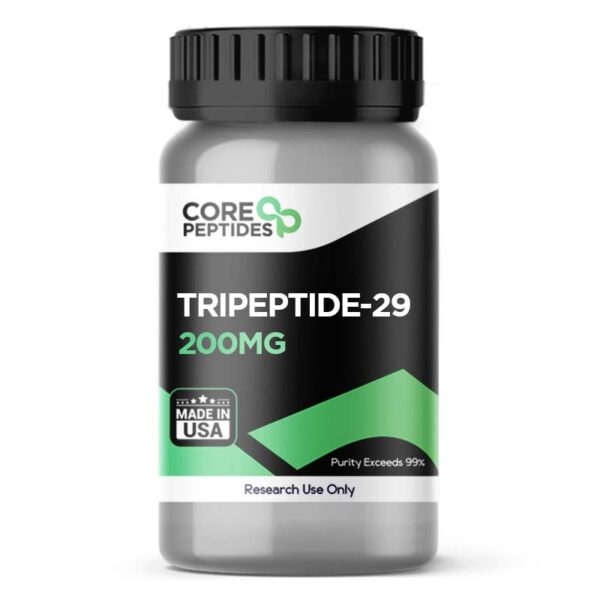
Tripeptide-29 (200MG)
CHF 158.40
Tripeptide-29 (Gly-Pro-Hyp, H-Gly-Pro-Hyp-OH) is a synthetic biomimetic tripeptide corresponding to the primary repeating unit of type I collagen the most abundant protein in the extracellular matrix of connective tissues. Researchers investigate Tripeptide-29 for its ability to stimulate dermal fibroblast proliferation, enhance collagen type I synthesis, and inhibit matrix metalloproteinase (MMP) activity. The peptide also functions as a Dipeptidyl Peptidase-4 (DPP-4) inhibitor and can bind to the DNA-binding site of the JUN/FOS complex to modulate transcriptional activity. Available for laboratory research purposes only. Buy Tripeptide-29 in Switzerland from Core Peptides, a trusted research peptide supplier.
What Is Tripeptide-29?
Tripeptide-29, also known as Gly-Pro-Hyp (GPHyp) or H-Gly-Pro-Hyp-OH, is a synthetic biomimetic tripeptide with the amino acid sequence Glycine-Proline-Hydroxyproline (Gly-Pro-Hyp). This sequence corresponds to the primary repeating unit of type I collagen, the most abundant protein in the extracellular matrix (ECM) of connective tissues, including skin, bone, and tendons. For those looking to buy Tripeptide-29 in Switzerland, Core Peptides offers high-quality research-grade material for laboratory applications.
As a tripeptide a peptide composed of three amino acids Tripeptide-29 is a highly purified synthetic peptide rather than a product of collagen hydrolysis, which yields random peptide mixtures. The peptide is identified by CAS number 2239-67-0, with a molecular formula of C12H19N3O5 and a molecular weight of approximately 285.30 g/mol. The acetate salt form (Tripeptide-29 Acetate) is commonly used in research and has a molecular formula of C14H23N3O7 and a molecular weight of approximately 345.35 g/mol. The peptide features N-terminal glycine and C-terminal hydroxyproline, with the sequence H-Gly-Pro-Hyp-OH.
Tripeptide-29 Research Overview
Tripeptide-29 has attracted significant research interest as a biomimetic collagen peptide with well-documented roles in stimulating collagen synthesis, protecting against photoaging, and promoting tissue repair. The peptide is a synthetic, highly purified tripeptide consisting of amino acids glycine and proline plus the amino acid derivative hydroxyproline. Its small size allows it to penetrate biological barriers more easily to reach target areas.
Research interest in Tripeptide-29 centers on its ability to stimulate dermal fibroblast proliferation and enhance collagen type I synthesis. Studies have demonstrated that the peptide can activate fibroblasts by binding to cell surface receptors, significantly increasing type I collagen production. Additionally, research explores Tripeptide-29’s potential to reduce the activity of matrix metalloproteinases (MMPs) enzymes that degrade the extracellular matrix. The peptide also functions as a Dipeptidyl Peptidase-4 (DPP-4) inhibitor and can bind to the DNA-binding site of the JUN/FOS complex, blocking transcription factor activity.
When researchers choose to buy Tripeptide-29 in Switzerland for laboratory studies, they gain access to a compound that may help elucidate mechanisms of fibroblast activation, collagen biosynthesis, extracellular matrix remodeling, and transcriptional regulation at the molecular level.
How Does Tripeptide-29 Work?
Tripeptide-29 exerts its biological effects through multiple interconnected mechanisms involving fibroblast activation, collagen synthesis stimulation, MMP inhibition, and transcriptional modulation. The peptide’s mechanism involves several well-characterized pathways.
Fibroblast Activation and Collagen Synthesis
Tripeptide-29 stimulates dermal fibroblasts by binding to cell surface receptors, initiating intracellular signaling cascades that promote fibroblast proliferation and activation. Once activated, fibroblasts increase the synthesis of extracellular matrix components, most notably type I collagen. The Gly-Pro-Hyp sequence is the primary repeating unit of type I collagen, and the peptide’s biomimetic structure enables it to serve as a signaling molecule that communicates with fibroblasts to enhance collagen production.
Research has demonstrated that Tripeptide-29 significantly enhances the cell activity of fibroblasts, improving skin elasticity and promoting tissue firmness. The peptide’s small molecular size allows it to penetrate biological barriers more effectively, reaching target cells in the dermis.
MMP Inhibition and ECM Protection
In addition to stimulating collagen synthesis, Tripeptide-29 inhibits the activity of matrix metalloproteinases (MMPs) enzymes responsible for degrading the extracellular matrix. This dual-action mechanism promoting collagen synthesis while reducing degradation supports extracellular matrix integrity and tissue structure. Research suggests that Tripeptide-29 may protect against UVB-induced skin aging through this mechanism.
DPP-4 Inhibition and Transcriptional Modulation
Tripeptide-29 functions as a Dipeptidyl Peptidase-4 (DPP-4) inhibitor. DPP-4 is an enzyme involved in glucose metabolism and immune regulation, and its inhibition may have implications for metabolic and inflammatory research.
Furthermore, Tripeptide-29 binds to the DNA-binding site of the JUN/FOS complex (AP-1 transcription factor), blocking the formation of the DNA-JUN/FOS complex and inhibiting transcriptional activity. This mechanism may influence the expression of genes involved in inflammation, matrix remodeling, and cellular proliferation.
Researchers who buy Tripeptide-29 in Switzerland for research purposes can investigate these mechanisms across diverse experimental models of dermatology, fibroblast biology, and extracellular matrix research.
Why Is Tripeptide-29 Studied?
Researchers study Tripeptide-29 primarily for its potential relevance to fibroblast biology, collagen synthesis, extracellular matrix remodeling, and dermatological research. The peptide’s ability to stimulate fibroblast proliferation, enhance collagen production, and inhibit MMP activity makes it a valuable tool for understanding the molecular basis of connective tissue maintenance and repair.
Tripeptide-29 has been investigated in the context of skin aging and photoaging. The peptide is an orally active bioactive peptide against UVB-induced skin aging. Research has explored its potential to improve skin firmness, elasticity, and hydration. Clinical studies have demonstrated that formulations containing 0.1% Tripeptide-29 produce significant improvements in skin hydration, softness, and barrier function.
Moreover, researchers study Tripeptide-29 in the context of tissue regeneration and wound healing. Its well-documented roles in stimulating collagen synthesis and promoting wound healing make it a compelling candidate for therapeutic and cosmetic research applications.
Researchers who buy Tripeptide-29 in Switzerland from Core Peptides can incorporate this peptide into their studies on fibroblast biology, collagen synthesis, extracellular matrix remodeling, and dermatological research.
Tripeptide-29 Research Areas
| Research Area | Description |
|---|---|
| Collagen Synthesis | Investigating Tripeptide-29’s stimulation of type I collagen production in fibroblasts |
| Fibroblast Activation | Studying Tripeptide-29’s effects on fibroblast proliferation and extracellular matrix production |
| MMP Inhibition | Examining Tripeptide-29’s inhibition of matrix metalloproteinase activity and collagen degradation |
| Extracellular Matrix Remodeling | Exploring Tripeptide-29’s influence on ECM composition and structural integrity |
| Photoaging Research | Investigating Tripeptide-29’s protective effects against UVB-induced skin aging |
| DPP-4 Inhibition | Studying Tripeptide-29’s function as a Dipeptidyl Peptidase-4 inhibitor |
| Transcriptional Regulation | Exploring Tripeptide-29’s binding to the JUN/FOS complex and modulation of gene expression |
| Wound Healing | Preclinical research into Tripeptide-29’s potential to promote tissue repair and regeneration |
Scientific Research on Tripeptide-29
Researchers have conducted scientific studies on Tripeptide-29 in both in vitro and clinical settings, deriving evidence from cell cultures, preclinical models, and human studies. The peptide has emerged as a key bioactive compound with significant potential in dermatology and regenerative medicine.
In Vitro Evidence
In vitro studies using human dermal fibroblasts have demonstrated that Tripeptide-29 stimulates collagen synthesis and fibroblast proliferation. The peptide binds to fibroblast cell surface receptors, initiating signaling cascades that promote collagen type I production. Research has shown that the Gly-Pro-Hyp motif is the most abundant tripeptide resulting from collagen digestion and is critical to its triple-helix structure.
Furthermore, studies have demonstrated that Tripeptide-29 functions as a DPP-4 inhibitor and binds to the DNA-binding site of the JUN/FOS complex, blocking the formation of the DNA-JUN/FOS complex and inhibiting transcriptional activity.
Clinical Studies
A 2026 four-week clinical study evaluated a formulation containing 0.1% biomimetic collagen tripeptide (Tripeptide-29) in 47 healthy women aged 36-65 years. The study demonstrated significant improvements across all parameters: facial dryness decreased by 74.6% immediately and continued to week 4 (93.7%), hydration increased up to 72.5%, softness improved up to 37.7%, and roughness decreased up to 37.9%. The serum lotion demonstrated robust, well-tolerated benefits for enhancing multiple markers of thin, dry, aging skin.
Research has also explored Tripeptide-29’s potential to reduce fine lines and wrinkles. The peptide increases the condition of skin and helps reduce fine lines and wrinkles. Typical usage levels are between 0.1–1%.
Structural and Stability Studies
Research has characterized the stability of Gly-Pro-Hyp in biological environments. The Gly-Pro-Hyp tripeptide is reported to be stable in gastrointestinal fluid and rat plasma. Contiguous Gly-Pro-Hyp units are known to be highly stable and promote the formation of triple-helical structures characteristic of collagen.
Nevertheless, researchers should note that Tripeptide-29 is supplied for laboratory research purposes only. Scientists who buy Tripeptide-29 in Switzerland should remain aware of these evidence considerations.
Tripeptide-29 Compared With Related Peptides
| Peptide | Relationship to Tripeptide-29 | Key Differences |
|---|---|---|
| Palmitoyl Tripeptide-29 | Palmitoylated derivative of Tripeptide-29 | Palmitoyl modification enhances lipophilicity and penetration; Tripeptide-29 is the unmodified biomimetic peptide |
| Palmitoyl Tripeptide-1 (Pal-GHK) | Both are palmitoylated tripeptides for skin research | Pal-GHK has GHK sequence and different signaling mechanism; Tripeptide-29 has Gly-Pro-Hyp sequence mimicking collagen |
| Palmitoyl Tripeptide-5 (Syn-Coll) | Both studied for collagen synthesis | Syn-Coll targets TGF-β via TSP-1 mimicry; Tripeptide-29 is a biomimetic collagen fragment |
| Collagen Tripeptide (CTP) | Similar sequence, often derived from collagen hydrolysate | Collagen tripeptide is typically a mixture; Tripeptide-29 is a single defined synthetic peptide |
| GHK-Cu | Both studied for skin and cellular research | GHK-Cu is a copper-binding peptide; Tripeptide-29 is a biomimetic collagen fragment |
Research Applications
Researchers utilize Tripeptide-29 in a variety of laboratory research applications, primarily in the fields of dermatology, cell biology, and extracellular matrix research. Key research applications include:
- Collagen Synthesis Studies: Investigating Tripeptide-29’s stimulation of type I collagen production in fibroblasts
- Fibroblast Activation Research: Studying Tripeptide-29’s effects on fibroblast proliferation and extracellular matrix production
- MMP Inhibition Studies: Examining Tripeptide-29’s inhibition of matrix metalloproteinase activity and collagen degradation
- Extracellular Matrix Remodeling Research: Exploring Tripeptide-29’s influence on ECM composition and structural integrity
- Photoaging Research: Investigating Tripeptide-29’s protective effects against UVB-induced skin aging
- DPP-4 Inhibition Studies: Studying Tripeptide-29’s function as a Dipeptidyl Peptidase-4 inhibitor
- Transcriptional Regulation Studies: Exploring Tripeptide-29’s binding to the JUN/FOS complex and modulation of gene expression
- Wound Healing Research: Preclinical research into Tripeptide-29’s potential to promote tissue repair and regeneration
Researchers who buy Tripeptide-29 in Switzerland can incorporate this peptide into their experimental protocols across these diverse research areas.
Tripeptide-29 Product Specifications
| Specification | Detail |
|---|---|
| Product Name | Tripeptide-29 (Gly-Pro-Hyp) |
| Amount | 200mg |
| Form | Lyophilized powder |
| Sequence (One-Letter) | H-Gly-Pro-Hyp-OH |
| Sequence (Three-Letter) | Glycyl-Prolyl-Hydroxyproline |
| Molecular Formula (Free Base) | C12H19N3O5 |
| Molecular Weight (Free Base) | Approximately 285.30 g/mol |
| Molecular Formula (Acetate) | C14H23N3O7 |
| Molecular Weight (Acetate) | Approximately 345.35 g/mol |
| CAS Number | 2239-67-0 |
| IUPAC Name | (2S,4R)-1-[(2S)-1-(2-aminoacetyl)pyrrolidine-2-carbonyl]-4-hydroxypyrrolidine-2-carboxylic acid |
| Synonyms | Gly-Pro-Hyp, Glycyl-prolyl-hydroxyproline, Collagen Tripeptide |
| INCI Name | Tripeptide-29 |
| Solubility | Slightly soluble in water, DMSO, and methanol |
| Stability | Stable in gastrointestinal fluid and rat plasma |
| Purity | ≥98% (HPLC) |
| Research Category | Skin, Hair & Beauty Peptides |
| Storage | Store desiccated at -20°C, protected from light |
How to Evaluate Tripeptide-29 Quality
When sourcing Tripeptide-29 for research purposes, researchers should consider several quality indicators. A reliable Tripeptide-29 peptide supplier should provide:
- Identity Confirmation: Analytical verification that the peptide matches the expected tripeptide sequence (H-Gly-Pro-Hyp-OH) and molecular weight (free base: approximately 285.30 g/mol; acetate: approximately 345.35 g/mol)
- Purity Analysis: Documentation of purity through methods such as HPLC – research grade typically provides ≥98% purity
- Hydroxyproline Confirmation: Verification of the hydroxyproline residue, which is essential for the peptide’s collagen-mimetic properties
- Batch Information: Clear lot numbers and batch traceability
- Certificate of Analysis (CoA): Documentation of analytical testing results
- Appearance: White to off-white lyophilized powder
- Solubility: Slightly soluble in water, DMSO, and methanol
Researchers looking to buy Tripeptide-29 in Switzerland should seek suppliers who provide comprehensive documentation and quality assurance. Core Peptides remains committed to supporting research with properly documented products.
Understanding the Certificate of Analysis
A Certificate of Analysis (CoA) provides analytical data for a specific batch of a research peptide. For Tripeptide-29 research, a CoA typically includes:
- Identity Confirmation: Mass spectrometry or other analytical methods confirming the peptide’s identity
- Purity Assessment: HPLC chromatograms showing the purity of the peptide
- Batch/Lot Information: Unique identifiers for traceability
- Analytical Methods: Description of the testing methods used
Importantly, researchers should understand that a CoA demonstrates the chemical identity and purity of a peptide but does not establish safety, efficacy, therapeutic effectiveness, or suitability for human use. The CoA serves as a quality control document for research purposes only.
Storage and Stability
Proper storage of research peptides is essential for maintaining their integrity and stability. For Tripeptide-29, researchers should refer to the product documentation provided with their order for specific storage recommendations.
General best practices for Tripeptide-29 storage include keeping the lyophilized peptide desiccated, protected from light, and stored at -20°C or between 0-8°C. The Gly-Pro-Hyp tripeptide is reported to be stable in gastrointestinal fluid and rat plasma. For specific temperature requirements and reconstitution protocols, consult the applicable product documentation or contact Core Peptides for the applicable storage specifications.
Research Considerations
Researchers incorporating Tripeptide-29 into their studies should be aware of several important considerations:
- Clinical Status: Tripeptide-29 has been studied in clinical research for dermatological applications. However, the peptide is supplied for laboratory research purposes only.
- Experimental Status: Researchers consider Tripeptide-29 a well-characterized compound with a growing evidence base, but findings should be interpreted within the context of ongoing research.
- Model Differences: Results from cell cultures and clinical studies may not translate directly to all experimental outcomes.
- Regulatory Status: Tripeptide-29 is not FDA-approved and is intended for laboratory research use only.
- Quality Considerations: Researchers should verify the quality and identity of their Tripeptide-29 through appropriate analytical methods.
- Mechanistic Context: Tripeptide-29’s proposed mechanisms involve fibroblast activation, collagen synthesis stimulation, MMP inhibition, DPP-4 inhibition, and JUN/FOS transcriptional modulation. Researchers should consider appropriate experimental approaches to investigate these pathways.
- Biomimetic Nature: Tripeptide-29 is a synthetic peptide corresponding to the primary repeating unit of type I collagen, which may influence experimental design and interpretation.
Researchers who buy Tripeptide-29 in Switzerland should ensure their studies include appropriate controls and interpret findings with scientific rigor.
Frequently Asked Questions About Tripeptide-29
What is Tripeptide-29?
Tripeptide-29 (Gly-Pro-Hyp, H-Gly-Pro-Hyp-OH) is a synthetic biomimetic tripeptide corresponding to the primary repeating unit of type I collagen, with the sequence Glycine-Proline-Hydroxyproline.
What is Tripeptide-29 researched for?
Researchers primarily investigate Tripeptide-29 for its ability to stimulate fibroblast proliferation, enhance collagen type I synthesis, inhibit MMP activity, and modulate extracellular matrix remodeling.
What is the amino acid sequence of Tripeptide-29?
The amino acid sequence of Tripeptide-29 is H-Gly-Pro-Hyp-OH (Glycyl-Prolyl-Hydroxyproline).
What is the molecular weight of Tripeptide-29?
The molecular weight of Tripeptide-29 free base is approximately 285.30 g/mol. The acetate salt has a molecular weight of approximately 345.35 g/mol.
What is the CAS number for Tripeptide-29?
The CAS number for Tripeptide-29 is 2239-67-0.
What is the mechanism of action for Tripeptide-29?
Tripeptide-29 acts through multiple mechanisms: fibroblast activation and collagen synthesis stimulation, MMP inhibition, DPP-4 inhibition, and JUN/FOS transcriptional modulation.
How does Tripeptide-29 differ from collagen hydrolysate?
Tripeptide-29 is a single, highly purified synthetic peptide with a defined sequence. Collagen hydrolysate is a mixture of peptides with variable sequences and lengths.
Does Tripeptide-29 have human clinical evidence?
Yes, Tripeptide-29 has been studied in clinical research. A 2026 four-week clinical study demonstrated significant improvements in skin hydration, softness, and barrier function with 0.1% Tripeptide-29 formulation.
Is Tripeptide-29 FDA-approved?
Tripeptide-29 is not FDA-approved. It is intended for laboratory research use only and is not approved for human consumption or therapeutic use.
Can I buy Tripeptide-29 in Switzerland?
Yes, researchers can buy Tripeptide-29 in Switzerland from Core Peptides for laboratory research purposes.
What is the primary research category for Tripeptide-29?
Tripeptide-29 belongs to the Skin, Hair & Beauty Peptides category, with secondary relevance to Cellular Research & Signaling research.
What related peptides are studied alongside Tripeptide-29?
Related peptides include Palmitoyl Tripeptide-29, Palmitoyl Tripeptide-1 (Pal-GHK), Palmitoyl Tripeptide-5 (Syn-Coll), and GHK-Cu.
What is the purity of Core Peptides‘ Tripeptide-29?
Core Peptides provides Tripeptide-29 with a purity of ≥98% as verified by HPLC analysis.
How should Tripeptide-29 be stored?
Tripeptide-29 should be stored lyophilized, desiccated, protected from light, at -20°C or between 0-8°C.
Is Tripeptide-29 soluble in water?
Tripeptide-29 is slightly soluble in water, DMSO, and methanol.
Related Research Peptides
Researchers interested in Tripeptide-29 may also find the following related peptides relevant to their work:
- Palmitoyl Tripeptide-29 – The palmitoylated derivative of Tripeptide-29, studied for enhanced penetration and collagen research
- Palmitoyl Tripeptide-1 (Pal-GHK) – A palmitoylated tripeptide studied for cellular signaling and collagen research
- Palmitoyl Tripeptide-5 (Syn-Coll) – A TSP-1 mimetic peptide studied for collagen synthesis via TGF-β activation
- GHK-Cu – A copper peptide studied for skin and cellular research
- Palmitoyl Tetrapeptide-7 – A peptide studied for anti-inflammatory and matrix remodeling research
For a comprehensive selection of research peptides in Switzerland, explore the Core Peptides catalog.
Explore Skin, Hair & Beauty Peptides
Tripeptide-29 is part of our Skin, Hair & Beauty Peptides category, which features a range of research peptides investigated for their effects on cellular signaling, extracellular matrix biology, and tissue remodeling. Browse our selection to find the right peptides for your laboratory research.
Explore Related Research Categories
Researchers may also find the following related categories relevant to Tripeptide-29 research:
- Cellular Research & Signaling – Peptides studied for cellular signaling and gene expression modulation
- Anti-Aging & Longevity – Peptides investigated for age-related extracellular matrix research
- Healing & Regeneration Peptides – Peptides investigated for tissue repair and regeneration
Further Research
Researchers interested in learning more about Tripeptide-29 and related peptides should consult the primary scientific literature. Key areas of investigation include fibroblast biology, collagen synthesis regulation, MMP inhibition, and extracellular matrix remodeling. The PubMed database is an excellent resource for accessing peer-reviewed research articles on these topics.
Research Disclaimer
Core Peptides supplies Tripeptide-29 as a research peptide for laboratory research purposes only. All information provided is for educational and scientific reference purposes only and does not constitute medical advice. Researchers are responsible for ensuring compliance with all applicable laws and regulations governing the use of research peptides in their jurisdiction, including Switzerland.
Schreiben Sie die erste Rezension für «Tripeptide-29 (200MG)»
Sie müssen angemeldet sein, um eine Rezension veröffentlichen zu können.
Ähnliche Produkte
Skin, Hair & Beauty Peptides
Skin, Hair & Beauty Peptides
Skin, Hair & Beauty Peptides
Skin, Hair & Beauty Peptides
Skin, Hair & Beauty Peptides
Skin, Hair & Beauty Peptides
Skin, Hair & Beauty Peptides
Skin, Hair & Beauty Peptides
Rezensionen
Es gibt noch keine Rezensionen.