
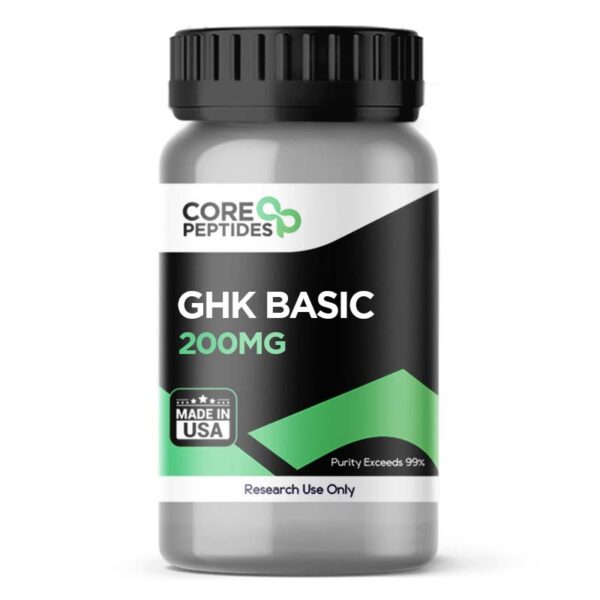
GHK Basic (Tripeptide-1) (200MG)
CHF 141.30
Tripeptide-1 (GHK Basic, Copper-Free GHK) is a synthetic tripeptide with the amino acid sequence Gly-His-Lys (GHK). This 200mg research peptide is the copper-free form of the naturally occurring GHK peptide, which has a high affinity for copper(II) ions and readily forms the GHK-Cu complex upon copper exposure. Researchers study Tripeptide-1 for its roles in tissue remodeling, extracellular matrix regulation, gene expression modulation (up- or downregulating over 4,000 genes), and cellular regeneration across various tissue types including skin, lung, bone, and liver. Buy Tripeptide-1 200mg in Switzerland from Core Peptides for your laboratory research needs.
What Is Tripeptide-1 and Why Buy It for Research?
Buy Tripeptide-1 200mg in Switzerland for research into tissue remodeling, gene expression modulation, and cellular regeneration mechanisms. Specifically, Tripeptide-1 (also known as GHK Basic, copper-free GHK, or Gly-His-Lys) is a synthetic tripeptide composed of three amino acids with the sequence glycyl-L-histidyl-L-lysine (Gly-His-Lys). Researchers first isolated GHK from human plasma in 1973, and it is present in human plasma, saliva, and urine, though its levels decline with age.
Tripeptide-1 is a naturally occurring peptide fragment of osteonectin, a matricellular protein with reported proangiogenic potential. The peptide has a very high affinity for copper(II) ions and readily forms the chelate GHK-Cu. Tripeptide-1 is supplied without pre-complexed copper, distinguishing it from the blue GHK-Cu copper complex. In scientific research, Tripeptide-1 serves as a molecular tool for studying copper-binding kinetics, tissue remodeling pathways, and gene expression regulation. Furthermore, Core Peptides supplies Tripeptide-1 as a lyophilized powder in a 200mg format exclusively for laboratory use. Therefore, researchers seeking to source this compound for their work will find it readily available when they buy Tripeptide-1 200mg in Switzerland.
Tripeptide-1 Research Overview: Buy Tripeptide-1 200mg in Switzerland for Tissue Remodeling Studies
Centrally, research into Tripeptide-1 has focused on its function as a pleiotropic peptide that influences multiple biological pathways through gene expression modulation and tissue remodeling. Tripeptide-1 is capable of up- or downregulating at least 4,000 human genes, essentially resetting DNA to a healthier state. This broad gene-regulatory activity underlies its diverse biological effects across multiple tissue types.
Tripeptide-1 functions as a copper-chelating molecule that plays a foundational role in human tissue remodeling, antioxidant defense, and cellular signaling. Its primary mechanisms involve the suppression of acute-phase inflammatory cytokines and the stimulation of extracellular matrix (ECM) components. Tripeptide-1 has also been identified as an endogenous antioxidant, functioning in living organisms by diminishing hydroxyl and peroxyl radicals.
Research on Tripeptide-1 has yielded a variety of potential biological activities, including possible stimulation of blood vessels and nerve outgrowth, increasing elastin, glycosaminoglycan, and collagen synthesis. The tissue repair potential of this peptide has been researched in lung connective tissue, bone tissue, liver, stomach lining, and skin. Accordingly, researchers who buy Tripeptide-1 200mg in Switzerland from Core Peptides can support their investigations into tissue remodeling, gene expression regulation, and cellular regeneration.
How Does Tripeptide-1 Work in Research?
Mechanistically, Tripeptide-1’s proposed action involves functioning as a signaling peptide that modulates cellular processes through gene expression regulation and copper-dependent pathways. The peptide operates through several interconnected mechanisms.
Gene Expression Modulation
Tripeptide-1 is capable of up- and downregulating at least 4,000 human genes, essentially resetting DNA to a healthier state. This broad gene-regulatory activity influences multiple cellular pathways, including those involved in tissue repair, inflammation, and aging. Furthermore, Tripeptide-1 modulates the expression of genes related to collagen synthesis, extracellular matrix remodeling, antioxidant defense, and inflammatory signaling.
Copper Binding and GHK-Cu Formation
Tripeptide-1 has a high affinity for copper(II) ions, similar to the copper transport site on albumin. When copper is present, Tripeptide-1 readily forms the chelate GHK-Cu. This copper-binding property is central to many of its biological activities, as the copper complex is the form in which copper is transported in tissues and permeates through cell membranes. Tripeptide-1 (copper-free) allows researchers to study copper-binding kinetics and the conversion to GHK-Cu in experimental systems.
Extracellular Matrix Remodeling
Tripeptide-1 stimulates collagen production, glycosaminoglycans, and small proteoglycans such as decorin. It also influences the activities of metalloproteinases enzymes that initiate extracellular matrix protein breakdown and antiprotease actions. This dual action may regulate skin protein breakdown, potentially preventing damaged protein accumulation and excessive proteolysis.
Anti-Inflammatory and Antioxidant Activity
Tripeptide-1 suppresses acute-phase inflammatory cytokines and has been shown to reduce pro-inflammatory markers including MMP-2, MMP-9, and TNF-alpha. The peptide also functions as an endogenous antioxidant, diminishing hydroxyl and peroxyl radicals in living organisms.
Why Is Tripeptide-1 Studied in Switzerland?
Primarily, researchers study Tripeptide-1 because it represents a well-characterized copper-free tripeptide that enables investigation of tissue remodeling, gene expression regulation, and copper-dependent signaling pathways. In fact, this compound offers a focused tool for studying the molecular mechanisms underlying wound healing, extracellular matrix remodeling, and cellular regeneration.
Research has demonstrated Tripeptide-1’s relevance across multiple domains. Studies have shown that Tripeptide-1 can tighten loose skin and improve elasticity, skin density, and firmness, reduce fine lines and wrinkles. Tripeptide-1 has been reported to promote wound healing through increased collagen synthesis, glycosaminoglycan secretion, and angiogenesis. The peptide has also been shown to accelerate wound healing in the skin, hair follicles, gastrointestinal tract, and boney tissue.
Furthermore, Tripeptide-1 has demonstrated potential in stem cell research, with studies showing that copper-free Tripeptide-1 promotes the recovery and survival of skin stem cells by increasing integrin expression and stemness in epidermal basal cells. Research has also explored Tripeptide-1’s role in reversing emphysema-related gene expression signatures, liver regeneration, and the stimulation of hepatic erythropoietic factor production. Ultimately, researchers who buy Tripeptide-1 200mg in Switzerland gain access to a comprehensive research tool for investigating tissue remodeling, gene expression regulation, and cellular regeneration.
Tripeptide-1 Research Areas in Laboratory Studies
| Research Area | Focus | Evidence Level |
|---|---|---|
| Gene Expression Modulation | Regulation of 4,000+ genes, DNA resetting, transcriptional control | Mechanistic / In Vitro |
| Tissue Remodeling | Collagen synthesis, elastin production, glycosaminoglycan regulation | In Vitro / Animal |
| Wound Healing | Angiogenesis, fibroblast activation, epithelialization, granulation tissue | Animal / Preclinical |
| Anti-Inflammatory Research | Cytokine suppression, MMP inhibition, TNF-alpha reduction | Mechanistic / In Vitro |
| Antioxidant Defense | Free radical scavenging, oxidative stress reduction | Mechanistic |
| Skin and Connective Tissue | Dermal regeneration, wound closure, anti-aging research | In Vitro / Animal |
| Stem Cell Research | Stem cell recovery, integrin expression, epidermal stemness | In Vitro |
| Pulmonary Research | Emphysema gene signature reversal, lung tissue remodeling | Preclinical |
Tripeptide-1 Compared With Related Research Compounds
| Compound | Research Focus | Mechanism / Target | Key Difference |
|---|---|---|---|
| Tripeptide-1 (GHK Basic) | Tissue remodeling, gene regulation, copper-binding studies | Gene expression modulation, copper chelation | Copper-free tripeptide; converts to GHK-Cu upon copper exposure |
| GHK-Cu | Skin regeneration, wound healing, anti-aging | Pre-complexed copper delivery, ECM remodeling | Copper-bound form; more robust documented activity |
| AHK-Cu | Hair follicle research, dermal papilla cells | Copper delivery, VEGF/KGF modulation | Alanine substitution; hair follicle specificity |
| BPC-157 | Tissue healing, gastrointestinal protection | Growth factor modulation | Different mechanism; no copper involvement |
Comparatively, Tripeptide-1 differs from GHK-Cu in its copper content and research applications. On the one hand, GHK-Cu is the copper-bound form of GHK, delivering pre-complexed copper for immediate biological activity. On the other hand, Tripeptide-1 is supplied without pre-formed copper, allowing researchers to study copper-binding kinetics and the conversion to GHK-Cu in experimental systems. In contrast, AHK-Cu and BPC-157 operate through different mechanisms unrelated to the GHK peptide family.
Research Applications for Tripeptide-1 in Switzerland
Scientists have investigated Tripeptide-1 across several research domains:
- Gene Expression Studies: Researchers use Tripeptide-1 to study gene regulation, transcriptional control, and the modulation of over 4,000 human genes involved in tissue repair and regeneration.
- Tissue Remodeling Research: Investigations have explored Tripeptide-1’s effects on collagen synthesis, elastin production, and extracellular matrix remodeling.
- Wound Healing Studies: Tripeptide-1 has been studied for its ability to promote wound closure, angiogenesis, and fibroblast activation in preclinical models.
- Copper-Binding Research: Tripeptide-1 serves as a tool for studying copper chelation kinetics and the formation of GHK-Cu complexes.
- Anti-Inflammatory Research: Studies have examined Tripeptide-1’s effects on cytokine suppression, MMP inhibition, and TNF-alpha reduction.
- Stem Cell Research: Tripeptide-1 has been investigated for its ability to promote stem cell survival, integrin expression, and epidermal stemness.
Evidently, researchers who buy Tripeptide-1 200mg in Switzerland gain a valuable addition to any laboratory toolkit focused on tissue remodeling, gene expression regulation, and cellular regeneration research.
Tripeptide-1 Product Specifications
| Specification | Details |
|---|---|
| Product Name | Tripeptide-1 (GHK Basic) |
| Alternative Names | GHK, Gly-His-Lys, Copper-Free GHK, Glycyl-L-Histidyl-L-Lysine |
| Amount | 200mg |
| Form | Lyophilized powder |
| Purity | Not verified |
| Amino Acid Sequence | H-Gly-His-Lys-OH (GHK) |
| Sequence (3-letter) | Gly-His-Lys |
| Peptide Length | 3 amino acids (tripeptide) |
| Molecular Formula | C₁₄H₂₄N₆O₄ |
| Molecular Weight | 340.38 g/mol |
| CAS Number | 49557-75-7 (free base); 72957-37-0 (acetate salt) |
| Research Category | Skin, Hair & Beauty / Healing & Regeneration |
| Research Use | Laboratory research use only |
| CoA | Available upon request (not verified) |
| Storage | Lyophilized powder should be stored desiccated at -20°C or below, protected from light |
| Solubility | Soluble in water and buffered aqueous solutions |
How to Evaluate Tripeptide-1 Quality for Research
When sourcing Tripeptide-1 peptide for laboratory research, researchers should consider several quality indicators:
- Identity Confirmation: Analytical techniques such as mass spectrometry should confirm the compound’s molecular weight (340.38 g/mol) and sequence (H-Gly-His-Lys-OH).
- Purity Assessment: High-performance liquid chromatography (HPLC) should verify purity, with ≥98% considered standard for research-grade material.
- Batch Traceability: Lot numbers and batch information enable researchers to track specific production runs.
- Certificate of Analysis: A CoA should accompany the product, detailing analytical testing results including HPLC purity and identity confirmation.
- Labeling Accuracy: Proper labeling should clearly indicate the product name, amount (200mg), sequence, molecular formula, CAS number, and storage recommendations.
- Storage Conditions: Appropriate storage at -20°C or below in desiccated, dark conditions helps maintain peptide stability.
Understanding the Certificate of Analysis
Typically, a Certificate of Analysis (CoA) accompanies research peptides and provides information about the specific batch’s analytical testing. For example, a CoA may include product identity confirmation, purity percentage as determined by HPLC, batch or lot number for traceability, analytical methods used (e.g., mass spectrometry, HPLC), and a physical description of the product.
Nevertheless, it is important to note that a CoA does not establish safety, efficacy, therapeutic effectiveness, or suitability for human use. Instead, it serves as a quality control document that helps researchers verify the identity and purity of the peptide they are using in their laboratory investigations.
Storage and Stability of Tripeptide-1
Core Peptides supplies Tripeptide-1 as a lyophilized (freeze-dried) powder. To maintain stability and integrity:
- Store the lyophilized powder desiccated at -20°C or below for long-term storage (up to 3 years)
- Store at 4°C for short-term storage if frequent access is required
- Avoid repeated freeze-thaw cycles
- Weigh under dry conditions; the peptide is hygroscopic
- Reconstitute only immediately before use with appropriate sterile solvents (sterile water or buffered aqueous solutions)
- Inject solvent slowly against the inner wall of the vial; avoid vigorous agitation during dissolution
- Filter sterilize if required (e.g., 0.22 µm) immediately prior to use
- Aliquot and store reconstituted solutions at -20°C or below to minimize degradation
- Protect from light and moisture; prolonged exposure to light, elevated temperature, or aqueous environments may reduce stability
Frequently Asked Questions About Buying Tripeptide-1 200mg in Switzerland
What is Tripeptide-1?
Specifically, Tripeptide-1 (GHK Basic, copper-free GHK) is a synthetic tripeptide with the amino acid sequence glycyl-L-histidyl-L-lysine (Gly-His-Lys). It is the copper-free form of the naturally occurring GHK peptide, which readily binds copper to form GHK-Cu.
What is Tripeptide-1 researched for?
Primarily, researchers study Tripeptide-1 for its role in tissue remodeling, gene expression modulation, and cellular regeneration. Studies have investigated its effects on collagen synthesis, wound healing, anti-inflammatory pathways, and antioxidant defense.
How does Tripeptide-1 work?
Mechanistically, Tripeptide-1 functions as a pleiotropic peptide that modulates gene expression (up- or downregulating over 4,000 genes), binds copper to form GHK-Cu, stimulates extracellular matrix components, suppresses inflammatory cytokines, and acts as an endogenous antioxidant.
What is the amino acid sequence of Tripeptide-1?
The amino acid sequence is H-Gly-His-Lys-OH (GHK).
What is the molecular weight of Tripeptide-1?
The molecular weight is 340.38 g/mol.
What is the molecular formula of Tripeptide-1?
The molecular formula is C₁₄H₂₄N₆O₄.
What is the CAS number of Tripeptide-1?
The CAS number is 49557-75-7 (free base).
Is Tripeptide-1 synthetic?
Yes, Tripeptide-1 is a synthetic peptide produced through solid-phase peptide synthesis.
How does Tripeptide-1 differ from GHK-Cu?
Tripeptide-1 is supplied without pre-formed copper, whereas GHK-Cu is the copper-bound form with pre-complexed copper. Tripeptide-1 readily converts to GHK-Cu when copper is present.
What research exists on Tripeptide-1?
Research on Tripeptide-1 includes studies demonstrating gene expression modulation (4,000+ genes), wound healing in animal models, tissue remodeling effects in skin, lung, bone, and liver, anti-inflammatory activity, antioxidant properties, and stem cell recovery.
Is Tripeptide-1 approved as a medicine?
No. Regulatory authorities have not approved Tripeptide-1 as a medicine, pharmaceutical, or therapeutic agent. It is a research tool for laboratory use only.
Is Tripeptide-1 intended for human use?
No. Tripeptide-1 is intended for laboratory research use only and is not for human consumption, injection, or therapeutic application.
Where can I buy Tripeptide-1 200mg in Switzerland?
You can buy Tripeptide-1 200mg in Switzerland from Core Peptides, a trusted research peptide supplier serving the Swiss scientific community.
How should researchers evaluate Tripeptide-1 quality?
Researchers should look for identity confirmation via mass spectrometry, purity data from HPLC, batch traceability, and a Certificate of Analysis.
Related Research Compounds
Researchers interested in Tripeptide-1 may also find the following related compounds relevant to their work:
- GHK-Cu — The copper-bound form of GHK, researched for skin regeneration, wound healing, and anti-aging applications.
- AHK-Cu — A copper tripeptide (Ala-His-Lys-Cu²⁺) researched for hair follicle and dermal papilla cell studies.
- BPC-157 — A peptide researched for tissue healing, gastrointestinal protection, and angiogenesis.
- TB-500 — A Thymosin Beta-4 fragment researched for tissue repair and wound healing.
Explore Skin, Hair & Beauty
Tripeptide-1 belongs to the Skin, Hair & Beauty category of research compounds. Skin, Hair & Beauty products are studied for their potential roles in dermal regeneration, tissue remodeling, and skin health research. Generally, researchers who buy Tripeptide-1 200mg in Switzerland often pair it with related compounds in this category to explore complementary pathways in tissue remodeling and regenerative research.
Explore Healing & Regeneration
Researchers studying tissue repair, wound healing, and regenerative mechanisms may also find relevant compounds in the Healing & Regeneration category. Tripeptide-1’s effects on tissue remodeling, angiogenesis, and cellular regeneration make it a valuable tool for investigating regenerative biology.
Further Research
For researchers seeking to deepen their understanding of Tripeptide-1 and its research applications, the following areas may warrant further investigation:
- The relationship between Tripeptide-1-mediated gene expression modulation and specific downstream effects on tissue remodeling pathways
- Comparative studies between Tripeptide-1 and GHK-Cu in various tissue regeneration and wound healing models
- The potential role of Tripeptide-1 in modulating copper-dependent enzymatic pathways and cellular signaling
- Mechanistic studies on Tripeptide-1’s interaction with copper ions and its functional consequences for cellular processes
- Exploration of Tripeptide-1’s effects on different cell types and tissue systems beyond skin and connective tissue
Research Disclaimer
Tripeptide-1 is a research peptide supplied for laboratory research use only. Researchers must not use it for human consumption, injection, or any form of therapeutic application. Moreover, this product is not a medicine, pharmaceutical, or medical device. Furthermore, Swissmedic, the FDA, EMA, or any other regulatory authority have not approved it for human use. Researchers should consult Swissmedic for applicable regulations and guidance on research peptide handling in Switzerland.
Generally, the information provided on this page is for educational and scientific reference purposes only. Therefore, it does not constitute medical advice, treatment recommendations, or dosing instructions. Ultimately, researchers bear the responsibility for ensuring that their use of this product complies with all applicable laws, regulations, and institutional guidelines.
Finally, all research involving peptides should be conducted by qualified personnel in appropriate laboratory settings with proper safety protocols.
Schreiben Sie die erste Rezension für «GHK Basic (Tripeptide-1) (200MG)»
Sie müssen angemeldet sein, um eine Rezension veröffentlichen zu können.
Ähnliche Produkte
Skin, Hair & Beauty Peptides
Skin, Hair & Beauty Peptides
Skin, Hair & Beauty Peptides
Skin, Hair & Beauty Peptides
Skin, Hair & Beauty Peptides
Skin, Hair & Beauty Peptides
Skin, Hair & Beauty Peptides
Skin, Hair & Beauty Peptides
Rezensionen
Es gibt noch keine Rezensionen.