
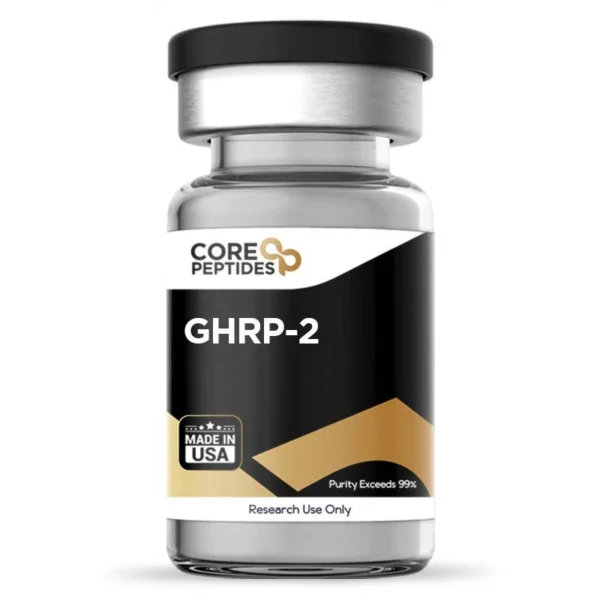
GHRP-2 (5MG / 10MG)
Preisspanne: CHF 18.00 bis CHF 26.10
GHRP-2 (Pralmorelin, KP-102) is a synthetic hexapeptide with the sequence H-D-Ala-D-2-Nal-Ala-Trp-D-Phe-Lys-NH₂. This research peptide is a potent agonist of the growth hormone secretagogue receptor type 1a (GHS-R1a), also known as the ghrelin receptor. Available in 5mg and 10mg formulations, GHRP-2 is studied for its ability to stimulate endogenous growth hormone release from the pituitary, as well as its effects on food intake, energy metabolism, and GH axis signaling. Buy GHRP-2 5mg in Switzerland from Core Peptides for your laboratory research needs.
What Is GHRP-2 and Why Buy It for Research?
Buy GHRP-2 5mg in Switzerland for research into growth hormone axis signaling, ghrelin receptor pharmacology, and metabolic regulation. Specifically, GHRP-2 (also known as Pralmorelin, KP-102, or Growth Hormone-Releasing Peptide-2) is a synthetic hexapeptide composed of six amino acids with the sequence H-D-Ala-D-2-Nal-Ala-Trp-D-Phe-Lys-NH₂ (D-Ala-D-2-Nal-Ala-Trp-D-Phe-Lys-NH₂). It is a member of the growth hormone-releasing peptide (GHRP) family and acts as a potent agonist of the growth hormone secretagogue receptor type 1a (GHS-R1a), also known as the ghrelin receptor.
Pralmorelin (GHRP-2) is the only GHS-R1a agonist approved as a diagnostic agent (Japan, GHRP Kaken 100), providing a clinically validated tool for GH deficiency testing and ghrelin receptor research. GHRP-2 has a molecular weight of 817.97 g/mol (free base) and the molecular formula C₄₅H₅₅N₉O₆. In scientific research, GHRP-2 serves as a molecular tool for studying GH secretion pathways, ghrelin receptor signaling, and neuroendocrine regulation. Furthermore, Core Peptides supplies GHRP-2 as a lyophilized powder in both 5mg and 10mg formats exclusively for laboratory use. Therefore, researchers seeking to source this compound for their work will find it readily available when they buy GHRP-2 5mg in Switzerland.
GHRP-2 Research Overview: Buy GHRP-2 5mg in Switzerland for GHS-R1a Studies
Centrally, research into GHRP-2 has focused on its function as a potent agonist of the ghrelin receptor (GHS-R1a). GHRP-2 mimics the action of the endogenous ligand ghrelin, binding to the GHS-R1a with high affinity. This binding event initiates a conformational change in the receptor, a G-protein-coupled receptor (GPCR), leading to the activation of downstream signaling pathways. GHRP-2 acts at both hypothalamic and pituitary sites to powerfully stimulate the release of growth hormone (GH).
The primary signaling pathway involves the coupling of activated GHS-R1a to the Gαq/11 subunit of the heterotrimeric G protein. This activation stimulates phospholipase C (PLC), which hydrolyzes phosphatidylinositol 4,5-bisphosphate (PIP2) into two key second messengers: inositol trisphosphate (IP3) and diacylglycerol (DAG). IP3 triggers the release of stored calcium (Ca²⁺) from the endoplasmic reticulum, and this sharp increase in intracellular calcium is critical for the exocytosis of growth hormone-containing vesicles from somatotroph cells in the anterior pituitary. Additionally, DAG activates protein kinase C (PKC), contributing to downstream cellular responses. This canonical pathway is central to the potent secretagogue effect of GHRP-2 on growth hormone.
Studies have also shown that GHRP-2 stimulates the hypothalamic-pituitary-adrenal axis by releasing endogenous ACTH secretagogues. Furthermore, GHRP-2 has demonstrated anti-inflammatory effects mediated by activation of ghrelin receptors expressed by immune-competent cells. Accordingly, researchers who buy GHRP-2 5mg in Switzerland from Core Peptides can support their investigations into GHS-R1a signaling, GH secretion, and neuroendocrine regulation.
How Does GHRP-2 Work in Research?
Mechanistically, GHRP-2’s proposed action involves functioning as a ghrelin receptor agonist that activates GHS-R1a to stimulate GH release through multiple signaling pathways. The peptide operates through several interconnected mechanisms.
GHS-R1a Receptor Activation
GHRP-2 binds to and activates the growth hormone secretagogue receptor type 1a (GHS-R1a), a G-protein coupled receptor (GPCR) expressed on pituitary somatotrophs and in hypothalamic neurons. This binding event initiates a conformational change in the receptor, leading to the activation of downstream signaling pathways. GHRP-2 has a receptor binding affinity (Ki) of approximately 2-10 nM and a functional potency (EC50) of approximately 0.5-5 nM for calcium mobilization.
Intracellular Signaling Cascade
The primary signaling pathway involves the coupling of activated GHS-R1a to the Gαq/11 subunit of the heterotrimeric G protein. This activation stimulates phospholipase C (PLC), which hydrolyzes phosphatidylinositol 4,5-bisphosphate (PIP2) into two key second messengers: inositol trisphosphate (IP3) and diacylglycerol (DAG). IP3 triggers the release of stored calcium (Ca²⁺) from the endoplasmic reticulum, and the resulting sharp increase in intracellular calcium is critical for the exocytosis of growth hormone-containing vesicles. Additionally, DAG activates protein kinase C (PKC), which contributes to downstream cellular responses. Modulation of the cAMP/PKA and MAPK/ERK signaling pathways has also been implicated in the cellular response to GHSR agonists.
Growth Hormone Release
GHRP-2 stimulates the release of endogenous growth hormone from the pituitary gland. In functional assays, GHRP-2 has demonstrated an EC50 of approximately 100 nM for GH release in ovine pituitary cells. GHRP-2 has been shown to be effective at stimulating GH production in research subjects. Orally administered GHRP-2 stimulates GH secretion in normal children, and its effect is synergistic with GHRH 1-29 NH₂.
Hypothalamic and Extra-Pituitary Effects
Beyond pituitary GH release, GHRP-2 activates hypothalamic circuits that influence neuroendocrine regulation. Studies have shown that GHRP-2 stimulates food intake in healthy men, indicating an orexigenic effect mediated via ghrelin signaling. Additionally, GHRP-2 has demonstrated anti-inflammatory effects in arthritic rats, mediated by activation of ghrelin receptors expressed by immune-competent cells.
Why Is GHRP-2 Studied in Switzerland?
Primarily, researchers study GHRP-2 because it represents a well-characterized GHS-R1a agonist that enables investigation of GH secretion, ghrelin receptor signaling, and neuroendocrine regulation. In fact, this compound offers a focused tool for studying the molecular mechanisms underlying GH pulsatility, appetite regulation, and energy metabolism.
Research has demonstrated GHRP-2’s relevance across multiple domains. GHRP-2 has been validated as a diagnostic tool for adult GH deficiency, with a diagnostic cut-off of 15 μg/l and favorable reproducibility. The GHRP-2 provocative test provides a safe and reliable alternative to the insulin tolerance test for diagnosing adult GHD.
Furthermore, GHRP-2 has been studied for its orexigenic effects, increasing food intake in healthy men through ghrelin receptor activation. The peptide has also demonstrated anti-inflammatory properties in models of chronic arthritis. GHRP-2 has shown efficacy in stimulating GH release in children with short stature and has been studied for potential therapeutic roles in growth disorders, aging, and cachexia. Ultimately, researchers who buy GHRP-2 5mg in Switzerland gain access to a comprehensive research tool for investigating GH axis signaling, ghrelin receptor pharmacology, and neuroendocrine regulation.
GHRP-2 Research Areas in Laboratory Studies
| Research Area | Focus | Evidence Level |
|---|---|---|
| GHS-R1a Receptor Pharmacology | Receptor binding, Gq/11 signaling, calcium mobilization, biased agonism | Mechanistic / In Vitro |
| GH Secretion | Pituitary GH release, GH pulsatility, GH axis regulation | Mechanistic / In Vivo / Clinical |
| Hypothalamic-Pituitary Axis | Hypothalamic GHRH release, somatostatin modulation, HPA axis | Preclinical / Clinical |
| Food Intake and Appetite | Orexigenic signaling, ghrelin pathway activation, energy balance | Clinical |
| Anti-Inflammatory Research | Immune cell ghrelin receptors, cytokine modulation, arthritis models | Preclinical |
| GH Deficiency Diagnosis | Diagnostic testing, provocative tests, cut-off values | Clinical |
| Growth Disorders | Short stature, pediatric GH deficiency, growth hormone axis | Clinical |
GHRP-2 Compared With Related Research Compounds
| Compound | Research Focus | Mechanism / Target | Key Difference |
|---|---|---|---|
| GHRP-2 (Pralmorelin) | GH release, food intake, GH deficiency diagnosis | GHS-R1a agonist (Gq/11 signaling) | Potent GH release; moderate ACTH/cortisol/prolactin elevation |
| GHRP-6 | GH release, appetite stimulation | GHS-R1a agonist (Gq/11 signaling) | Stronger appetite stimulation; similar GH potency |
| Ipamorelin | Selective GH release | GHS-R1a agonist (Gq/11 signaling) | Weaker GH pulse; minimal cortisol/prolactin elevation |
| Hexarelin | GH release, cardioprotection | GHS-R1a agonist (Gq/11 signaling) | Most potent GH pulse; CD36 cardioprotection |
Comparatively, GHRP-2 differs from other GHRPs in its potency and clinical applications. On the one hand, GHRP-2 produces the strongest GH release among GHRPs and has been approved as a diagnostic agent for GH deficiency in Japan. On the other hand, GHRP-6 produces notably more appetite stimulation while maintaining similar GH-releasing potency. In contrast, Ipamorelin provides more selective GH release with minimal cortisol or prolactin elevation, while Hexarelin is the most potent but also stimulates significant cortisol and prolactin release.
Research Applications for GHRP-2 in Switzerland
Scientists have investigated GHRP-2 across several research domains:
- GHS-R1a Receptor Pharmacology: Researchers use GHRP-2 to study ghrelin receptor binding, Gq/11 signaling, calcium mobilization, and biased agonism.
- GH Secretion Studies: The peptide is employed to investigate pituitary GH release, GH pulsatility, and GH axis regulation.
- Neuroendocrine Research: Studies have examined GHRP-2’s effects on the hypothalamic-pituitary axis, including GHRH release and somatostatin modulation.
- Food Intake and Energy Balance: GHRP-2’s orexigenic effects are studied in models of appetite regulation and energy metabolism.
- Anti-Inflammatory Research: The peptide has been investigated for its anti-inflammatory properties mediated by ghrelin receptor activation on immune cells.
- Diagnostic Research: GHRP-2 is used in provocative testing for GH deficiency diagnosis.
Evidently, researchers who buy GHRP-2 5mg in Switzerland gain a valuable addition to any laboratory toolkit focused on GH axis signaling, ghrelin receptor pharmacology, and neuroendocrine research.
GHRP-2 Product Specifications
| Specification | Details |
|---|---|
| Product Name | GHRP-2 (Pralmorelin) |
| Alternative Names | Pralmorelin, KP-102, Growth Hormone-Releasing Peptide-2, GPA 748 |
| Available Dosages | 5mg and 10mg |
| Form | Lyophilized powder |
| Purity | Not verified |
| Amino Acid Sequence | H-D-Ala-D-2-Nal-Ala-Trp-D-Phe-Lys-NH₂ |
| Sequence Abbreviation | D-Ala-D-2-Nal-Ala-Trp-D-Phe-Lys-NH₂ |
| Peptide Length | 6 amino acids (hexapeptide) |
| Molecular Formula | C₄₅H₅₅N₉O₆ (free base) |
| Molecular Weight | 817.97 g/mol (free base) |
| CAS Number | 158861-67-7 (free base) |
| PubChem CID | 6918245 |
| Half-Life | Approximately 30 minutes |
| Research Category | Growth Hormone Peptides / Muscle & Performance |
| Research Use | Laboratory research use only |
| CoA | Available upon request (not verified) |
| Storage | Lyophilized powder should be stored desiccated at -20°C or below, protected from light |
| Solubility | Soluble in water and bacteriostatic water; reconstitute slowly |
How to Evaluate GHRP-2 Quality for Research
When sourcing GHRP-2 peptide for laboratory research, researchers should consider several quality indicators:
- Identity Confirmation: Analytical techniques such as mass spectrometry should confirm the compound’s molecular weight (817.97 g/mol) and sequence (H-D-Ala-D-2-Nal-Ala-Trp-D-Phe-Lys-NH₂).
- Purity Assessment: High-performance liquid chromatography (HPLC) should verify purity, with ≥98% considered standard for research-grade material.
- Batch Traceability: Lot numbers and batch information enable researchers to track specific production runs.
- Certificate of Analysis: A CoA should accompany the product, detailing analytical testing results including HPLC purity and identity confirmation.
- Labeling Accuracy: Proper labeling should clearly indicate the product name, amount (5mg or 10mg), sequence, molecular formula, CAS number, and storage recommendations.
- Storage Conditions: Appropriate storage at -20°C or below in desiccated, dark conditions helps maintain peptide stability.
Understanding the Certificate of Analysis
Typically, a Certificate of Analysis (CoA) accompanies research peptides and provides information about the specific batch’s analytical testing. For example, a CoA may include product identity confirmation, purity percentage as determined by HPLC, batch or lot number for traceability, analytical methods used (e.g., mass spectrometry, HPLC), and a physical description of the product.
Nevertheless, it is important to note that a CoA does not establish safety, efficacy, therapeutic effectiveness, or suitability for human use. Instead, it serves as a quality control document that helps researchers verify the identity and purity of the peptide they are using in their laboratory investigations.
Storage and Stability of GHRP-2
Core Peptides supplies GHRP-2 as a lyophilized (freeze-dried) powder. To maintain stability and integrity:
- Store the lyophilized powder desiccated at -20°C or below for long-term storage
- Store at 4°C for short-term storage if frequent access is required
- Avoid repeated freeze-thaw cycles
- Reconstitute only immediately before use with appropriate sterile solvents (e.g., bacteriostatic water or sterile water)
- Inject solvent slowly against the inner wall of the vial rather than directly onto the powder; do not shake
- Gently roll the vial in a circular motion to dissolve
- Once reconstituted, store at 4°C for 2-7 days or below -18°C for long-term storage
- For long-term storage, adding a carrier protein (0.1% HSA or BSA) is recommended
- Protect from light and moisture
Frequently Asked Questions About Buying GHRP-2 5mg in Switzerland
What is GHRP-2?
Specifically, GHRP-2 (Pralmorelin, KP-102) is a synthetic hexapeptide growth hormone secretagogue with the sequence H-D-Ala-D-2-Nal-Ala-Trp-D-Phe-Lys-NH₂. It acts as a potent agonist of the ghrelin receptor (GHS-R1a).
What is GHRP-2 researched for?
Primarily, researchers study GHRP-2 for its role as a GHS-R1a agonist in GH secretion, food intake regulation, and neuroendocrine signaling. Studies have investigated its effects on GH release, appetite stimulation, anti-inflammatory properties, and diagnostic applications for GH deficiency.
How does GHRP-2 work?
Mechanistically, GHRP-2 binds to and activates GHS-R1a, a GPCR on pituitary somatotrophs and hypothalamic neurons. This triggers Gαq/11 signaling, activating PLC, increasing intracellular calcium, and promoting GH exocytosis from somatotrophs.
What is the amino acid sequence of GHRP-2?
The amino acid sequence is H-D-Ala-D-2-Nal-Ala-Trp-D-Phe-Lys-NH₂.
What is the molecular weight of GHRP-2?
The molecular weight is 817.97 g/mol (free base).
What is the molecular formula of GHRP-2?
The molecular formula is C₄₅H₅₅N₉O₆.
What is the CAS number of GHRP-2?
The CAS number is 158861-67-7 (free base).
What dosages are available for GHRP-2?
GHRP-2 is available in both 5mg and 10mg lyophilized powder formats for laboratory research.
How does GHRP-2 differ from other GHRPs?
GHRP-2 produces the strongest GH release among GHRPs and has been approved as a diagnostic agent for GH deficiency in Japan. It produces moderate ACTH, cortisol, and prolactin elevation, with less appetite stimulation than GHRP-6.
What is the half-life of GHRP-2?
GHRP-2 has a short half-life of approximately 30 minutes, with peak GH concentrations occurring around 15 minutes after administration.
Where can I buy GHRP-2 5mg in Switzerland?
You can buy GHRP-2 5mg in Switzerland from Core Peptides, a trusted research peptide supplier serving the Swiss scientific community. GHRP-2 is also available in a 10mg format.
How should researchers evaluate GHRP-2 quality?
Researchers should look for identity confirmation via mass spectrometry, purity data from HPLC, batch traceability, and a Certificate of Analysis.
Related Research Compounds
Researchers interested in GHRP-2 may also find the following related compounds relevant to their work:
- GHRP-6 — A GHRP researched for GH release, appetite stimulation, and ghrelin receptor pharmacology.
- Ipamorelin — A GHRP researched for selective GH release with minimal cortisol or prolactin elevation.
- Hexarelin — A GHRP researched for potent GH release and cardioprotective effects via CD36 binding.
- CJC-1295 (Mod GRF 1-29) — A GHRH analog researched for GH synthesis and pulsatile secretion.
Explore Growth Hormone Peptides
GHRP-2 belongs to the Growth Hormone Peptides category of research compounds. Growth Hormone Peptides products are studied for their potential roles in GH axis signaling, metabolic regulation, and growth-related pathways. Generally, researchers who buy GHRP-2 5mg in Switzerland often pair it with related compounds in this category to explore complementary pathways in GH research and metabolic studies.
Explore Growth Hormone Blends
Researchers studying multi-peptide GH axis signaling and synergistic GH release may also find relevant compounds in the Growth Hormone Blends subcategory. GHRP-2’s potent GHS-R1a agonism makes it a valuable component for investigating receptor pharmacology and convergent GH signaling.
Explore Muscle & Performance
Researchers studying muscle preservation, recovery, and performance-related mechanisms may also find relevant compounds in the Muscle & Performance category. GHRP-2’s effects on GH-dependent anabolic signaling make it a valuable tool for investigating muscle function and recovery.
Further Research
For researchers seeking to deepen their understanding of GHRP-2 and its research applications, the following areas may warrant further investigation:
- The relationship between GHRP-2-mediated GHS-R1a activation and specific downstream signaling pathways in different cell types
- Comparative studies between GHRP-2 and other GHRPs in various GH axis and metabolic models
- The potential for GHRP-2’s orexigenic effects to provide insights into energy balance and appetite regulation research
- Mechanistic studies on GHRP-2’s interaction with the ghrelin receptor and its functional consequences for GH secretion
- Exploration of GHRP-2’s effects on different tissue systems beyond the GH axis
Research Disclaimer
Researchers must not use it for human consumption, injection, or any form of therapeutic application outside approved diagnostic contexts. Moreover, this product is not a medicine, pharmaceutical, or medical device. Furthermore, Swissmedic, the FDA, EMA, or any other regulatory authority have not approved it for therapeutic human use. Researchers should consult Swissmedic for applicable regulations and guidance on research peptide handling in Switzerland.
Generally, the information provided on this page is for educational and scientific reference purposes only. Therefore, it does not constitute medical advice, treatment recommendations, or dosing instructions. Ultimately, researchers bear the responsibility for ensuring that their use of this product complies with all applicable laws, regulations, and institutional guidelines.
| Choose | 5mg, 10mg |
|---|
Schreiben Sie die erste Rezension für «GHRP-2 (5MG / 10MG)»
Sie müssen angemeldet sein, um eine Rezension veröffentlichen zu können.
Ähnliche Produkte
Growth Hormone Peptides
Growth Hormone Blends
Growth Hormone Peptides
Growth Hormone Blends
Growth Hormone Blends
Growth Hormone Blends
Growth Hormone Blends
Growth Hormone Blends
Rezensionen
Es gibt noch keine Rezensionen.