
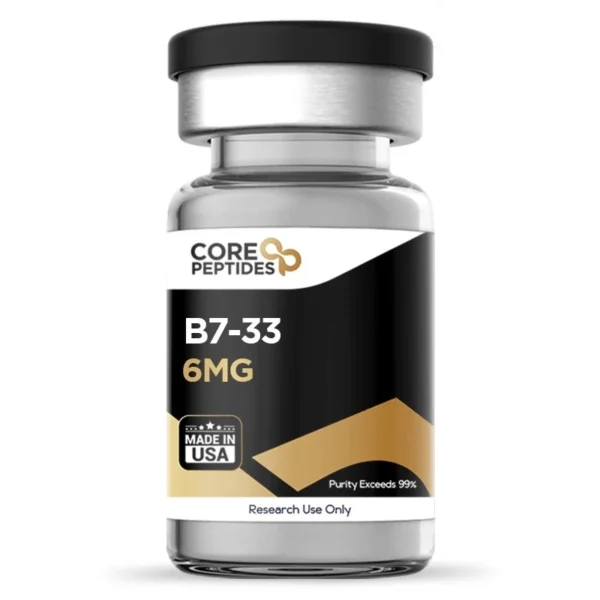
B7-33 (6MG)
CHF 54.00
B7-33 is a synthetic single-chain 26-residue peptide analogue derived from the B-chain of human relaxin-2 (H2 relaxin). This 6mg research peptide functions as a functionally selective agonist of the relaxin family peptide receptor 1 (RXFP1), preferentially activating the pERK1/2 signaling pathway over the cAMP pathway. Researchers study B7-33 for its anti-fibrotic, cardioprotective, and vasoprotective properties in models of fibrosis, cardiac remodeling, and ischemia-reperfusion injury. Buy B7-33 6mg in Switzerland from Core Peptides for your laboratory research needs.
What Is B7-33 and Why Buy It for Research?
Buy B7-33 6mg in Switzerland for research into relaxin receptor signaling, anti-fibrotic mechanisms, and cardioprotective pathways. Specifically, B7-33 is a synthetic single-chain 26-residue peptide analogue derived from the B-chain of human relaxin-2 (H2 relaxin). Structurally, it corresponds to a truncated version of the relaxin B-chain that retains the core receptor-binding and signaling functionalities of the native hormone while simplifying its structure to a single-chain format devoid of disulfide bonds.
In scientific research, B7-33 serves as a molecular tool for studying the relaxin family peptide receptor 1 (RXFP1), a class A G protein-coupled receptor. Researchers consider this peptide particularly valuable for investigating biased GPCR signaling, anti-fibrotic pathways, and tissue-protective mechanisms. Furthermore, Core Peptides supplies B7-33 as a lyophilized powder in a 6mg format exclusively for laboratory use. Therefore, researchers seeking to source this compound for their work will find it readily available through trusted suppliers.
B7-33 Research Overview: Buy B7-33 6mg in Switzerland for RXFP1 Studies
Centrally, research into B7-33 has focused on its function as a functionally selective agonist of RXFP1, the cognate receptor for relaxin-2. Endogenously, human relaxin-2 is a peptide hormone capable of pleiotropic effects in several organ systems, including the cardiovascular, renal, and reproductive systems. However, the complex and costly synthesis of the native two-chain relaxin hormone has limited its research and therapeutic applications.
B7-33 overcomes this limitation by providing a single-chain alternative that reproduces the beneficial effects of relaxin without the synthetic complexity. Importantly, B7-33 binds to RXFP1 and preferentially activates the pERK1/2 (extracellular signal-regulated kinase 1/2) pathway over the cAMP pathway in cells that endogenously express RXFP1. This biased signaling profile makes B7-33 the first functionally selective agonist of the complex GPCR, RXFP1. Accordingly, researchers can buy B7-33 6mg in Switzerland from Core Peptides to support their investigations into RXFP1 pharmacology, biased GPCR signaling, and anti-fibrotic mechanisms.
How Does B7-33 Work in Research?
Mechanistically, B7-33’s proposed action involves functioning as a biased agonist that engages RXFP1 and preferentially activates the mitogen-activated protein kinase (MAPK) pathway. The peptide binds to RXFP1, which triggers the phosphorylation of ERK1/2, a key signaling node that mediates the anti-fibrotic and tissue-protective effects of relaxin.
Furthermore, research has demonstrated that B7-33 mediates its anti-fibrotic actions by signaling through constitutive RXFP1-AT2R (angiotensin II type 2 receptor) heterodimers. This heterodimerization activates selective downstream signaling of pERK1/2 and the collagen-degrading enzyme MMP, contributing to the peptide’s strong anti-fibrotic effects. Importantly, B7-33 does not trigger pathways often associated with tumorigenesis, making it a more targeted research tool.
In cell-based assays, B7-33 demonstrates a biased signaling profile, showing comparatively weaker cAMP accumulation relative to native relaxin-2 while maintaining robust pERK1/2 activation. This biased agonism allows researchers to dissect the distinct signaling pathways downstream of RXFP1 and investigate their specific physiological roles. The peptide also exhibits a short circulation time in vitro, with a half-life of approximately 6 minutes in serum, although lipidated derivatives have shown improved stability.
Why Is B7-33 Studied in Switzerland?
Primarily, researchers study B7-33 because it represents a well-characterized relaxin-2 analogue that enables investigation of RXFP1 signaling, anti-fibrotic mechanisms, and tissue protection without the complexities of the native two-chain hormone. In fact, this peptide offers a focused tool for studying the molecular mechanisms underlying fibrosis resolution, cardiac protection, and vasoprotection.
Preclinical studies have demonstrated B7-33’s efficacy across multiple research domains. For example, in a mouse model of myocardial ischemia-reperfusion injury, B7-33 significantly reduced infarct size (21.99% versus 45.32% in vehicle controls) and preserved cardiac function (fractional shortening of 29% versus 23% in vehicle controls). Additionally, B7-33 has shown promise in reducing left ventricular fibrosis, modulating pro-fibrotic gene expression in hypertrophic scar fibroblasts, and replicating the vasoprotective functions of human relaxin-2. Ultimately, researchers can buy B7-33 6mg in Switzerland to access a research tool that may help uncover mechanisms underlying fibrosis, cardiac remodeling, and RXFP1-mediated tissue protection.
B7-33 Research Areas in Laboratory Studies
| Research Area | Focus | Evidence Level |
|---|---|---|
| RXFP1 Receptor Pharmacology | Biased signaling, pERK vs. cAMP, GPCR agonism | Mechanistic / In Vitro |
| Anti-Fibrotic Research | TGF-β/Smad signaling, collagen degradation, ECM remodeling | Mechanistic / In Vitro / In Vivo |
| Cardioprotection | Ischemia-reperfusion injury, infarct size reduction, cardiac function | Animal / Preclinical |
| Cardiac Remodeling | Left ventricular fibrosis, adverse remodeling prevention | Animal / Preclinical |
| Vasoprotection | Vascular function, endothelial protection, blood pressure regulation | Animal / Preclinical |
| Hypertrophic Scar Research | Fibroblast proliferation, collagen type I α-1 chain downregulation | In Vitro |
| Receptor Heterodimerization | RXFP1-AT2R interactions, biased signaling complexes | Mechanistic |
B7-33 Compared With Related Research Compounds
| Compound | Research Focus | Mechanism / Target | Key Difference |
|---|---|---|---|
| B7-33 | RXFP1 signaling, anti-fibrosis, cardioprotection | Biased RXFP1 agonist (pERK over cAMP) | 26-residue single-chain peptide; no disulfide bonds |
| Human Relaxin-2 (Serelaxin) | Pleiotropic effects, cardiovascular, renal | Full RXFP1 agonist (cAMP and pERK) | Two-chain 53-amino acid hormone; complex synthesis |
| ML290 | RXFP1 signaling | Allosteric RXFP1 agonist (cGMP bias) | Small molecule; different biased signaling profile |
| BPC-157 | Tissue healing, angiogenesis | Growth factor modulation | Different mechanism; no RXFP1 involvement |
Comparatively, B7-33 differs from native human relaxin-2 in its structure and signaling profile. On the one hand, native relaxin-2 consists of two chains (A and B) linked by disulfide bonds and activates both cAMP and pERK pathways through RXFP1. On the other hand, B7-33 is a single-chain peptide that preferentially activates pERK over cAMP, making it a more focused tool for studying the specific signaling pathways responsible for the anti-fibrotic and tissue-protective effects of relaxin. In contrast, ML290 is a small-molecule allosteric agonist with a different biased signaling profile, while BPC-157 operates through entirely different mechanisms unrelated to RXFP1 signaling.
Research Applications for B7-33 in Switzerland
Scientists have investigated B7-33 across several research domains:
- RXFP1 Receptor Pharmacology: Researchers use B7-33 to study biased GPCR signaling, receptor activation mechanisms, and the distinct roles of pERK versus cAMP pathways downstream of RXFP1.
- Anti-Fibrotic Research: Investigations have explored B7-33’s effects on TGF-β/Smad signaling, collagen synthesis, extracellular matrix remodeling, and fibroblast activity in cardiac, renal, pulmonary, and hepatic fibrosis models.
- Cardioprotection Studies: B7-33 is used to study ischemia-reperfusion injury, infarct size reduction, and preservation of cardiac function in preclinical models of myocardial infarction.
- Cardiac Remodeling Research: The compound is employed to investigate left ventricular fibrosis prevention, adverse remodeling attenuation, and long-term cardiac function preservation.
- Vasoprotection Studies: B7-33 has been examined for its ability to replicate the vasoprotective functions of human relaxin-2, including vascular function and endothelial protection.
- Hypertrophic Scar Research: In vitro studies have evaluated B7-33’s biocompatibility and anti-fibrotic efficacy on human hypertrophic scar fibroblasts.
- Receptor Heterodimerization Studies: B7-33 is used to investigate RXFP1-AT2R heterodimer formation and its role in mediating anti-fibrotic signaling.
Evidently, researchers can buy B7-33 6mg in Switzerland for these applications, as it is a valuable addition to any laboratory toolkit focused on RXFP1 signaling, fibrosis research, and cardioprotective mechanisms.
B7-33 Product Specifications
| Specification | Details |
|---|---|
| Product Name | B7-33 |
| Alternative Names | Single-chain relaxin-2 B-chain analogue, functionally selective RXFP1 agonist, relaxin mimetic peptide |
| Amount | 6mg |
| Form | Lyophilized powder (white to off-white) |
| Purity | Not verified (≥98.5% to ≥99% reported by some suppliers) |
| Amino Acid Sequence (1-letter) | VIKLSGRELVRAQIAISGMSTWSKRSL |
| Amino Acid Sequence (3-letter) | Val-Ile-Lys-Leu-Ser-Gly-Arg-Glu-Leu-Val-Arg-Ala-Gln-Ile-Ala-Ile-Ser-Gly-Met-Ser-Thr-Trp-Ser-Lys-Arg-Ser-Leu |
| Peptide Length | 27 residues (26-mer reported by some sources; 27-mer by others) |
| Molecular Formula | C₁₃₁H₂₂₉N₄₁O₃₆S |
| Molecular Weight | 2986.54 g/mol (varies by source) |
| CAS Number | 1818415-56-3 |
| PubChem CID | 91810664 |
| Research Category | Healing & Regeneration / Immunity & Inflammation |
| Research Use | Laboratory research use only |
| CoA | Available upon request (not verified) |
| Storage | Lyophilized powder should be stored desiccated at -20°C or below, protected from light |
| Solubility | Soluble in water and buffered aqueous solutions |
How to Evaluate B7-33 Quality for Research
When sourcing B7-33 peptide for laboratory research, researchers should consider several quality indicators:
- Identity Confirmation: Analytical techniques such as mass spectrometry should confirm the compound’s molecular weight (approximately 2986.54 g/mol) and sequence (VIKLSGRELVRAQIAISGMSTWSKRSL).
- Purity Assessment: High-performance liquid chromatography (HPLC) can provide information about peptide purity, with ≥98% considered standard for research-grade material.
- Batch Traceability: Lot numbers and batch information enable researchers to track specific production runs.
- Certificate of Analysis: A CoA should accompany the product, detailing analytical testing results including HPLC purity and identity confirmation.
- Labeling Accuracy: Proper labeling should clearly indicate the product name, amount, sequence, molecular formula, CAS number, and storage recommendations.
- Storage Conditions: Appropriate storage at -20°C or below in desiccated, dark conditions helps maintain peptide stability.
Understanding the Certificate of Analysis
Typically, a Certificate of Analysis (CoA) accompanies research peptides and provides information about the specific batch’s analytical testing. For example, a CoA may include product identity confirmation, purity percentage as determined by HPLC, batch or lot number for traceability, analytical methods used (e.g., mass spectrometry, HPLC), and a physical description of the product.
Nevertheless, it is important to note that a CoA does not establish safety, efficacy, therapeutic effectiveness, or suitability for human use. Instead, it serves as a quality control document that helps researchers verify the identity and purity of the peptide they are using in their laboratory investigations.
Storage and Stability of B7-33
Core Peptides supplies B7-33 as a lyophilized (freeze-dried) powder. To maintain stability and integrity:
- Store the lyophilized powder desiccated at -20°C or below for long-term storage
- Store at 4°C for short-term storage if frequent access is required
- Avoid repeated freeze-thaw cycles
- Reconstitute only immediately before use with appropriate sterile solvents (e.g., water or buffered aqueous solutions)
- Gently swirl to dissolve; do not vortex
- Filter sterilize if required (e.g., 0.22 µm) immediately prior to use
- If stock solutions are required, store as aliquots in tightly sealed vials at -20°C
- Protect from light and moisture
Frequently Asked Questions About Buying B7-33 6mg in Switzerland
What is B7-33?
Specifically, B7-33 is a synthetic single-chain 26-residue peptide analogue derived from the B-chain of human relaxin-2 (H2 relaxin). It is a functionally selective agonist of the relaxin family peptide receptor 1 (RXFP1).
What is B7-33 researched for?
Primarily, researchers study B7-33 for its role as a biased RXFP1 agonist that preferentially activates pERK1/2 over cAMP. Studies have investigated its anti-fibrotic, cardioprotective, and vasoprotective effects in models of fibrosis, cardiac remodeling, and ischemia-reperfusion injury.
How does B7-33 work?
Mechanistically, B7-33 functions by binding to and activating RXFP1, preferentially phosphorylating ERK1/2. It mediates its anti-fibrotic actions through constitutive RXFP1-AT2R heterodimers, activating selective downstream signaling that promotes collagen degradation and inhibits fibrosis.
What is the amino acid sequence of B7-33?
The amino acid sequence is VIKLSGRELVRAQIAISGMSTWSKRSL (Val-Ile-Lys-Leu-Ser-Gly-Arg-Glu-Leu-Val-Arg-Ala-Gln-Ile-Ala-Ile-Ser-Gly-Met-Ser-Thr-Trp-Ser-Lys-Arg-Ser-Leu).
What is the molecular weight of B7-33?
The molecular weight is approximately 2986.54 g/mol.
What is the molecular formula of B7-33?
The molecular formula is C₁₃₁H₂₂₉N₄₁O₃₆S.
What is the CAS number of B7-33?
The CAS number is 1818415-56-3.
Is B7-33 synthetic?
Yes, B7-33 is a synthetic peptide produced through solid-phase peptide synthesis.
How does B7-33 differ from native relaxin-2?
B7-33 is a single-chain peptide devoid of disulfide bonds, whereas native relaxin-2 is a two-chain hormone with disulfide bridges. Additionally, B7-33 is a biased agonist that preferentially activates pERK over cAMP, while native relaxin-2 activates both pathways.
What research exists on B7-33?
Research on B7-33 includes a 2016 study demonstrating its design and functionally selective RXFP1 agonism, a 2017 study on its vasoprotective functions, a 2020 study on cardioprotection in myocardial infarction models, and a 2026 study on anti-fibrotic effects in hypertrophic scar fibroblasts.
Is B7-33 approved as a medicine?
No. Regulatory authorities have not approved B7-33 as a medicine, pharmaceutical, or therapeutic agent. It is a research tool for laboratory use only.
Is B7-33 intended for human use?
No. B7-33 is intended for laboratory research use only and is not for human consumption, injection, or therapeutic application.
Where can I buy B7-33 6mg in Switzerland?
You can buy B7-33 6mg in Switzerland from Core Peptides, a trusted research peptide supplier serving the Swiss scientific community.
How should researchers evaluate B7-33 quality?
Researchers should look for identity confirmation via mass spectrometry, purity data from HPLC, batch traceability, and a Certificate of Analysis.
Related Research Compounds
Researchers interested in B7-33 may also find the following related compounds relevant to their work:
- Human Relaxin-2 (Serelaxin) — The native two-chain hormone from which B7-33 is derived, researched for pleiotropic effects and cardioprotection.
- BPC-157 — A peptide researched for tissue healing, gastrointestinal health, and angiogenesis.
- TB-500 — A Thymosin Beta 4 fragment researched for tissue repair and wound healing.
- GHK-Cu — A copper-binding peptide researched for skin regeneration, wound healing, and anti-aging applications.
Explore Healing & Regeneration
B7-33 belongs to the Healing & Regeneration category of research compounds. Healing & Regeneration products are studied for their potential roles in tissue repair, fibrosis resolution, and regenerative mechanisms. Generally, researchers who buy B7-33 6mg in Switzerland often pair it with related compounds in this category to explore complementary pathways in tissue protection and anti-fibrotic research.
Explore Immunity & Inflammation
Researchers studying inflammatory signaling, fibrosis, and tissue remodeling may also find relevant compounds in the Immunity & Inflammation category. B7-33’s anti-fibrotic and tissue-protective properties make it a valuable tool for investigating inflammatory and fibrotic pathways.
Further Research
For researchers seeking to deepen their understanding of B7-33 and its research applications, the following areas may warrant further investigation:
- The relationship between B7-33-mediated pERK1/2 activation and specific downstream anti-fibrotic pathways in different cell types
- Comparative studies between B7-33 and native relaxin-2 in various fibrosis and cardioprotection models
- The potential role of B7-33 in modulating RXFP1-AT2R heterodimerization and its functional consequences
- Mechanistic studies on B7-33’s biased signaling profile and its implications for receptor pharmacology
- Exploration of B7-33’s effects on different tissue systems beyond cardiovascular and fibrotic models
Research Disclaimer
B7-33 is a research peptide supplied for laboratory research use only. Researchers must not use it for human consumption, injection, or any form of therapeutic application. Moreover, this product is not a medicine, pharmaceutical, or medical device. Furthermore, Swissmedic, the FDA, EMA, or any other regulatory authority have not approved it for human use. Researchers should consult Swissmedic for applicable regulations and guidance on research peptide handling in Switzerland.
Generally, the information provided on this page is for educational and scientific reference purposes only. Therefore, it does not constitute medical advice, treatment recommendations, or dosing instructions. Ultimately, researchers bear the responsibility for ensuring that their use of this product complies with all applicable laws, regulations, and institutional guidelines.
Finally, all research involving peptides should be conducted by qualified personnel in appropriate laboratory settings with proper safety protocols.
Schreiben Sie die erste Rezension für «B7-33 (6MG)»
Sie müssen angemeldet sein, um eine Rezension veröffentlichen zu können.
Ähnliche Produkte
Healing & Regeneration Peptides
Healing & Regeneration Peptides
Healing & Regeneration Peptides
Healing & Regeneration Peptides
Healing & Regeneration Peptides
Healing & Regeneration Peptides
Healing & Regeneration Peptides
Healing & Regeneration Peptides
Rezensionen
Es gibt noch keine Rezensionen.