
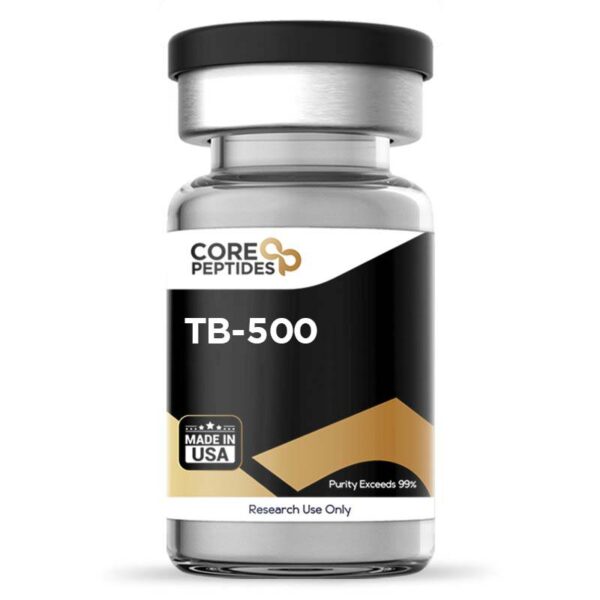
TB-500 (Thymosin Beta 4) (5MG / 10MG)
Fascia di prezzo: da CHF 70.20 a CHF 126.00
TB-500 is a synthetic 7-amino acid acetylated peptide fragment (Ac-LKKTETQ) derived from the actin-binding domain of thymosin beta-4 (Tβ4), a 43-amino acid protein that serves as the primary intracellular G-actin-sequestering peptide. Researchers investigate TB-500 for its ability to regulate actin dynamics, promote cell migration, stimulate angiogenesis, and support tissue repair and regeneration. Studies have explored its effects on wound healing, keratinocyte migration, collagen deposition, and endothelial cell differentiation. Available for laboratory research purposes only. Buy TB-500 in Switzerland from Core Peptides, a trusted research peptide supplier.
What Is TB-500?
TB-500 is a synthetic acetylated heptapeptide with the amino acid sequence Ac-Leu-Lys-Lys-Thr-Glu-Thr-Gln (Ac-LKKTETQ). It corresponds to the actin-binding domain of thymosin beta-4 (Tβ4), specifically residues 17 through 23 of the parent 43-amino acid protein. Thymosin beta-4 is a highly conserved polypeptide that serves as the primary intracellular G-actin-sequestering protein in many cell types. For those looking to buy TB-500 in Switzerland, Core Peptides offers high-quality research-grade material for laboratory applications.
As a heptapeptide—a peptide composed of seven amino acids—TB-500 features N-terminal acetylation, which enhances its stability and biological activity. The peptide is commonly supplied as the acetate salt with the molecular formula C38H68N10O14 and a molecular weight of approximately 889.01 g/mol. It is identified by CAS number 885340-08-9. Researchers developed TB-500 as a synthetic fragment designed to leverage the core regenerative properties of thymosin beta-4 associated with actin regulation, cell migration, and tissue repair.
TB-500 Research Overview
TB-500 has attracted significant research interest as a tool for investigating actin cytoskeleton dynamics, cell migration, and tissue regeneration. The peptide’s design—a 7-amino acid acetylated fragment capturing the actin-binding motif of thymosin beta-4—enables it to regulate actin polymerization and influence cellular processes critical for wound healing and repair.
Research interest in TB-500 centers on its ability to sequester G-actin (monomeric actin), thereby controlling the availability of actin monomers for polymerization into F-actin filaments. By regulating actin dynamics, TB-500 influences cell motility, migration, and cytoskeletal reorganization—processes fundamental to tissue repair and regeneration. Consequently, TB-500 has generated significant interest as a research tool for investigating wound healing, angiogenesis, and tissue repair mechanisms at the molecular level.
When researchers choose to buy TB-500 in Switzerland for laboratory studies, they gain access to a compound that may help elucidate mechanisms of actin regulation, cell migration, and tissue regeneration.
How Does TB-500 Work?
TB-500 exerts its biological effects through regulation of actin dynamics and modulation of key signaling pathways. The peptide’s mechanism involves several interconnected steps.
Actin Sequestration and Cytoskeletal Regulation
TB-500’s primary mechanism involves binding to G-actin (monomeric actin) in a 1:1 stoichiometric ratio, preventing its polymerization into filamentous actin (F-actin). This sequestration maintains a large pool of actin monomers that can be rapidly mobilized for polymerization when and where needed. The binding affinity of TB-500 for G-actin is significantly influenced by the nucleotide (ATP or ADP) bound to actin, with substantially higher affinity for MgATP-actin than for MgADP-actin.
By regulating actin dynamics, TB-500 controls the availability of monomers for polymerization—a key factor in cellular processes that require rapid cytoskeletal reorganization, such as cell migration and division.
Signaling Pathway Activation
Beyond its direct interaction with actin, TB-500 modulates key signaling pathways fundamental to its tissue repair and regeneration properties. The peptide promotes endothelial cell differentiation and angiogenesis through activation of the PI3K-Akt and MAPK-ERK/p38 pathways. These signaling cascades support endothelial cell migration, tube formation, and capillary-like structure development.
Angiogenesis and Vascular Research
TB-500 stimulates angiogenesis, or the formation of new blood vessels, in part by upregulating Vascular Endothelial Growth Factor (VEGF). This pro-angiogenic effect supports endothelial cell migration, tube formation, and capillary-like structures, making TB-500 valuable for investigating vascular development and microvascular regeneration.
Tissue Repair and Wound Healing
TB-500 promotes endothelial cell differentiation, angiogenesis in dermal tissues, keratinocyte migration, and collagen deposition while reducing inflammation. The peptide also exhibits anti-inflammatory properties and can reduce the number of myofibroblasts, potentially leading to less scar formation. Research suggests that TB-500 may enhance re-epithelialization, migration of keratinocytes, and deposition of collagen by influencing actin dynamics and cell motility.
Researchers who buy TB-500 in Switzerland for research purposes can investigate these mechanisms across diverse experimental models of tissue repair, wound healing, and angiogenesis.
Why Is TB-500 Studied?
Researchers study TB-500 primarily for its potential relevance to tissue repair, wound healing, angiogenesis, and cytoskeletal regulation. The peptide’s ability to regulate actin dynamics and promote cell migration makes it a valuable tool for understanding the molecular basis of tissue regeneration and repair.
TB-500’s connection to thymosin beta-4 has made it a focus of regenerative medicine research. For instance, preclinical studies have explored TB-500’s effects on wound healing, angiogenesis, and tissue repair in various experimental models, including dermal wound healing models and ischemic tissue models.
Moreover, researchers study TB-500 in the context of musculoskeletal repair and tissue regeneration. As the parent molecule thymosin beta-4 is upregulated during repair processes, TB-500—retaining the core actin-binding fragment—may be relevant to probing mechanisms of repair.
Researchers who buy TB-500 in Switzerland from Core Peptides can incorporate this peptide into their studies on actin cytoskeleton dynamics, wound healing, angiogenesis, and tissue regeneration.
TB-500 Research Areas
| Research Area | Description |
|---|---|
| Actin Cytoskeleton Regulation | Investigating TB-500’s G-actin sequestration and regulation of actin polymerization |
| Wound Healing | Studying TB-500’s effects on re-epithelialization, keratinocyte migration, and tissue repair |
| Angiogenesis | Examining TB-500’s promotion of endothelial cell differentiation and new blood vessel formation |
| Cell Migration | Exploring TB-500’s influence on cell motility and cytoskeletal reorganization |
| Collagen Deposition | Investigating TB-500’s effects on fibroblast activity and extracellular matrix remodeling |
| Anti-Inflammatory Research | Preclinical research into TB-500’s anti-inflammatory properties and reduction of myofibroblasts |
| Musculoskeletal Repair | Studying TB-500’s potential in tendon, muscle, and connective tissue repair |
| Neural Repair | Exploring TB-500’s relevance to oligodendrocyte activation and neural repair research |
Scientific Research on TB-500
Researchers have conducted scientific studies on TB-500 primarily in preclinical settings, deriving evidence from in vitro cell cultures, animal models, and ex vivo tissue samples. The peptide originates from thymosin beta-4 research, with the actin-binding motif at residues 17-23 (LKKTETQ) identified as the functional core.
In Vitro Evidence
In vitro studies using cell culture models have demonstrated that TB-500 regulates actin dynamics by binding to G-actin and controlling actin polymerization. Research has shown that TB-500 promotes endothelial cell differentiation, angiogenesis in dermal tissues, keratinocyte migration, and collagen deposition while reducing inflammation.
Furthermore, studies have investigated TB-500’s effects on cell migration and proliferation. The peptide’s regulation of the actin cytoskeleton is crucial for cell motility, a key component of wound healing.
Preclinical Animal Studies
In animal models, researchers have investigated TB-500’s effects on wound healing and tissue repair. Studies have demonstrated that TB-500 accelerates healing across multiple tissue types by binding to G-actin and controlling actin polymerization. For example, the peptide has been studied in dermal wound healing models, corneal repair models, and musculoskeletal injury models.
Research has also explored TB-500’s pro-angiogenic effects, with studies showing that the peptide upregulates VEGF and promotes endothelial cell migration and tube formation.
Human Research
TB-500 has limited human clinical evidence. As of April 2026, no completed, published human randomized controlled trials have examined TB-500 for any musculoskeletal or tissue-repair indication. Clinical data involving full-length thymosin beta-4 exists for ophthalmic indications (dry eye and neurotrophic keratopathy) but does not transfer directly to TB-500.
TB-500 is not FDA-approved for human use. As of the February 2026 reclassification, TB-500 is classified as an FDA 503A Category 2 bulk drug substance, prohibited in compounding. It is also banned at all times on the 2026 WADA Prohibited List under Section S2. Scientists who buy TB-500 in Switzerland should remain aware of these evidence considerations.
TB-500 Compared With Related Peptides
| Peptide | Relationship to TB-500 | Key Differences |
|---|---|---|
| Thymosin Beta-4 (Tβ4) | Parent protein; TB-500 is a synthetic fragment | Tβ4 is a 43-amino acid protein with broader activities; TB-500 is a 7-amino acid fragment (Ac-LKKTETQ) covering the actin-binding domain |
| BPC-157 | Both studied for tissue repair and wound healing | BPC-157 is a gastric pentadecapeptide with different mechanism; TB-500 targets actin dynamics and angiogenesis; often studied in combination |
| GHK-Cu | Both studied for tissue repair and regeneration | GHK-Cu is a copper-binding peptide with different mechanism; TB-500 is a thymosin beta-4 fragment regulating actin |
| PEG-MGF | Both studied for tissue repair | PEG-MGF targets IGF-1 receptor and satellite cells; TB-500 targets actin cytoskeleton and angiogenesis |
| Thymosin Alpha-1 | Both from thymosin family | Thymosin alpha-1 is an immunomodulatory peptide; TB-500 is a thymosin beta-4 fragment targeting actin and tissue repair |
Research Applications
Researchers utilize TB-500 in a variety of laboratory research applications, primarily in the fields of regenerative medicine, cell biology, and wound healing research. Key research applications include:
- Actin Cytoskeleton Studies: Investigating TB-500’s G-actin sequestration and regulation of actin polymerization
- Wound Healing Research: Studying TB-500’s effects on re-epithelialization, keratinocyte migration, and tissue repair
- Angiogenesis Studies: Examining TB-500’s promotion of endothelial cell differentiation and new blood vessel formation
- Cell Migration Research: Exploring TB-500’s influence on cell motility and cytoskeletal reorganization
- Collagen Deposition Studies: Investigating TB-500’s effects on fibroblast activity and extracellular matrix remodeling
- Anti-Inflammatory Research: Preclinical research into TB-500’s anti-inflammatory properties
- Musculoskeletal Repair Studies: Studying TB-500’s potential in tendon, muscle, and connective tissue repair
- Neural Repair Research: Exploring TB-500’s relevance to neural repair and oligodendrocyte activation
Researchers who buy TB-500 in Switzerland can incorporate this peptide into their experimental protocols across these diverse research areas.
TB-500 Product Specifications
| Specification | Detail |
|---|---|
| Product Name | TB-500 (Thymosin Beta-4 Fragment) |
| Amount | 5mg / 10mg |
| Form | Lyophilized powder |
| Sequence (One-Letter) | Ac-LKKTETQ |
| Sequence (Three-Letter) | Ac-Leu-Lys-Lys-Thr-Glu-Thr-Gln |
| Molecular Formula | C38H68N10O14 |
| Molecular Weight | Approximately 889.01 g/mol |
| CAS Number | 885340-08-9 |
| N-Terminal Modification | Acetylation |
| Synonyms | Thymosin Beta-4 Fragment 17-23, Ac-LKKTETQ |
| Mechanism | G-actin sequestration; PI3K-Akt and MAPK-ERK pathway activation; angiogenesis promotion |
| Research Category | Healing & Regeneration Peptides |
| Purity | >99% (HPLC) |
| Storage | Store desiccated at -20°C, protected from light |
How to Evaluate TB-500 Quality
When sourcing TB-500 for research purposes, researchers should consider several quality indicators. A reliable TB-500 peptide supplier should provide:
- Identity Confirmation: Analytical verification that the peptide matches the expected sequence (Ac-LKKTETQ) and molecular weight (approximately 889.01 g/mol)
- Purity Analysis: Documentation of purity through methods such as HPLC – research grade typically provides >99% purity
- N-Terminal Acetylation Confirmation: Verification of the acetylated N-terminus, which contributes to peptide stability and biological activity
- Batch Information: Clear lot numbers and batch traceability
- Certificate of Analysis (CoA): Documentation of analytical testing results
- Appearance: White to off-white lyophilized powder
- Solubility: Soluble in water and buffered aqueous solutions
Researchers looking to buy TB-500 in Switzerland should seek suppliers who provide comprehensive documentation and quality assurance. Core Peptides remains committed to supporting research with properly documented products.
Understanding the Certificate of Analysis
A Certificate of Analysis (CoA) provides analytical data for a specific batch of a research peptide. For TB-500 research, a CoA typically includes:
- Identity Confirmation: Mass spectrometry confirming the peptide’s identity
- Purity Assessment: HPLC chromatograms showing the purity of the peptide
- Batch/Lot Information: Unique identifiers for traceability
- Analytical Methods: Description of the testing methods used
Importantly, researchers should understand that a CoA demonstrates the chemical identity and purity of a peptide but does not establish safety, efficacy, therapeutic effectiveness, or suitability for human use. The CoA serves as a quality control document for research purposes only.
Storage and Stability
Proper storage of research peptides is essential for maintaining their integrity and stability. For TB-500, researchers should refer to the product documentation provided with their order for specific storage recommendations.
General best practices for peptide storage include keeping the lyophilized peptide desiccated, protected from light, and stored at -20°C or below. The peptide is soluble in water and buffered aqueous solutions. For specific temperature requirements and reconstitution protocols, consult the applicable product documentation or contact Core Peptides for the applicable storage specifications.
Research Considerations
Researchers incorporating TB-500 into their studies should be aware of several important considerations:
- Evidence Limitations: TB-500 has limited human clinical evidence. As of April 2026, no completed, published human randomized controlled trials have examined TB-500 for any musculoskeletal or tissue-repair indication.
- Experimental Status: Researchers consider TB-500 a preclinical compound. Therefore, findings should be interpreted within the context of ongoing research.
- Model Differences: Results from cell cultures and animal models may not translate directly to human outcomes.
- Regulatory Status: TB-500 is not FDA-approved and is intended for laboratory research use only. It is banned at all times on the 2026 WADA Prohibited List under Section S2.
- Quality Considerations: Researchers should verify the quality and identity of their TB-500 through appropriate analytical methods.
- Mechanistic Context: TB-500’s proposed mechanisms involve G-actin sequestration, PI3K-Akt and MAPK-ERK pathway activation, and angiogenesis promotion. Researchers should consider appropriate experimental approaches to investigate these pathways.
- Distinction from Full-Length Tβ4: TB-500 is a synthetic fragment of thymosin beta-4 and lacks the C-terminal AGES domain that drives many of the cardiac repair findings and the full-length protein’s anti-inflammatory activities.
Researchers who buy TB-500 in Switzerland should ensure their studies include appropriate controls and interpret findings with scientific rigor.
Frequently Asked Questions About TB-500
What is TB-500?
TB-500 is a synthetic acetylated heptapeptide (Ac-LKKTETQ) corresponding to the actin-binding domain (residues 17-23) of thymosin beta-4 (Tβ4), a 43-amino acid protein that serves as the primary intracellular G-actin-sequestering peptide.
What is TB-500 researched for?
Researchers primarily investigate TB-500 for its ability to regulate actin dynamics, promote cell migration, stimulate angiogenesis, and support tissue repair and regeneration.
What is the amino acid sequence of TB-500?
The amino acid sequence of TB-500 is Ac-LKKTETQ (Ac-Leu-Lys-Lys-Thr-Glu-Thr-Gln).
What is the molecular weight of TB-500?
The molecular weight of TB-500 is approximately 889.01 g/mol.
What is the CAS number for TB-500?
The CAS number for TB-500 is 885340-08-9.
What is the mechanism of action for TB-500?
TB-500 binds to G-actin, preventing its polymerization into F-actin, thereby regulating actin dynamics. It also activates PI3K-Akt and MAPK-ERK/p38 pathways, promoting angiogenesis, cell migration, and tissue repair.
How does TB-500 differ from thymosin beta-4?
TB-500 is a synthetic 7-amino acid fragment of thymosin beta-4 (Ac-LKKTETQ) covering the actin-binding domain. It lacks the C-terminal AGES domain that appears to drive many of the cardiac repair findings and the full-length protein’s anti-inflammatory activities.
Does TB-500 have human clinical evidence?
TB-500 has limited human clinical evidence. As of April 2026, no completed, published human randomized controlled trials have examined TB-500 for any musculoskeletal or tissue-repair indication.
Can I buy TB-500 in Switzerland?
Yes, researchers can buy TB-500 in Switzerland from Core Peptides for laboratory research purposes.
What is the primary research category for TB-500?
TB-500 belongs to the Healing & Regeneration Peptides category, with secondary relevance to Cellular Research & Signaling research.
What related peptides are studied alongside TB-500?
Related peptides include BPC-157, GHK-Cu, PEG-MGF, and Thymosin Beta-4. BPC-157 and TB-500 are often studied in combination for potential synergistic effects in tissue repair research.
What is the purity of Core Peptides’ TB-500?
Core Peptides provides TB-500 with a purity of >99% as verified by HPLC analysis.
How should TB-500 be stored?
TB-500 should be stored lyophilized, desiccated, protected from light, at -20°C or below.
Is TB-500 soluble in water?
Yes, TB-500 is soluble in water and buffered aqueous solutions.
Related Research Peptides
Researchers interested in TB-500 may also find the following related peptides relevant to their work:
- BPC-157 – A peptide studied for tissue repair and wound healing; often studied in combination with TB-500
- GHK-Cu – A copper peptide studied for skin and tissue research
- PEG-MGF – A PEGylated mechano growth factor studied for muscle and tissue repair
- Thymosin Beta-4 – The parent protein; a 43-amino acid peptide with broader biological activities
- BPC-157 & TB-500 Blend – A combination blend for tissue repair and regeneration research
For a comprehensive selection of research peptides in Switzerland, explore the Core Peptides catalog.
Explore Healing & Regeneration Peptides
TB-500 is part of our Healing & Regeneration Peptides category, which features a range of research peptides investigated for their effects on tissue repair, wound healing, and regeneration. Browse our selection to find the right peptides for your laboratory research.
Explore Related Research Categories
Researchers may also find the following related categories relevant to TB-500 research:
- Cellular Research & Signaling – Peptides studied for cell signaling and cytoskeletal regulation
- Anti-Aging & Longevity – Peptides investigated for age-related tissue repair research
- Muscle & Performance Peptides – Peptides studied for muscle repair and performance research
Further Research
Researchers interested in learning more about TB-500 and related peptides should consult the primary scientific literature. Key areas of investigation include actin cytoskeleton dynamics, wound healing, angiogenesis, and tissue regeneration. The PubMed database is an excellent resource for accessing peer-reviewed research articles on these topics.
Research Disclaimer
Core Peptides supplies TB-500 as a research peptide for laboratory research purposes only. All information provided is for educational and scientific reference purposes only and does not constitute medical advice. Researchers are responsible for ensuring compliance with all applicable laws and regulations governing the use of research peptides in their jurisdiction, including Switzerland.
| Choose | 5mg, 10mg |
|---|
Recensisci per primo “TB-500 (Thymosin Beta 4) (5MG / 10MG)”
Devi effettuare l’accesso per pubblicare una recensione.
Prodotti correlati
Healing & Regeneration Peptides
Healing & Regeneration Peptides
Healing & Regeneration Peptides
Healing & Regeneration Peptides
Healing & Regeneration Peptides
Healing & Regeneration Peptides
Healing & Regeneration Peptides
Healing & Regeneration Peptides
Recensioni
Ancora non ci sono recensioni.