
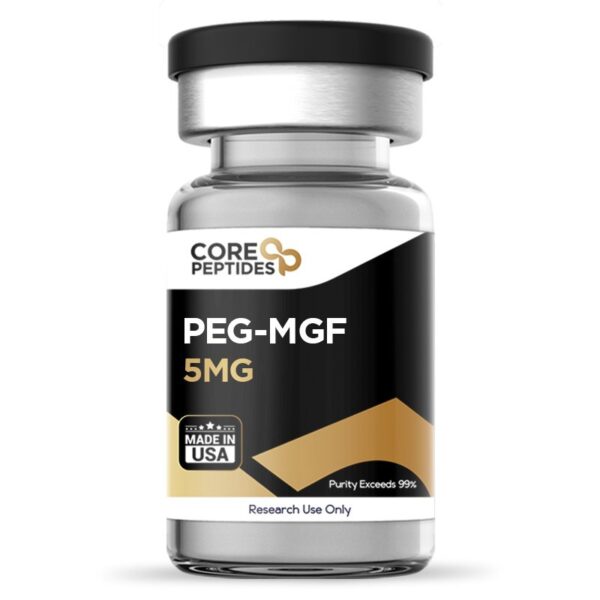
PEG-MGF (5MG)
CHF 56.70
PEG-MGF (PEGylated Mechano Growth Factor) is a modified form of mechano growth factor an IGF-1 splice variant (IGF-1Ec) produced locally in muscle tissue in response to mechanical stress or injury. Researchers investigate PEG-MGF for its ability to activate satellite cells, promote myoblast proliferation, and support muscle tissue repair and regeneration. The PEGylation extends the peptide’s half-life from minutes to several hours, enabling more sustained research applications. Available for laboratory research purposes only. Buy PEG-MGF in Switzerland from Core Peptides, a trusted research peptide supplier.
What Is PEG-MGF?
PEG-MGF (PEGylated Mechano Growth Factor) is a chemically modified form of mechano growth factor (MGF), a naturally occurring splice variant of the insulin-like growth factor 1 (IGF-1) gene. In humans, MGF is also known as IGF-1Ec and is produced locally in skeletal muscle tissue in response to mechanical loading, exercise, or tissue damage.
The native MGF peptide—a 24-amino-acid C-terminal E-domain fragment—has an extremely short half-life of approximately 5–7 minutes in circulation, which limits its utility in research settings. To overcome this limitation, researchers developed PEG-MGF by covalently attaching polyethylene glycol (PEG) chains to the native MGF peptide. This PEGylation process extends the peptide’s half-life from minutes to several hours, enabling systemic administration and more sustained research applications. For those looking to buy PEG-MGF in Switzerland, Core Peptides offers high-quality research-grade material for laboratory applications.
PEG-MGF Research Overview
Mechano Growth Factor was first characterized by Yang and Goldspink in 1996 as a distinct splice variant of the IGF-1 gene. The IGF-1 gene undergoes alternative splicing to produce multiple isoforms—IGF-1Ea, IGF-1Eb, and IGF-1Ec (MGF)—each with distinct biological functions. While the liver produces systemic IGF-1Ea under growth hormone stimulation, skeletal muscle produces MGF locally in response to mechanical stress.
Research interest in PEG-MGF centers on its ability to activate quiescent satellite cells—the resident stem cell population required for muscle fiber repair, regeneration, and hypertrophy. Unlike systemic IGF-1, MGF acts in an autocrine/paracrine fashion at the site of tissue stress. The unique E-domain of MGF is responsible for its satellite cell activation properties and is believed to act through a receptor system distinct from the classical IGF-1 receptor.
PEGylation preserves these biological activities while extending systemic bioavailability. When researchers choose to buy PEG-MGF in Switzerland for laboratory studies, they gain access to a compound that may help elucidate mechanisms of muscle repair, satellite cell activation, and tissue regeneration at the molecular level.
How Does PEG-MGF Work?
PEG-MGF exerts its biological effects through several interconnected mechanisms. The core MGF peptide retains the biological activity of native MGF, while the PEG moiety extends its circulation time and bioavailability.
Satellite Cell Activation
MGF’s primary mechanism involves activation of satellite cells—muscle stem cells residing between the basal lamina and the sarcolemma of muscle fibers. Research suggests that MGF activates satellite cells through the extracellular signal-regulated kinase (ERK) pathway, binding to a distinct receptor (not the canonical IGF-1R) and triggering ERK1/2 phosphorylation, which promotes satellite cell proliferation.
Once activated, satellite cells proliferate and eventually fuse with damaged muscle fibers, donating fresh nuclei to support repair and hypertrophy. This initial MGF pulse activates satellite cells, promoting their proliferation and delaying differentiation, thereby expanding the myogenic precursor pool available for subsequent fusion into damaged or growing muscle fibers.
IGF-1 Receptor Signaling
MGF also stimulates the IGF-1 receptor with potency comparable to full-length IGF-1 at equimolar concentrations. PEG-MGF binds the IGF-1 receptor on muscle satellite cells, activating the PI3K/Akt pathway to promote cell proliferation and muscle repair. Downstream signaling increases protein synthesis and supports regeneration of damaged muscle fibers.
Anti-Inflammatory and Anti-Apoptotic Effects
In injured tissue, MGF reduces inflammatory cytokine expression, attenuates oxidative stress, and recruits immune cells (macrophages and neutrophils) to the injury site. The peptide also modulates apoptotic pathways, reducing programmed cell death in hypoxic tissues.
PEGylation Benefits
The PEGylation modification prolongs receptor engagement by slowing renal clearance. While native MGF is degraded within minutes in circulation, PEG-MGF exhibits a half-life of several hours to several days. This extended stability enables researchers to conduct more controlled and reproducible studies of receptor-mediated activation, downstream kinase cascades, and gene expression changes.
Researchers who buy PEG-MGF in Switzerland for research purposes can investigate these mechanisms across diverse experimental models.
Why Is PEG-MGF Studied?
Researchers study PEG-MGF primarily for its potential relevance to muscle repair, satellite cell biology, and tissue regeneration. The peptide’s ability to activate satellite cells and promote myoblast proliferation makes it a valuable tool for understanding the molecular basis of muscle adaptation and repair.
The peptide’s connection to the mechanotransduction pathway—the process by which muscles “know” they have been damaged and initiate repair at the precise site of injury—has made it a focus of muscle biology research. Preclinical studies have explored PEG-MGF’s effects on muscle regeneration, hypertrophy, and recovery in various experimental models.
Moreover, researchers study PEG-MGF beyond skeletal muscle. Neurological studies have shown MGF’s neuroprotective effects in models of neurodegenerative disease and brain ischemia. Research has also explored its potential in cardiac repair after myocardial infarction, bone healing, and dental applications.
Researchers who buy PEG-MGF in Switzerland from Core Peptides can incorporate this peptide into their studies on satellite cell activation, muscle regeneration, and tissue repair.
PEG-MGF Research Areas
| Research Area | Description |
|---|---|
| Satellite Cell Activation | Investigating PEG-MGF’s ability to activate quiescent muscle stem cells |
| Muscle Repair & Regeneration | Studying PEG-MGF’s effects on muscle tissue repair and functional recovery |
| Myoblast Proliferation | Examining PEG-MGF’s stimulation of myoblast division and differentiation |
| Muscle Hypertrophy | Exploring PEG-MGF’s potential to support muscle fiber growth and adaptation |
| Cardiac Repair | Preclinical research into PEG-MGF’s protective effects following ischemic injury |
| Neuroprotection | Investigating PEG-MGF’s effects in models of neurodegenerative disease |
| Bone & Dental Healing | Studying PEG-MGF’s effects on osteogenic differentiation and periodontal repair |
| Sarcopenia Research | Exploring PEG-MGF’s potential relevance to age-related muscle loss |
Scientific Research on PEG-MGF
Researchers have conducted scientific studies on PEG-MGF primarily in preclinical settings, deriving evidence from in vitro cell cultures, ex vivo tissue samples, and in vivo animal models. The peptide originates from the discovery of MGF as a distinct IGF-1 splice variant by Yang and Goldspink in the late 1990s.
In Vitro Evidence
In vitro studies have demonstrated that PEG-MGF stimulates the proliferation of C2C12 muscle cells and myoblasts upon presentation. Research has shown that MGF-E peptide (the E-domain fragment) significantly increases the proliferative life span of human muscle progenitor cells. On mouse cortical neurons, PEG-MGF and its derivatives have enhanced synaptogenesis, measured by increased PSD-95 expression levels.
Research in human periodontal ligament cell cultures indicates that PEG-MGF improves osteogenic differentiation and boosts expression of MMP-1 and MMP-2 via the MEK/ERK1/2 pathway.
Preclinical Animal Studies
In a mouse model of muscle injury, MGF injected directly into muscle protects cells by decreasing expression of inflammatory hormones and reducing oxidative stress. Research has demonstrated that MGF modulates muscle inflammation and improves recruitment of macrophages and neutrophils to injury sites.
Studies have shown that muscle resistance activity activates MGF mRNA in muscle tissues, manifesting as a substantial 163% rise from baseline levels. Research in mice demonstrates a 25% increase in muscle mass following MGF administration.
Research has also explored MGF’s role in cardiac protection. Studies have demonstrated that local MGF injection can protect cardiac tissue following ischemia.
Human Research
PEG-MGF has limited human clinical evidence. As of April 2026, no completed randomized controlled trials of exogenous MGF exist. One independent laboratory found no proliferative effect on primary human myoblasts, a direct replication failure of earlier findings. PEG-MGF is not FDA-approved for any indication and is classified as a research-use-only compound. It is also classified as a prohibited substance by WADA under S2 (Peptide Hormones, Growth Factors, Related Substances, and Mimetics). Scientists who buy PEG-MGF in Switzerland should remain aware of these evidence considerations.
PEG-MGF Compared With Related Peptides
| Peptide | Relationship to PEG-MGF | Key Differences |
|---|---|---|
| MGF (unmodified) | Parent compound; PEG-MGF is the PEGylated form | MGF has 5–7 minute half-life; PEG-MGF has several hours to days half-life; PEG-MGF enables systemic administration |
| IGF-1 LR3 | Both are IGF-1 family members studied for muscle research | IGF-1 LR3 has modified N-terminus with longer half-life; PEG-MGF targets satellite cells specifically; different receptor binding kinetics |
| IGF-1 DES | Both are IGF-1 family members | IGF-1 DES lacks the first three amino acids; different receptor binding kinetics and tissue specificity |
| BPC-157 | Both studied for healing and tissue repair | BPC-157 is a gastric pentadecapeptide with different mechanism; PEG-MGF targets IGF-1 receptor and satellite cells |
| TB-500 | Both studied for tissue regeneration | TB-500 is a thymosin beta-4 derivative promoting actin polymerization; PEG-MGF targets IGF-1 receptor pathway |
Research Applications
Researchers utilize PEG-MGF in a variety of laboratory research applications, primarily in the fields of muscle biology, tissue regeneration, and neuroprotection. Key research applications include:
- Satellite Cell Studies: Investigating PEG-MGF’s ability to activate quiescent muscle stem cells
- Muscle Repair Research: Studying PEG-MGF’s effects on muscle tissue repair and functional recovery
- Myoblast Proliferation Studies: Examining PEG-MGF’s stimulation of myoblast division and differentiation
- Muscle Hypertrophy Research: Exploring PEG-MGF’s potential to support muscle fiber growth and adaptation
- Cardiac Repair Studies: Preclinical research into PEG-MGF’s protective effects following ischemic injury
- Neuroprotection Research: Investigating PEG-MGF’s effects in models of neurodegenerative disease
- Bone & Dental Healing Studies: Studying PEG-MGF’s effects on osteogenic differentiation and periodontal repair
- Sarcopenia Research: Exploring PEG-MGF’s potential relevance to age-related muscle loss
Researchers who buy PEG-MGF in Switzerland can incorporate this peptide into their experimental protocols across these diverse research areas.
PEG-MGF Product Specifications
| Specification | Detail |
|---|---|
| Product Name | PEG-MGF (PEGylated Mechano Growth Factor) |
| Amount | 5mg |
| Form | Lyophilized powder |
| Sequence (One-Letter) | PEG-Suc-YQPPSTNKNTKSQRRKGSTFEEHK-NH2 |
| Sequence (Three-Letter) | PEG-Suc-Tyr-Gln-Pro-Pro-Ser-Thr-Asn-Lys-Asn-Thr-Lys-Ser-Gln-Arg-Arg-Lys-Gly-Ser-Thr-Phe-Glu-Glu-His-Lys |
| Molecular Formula | C121H200N42O39 (base peptide) |
| Molecular Weight | Base peptide: ~2867–2948 g/mol; with PEG: ~5000–8000 Da depending on PEG chain |
| CAS Number | Not verified / not provided |
| Synonyms | PEG-MGF, PEGylated MGF, PEG IGF-1Ec, PEG-MGF-Ct24E |
| Half-Life (PEGylated) | Several hours to several days |
| Research Category | Muscle & Performance Peptides |
| Purity | >99% |
| Storage | Refer to product documentation |
How to Evaluate PEG-MGF Quality
When sourcing PEG-MGF for research purposes, researchers should consider several quality indicators. A reliable PEG-MGF peptide supplier should provide:
- Identity Confirmation: Analytical verification that the peptide matches the expected sequence (PEG-Suc-YQPPSTNKNTKSQRRKGSTFEEHK-NH2) and molecular weight (base peptide ~2867–2948 g/mol)
- Purity Analysis: Documentation of purity through methods such as HPLC (High-Performance Liquid Chromatography) – Core Peptides provides >99% purity
- Batch Information: Clear lot numbers and batch traceability
- Certificate of Analysis (CoA): Documentation of analytical testing results
- Proper Labeling: Accurate product identification and storage instructions
- PEGylation Confirmation: Verification of PEG conjugation through mass spectrometry and SDS-PAGE
Researchers looking to buy PEG-MGF in Switzerland should seek suppliers who provide comprehensive documentation and quality assurance. Core Peptides remains committed to supporting research with properly documented products.
Understanding the Certificate of Analysis
A Certificate of Analysis (CoA) provides analytical data for a specific batch of a research peptide. For PEG-MGF research, a CoA typically includes:
- Identity Confirmation: Mass spectrometry or other analytical methods confirming the peptide’s identity
- Purity Assessment: HPLC chromatograms showing the purity of the peptide
- Batch/Lot Information: Unique identifiers for traceability
- Analytical Methods: Description of the testing methods used
Importantly, researchers should understand that a CoA demonstrates the chemical identity and purity of a peptide but does not establish safety, efficacy, therapeutic effectiveness, or suitability for human use. The CoA serves as a quality control document for research purposes only.
Storage and Stability
Proper storage of research peptides is essential for maintaining their integrity and stability. For PEG-MGF, researchers should refer to the product documentation provided with their order for specific storage recommendations.
General best practices for peptide storage include keeping lyophilized peptides in a cool, dry environment, protected from light and moisture. For specific temperature requirements and reconstitution protocols, consult the applicable product documentation or contact Core Peptides for the applicable storage specifications.
Research Considerations
Researchers incorporating PEG-MGF into their studies should be aware of several important considerations:
- Evidence Limitations: PEG-MGF has limited human clinical evidence. As of April 2026, no completed randomized controlled trials of exogenous MGF exist. One independent laboratory found no proliferative effect on primary human myoblasts, highlighting replication gaps.
- Experimental Status: Researchers consider PEG-MGF an experimental compound. Therefore, findings should be interpreted within the context of early-stage research.
- Model Differences: Results from cell cultures and animal models may not translate directly to human outcomes.
- Regulatory Status: PEG-MGF is not FDA-approved and is intended for laboratory research use only. It is classified as a prohibited substance by WADA under S2 (Peptide Hormones, Growth Factors, Related Substances, and Mimetics).
- Quality Considerations: Researchers should verify the quality and identity of their PEG-MGF through appropriate analytical methods.
- PEGylation Effects: Researchers should consider that the PEG moiety significantly alters the peptide’s half-life, bioavailability, and pharmacokinetic properties compared to native MGF.
- Receptor Specificity: MGF may act through a receptor distinct from the classical IGF-1 receptor. Researchers should consider this when designing experiments.
Researchers who buy PEG-MGF in Switzerland should ensure their studies include appropriate controls and interpret findings with scientific rigor.
Frequently Asked Questions About PEG-MGF
What is PEG-MGF?
PEG-MGF (PEGylated Mechano Growth Factor) is a modified form of mechano growth factor, an IGF-1 splice variant (IGF-1Ec) produced locally in muscle tissue in response to mechanical stress or injury.
What is PEG-MGF researched for?
Researchers primarily investigate PEG-MGF for its effects on satellite cell activation, myoblast proliferation, muscle repair and regeneration, cardiac protection, and neuroprotection.
What is the amino acid sequence of PEG-MGF?
The amino acid sequence of PEG-MGF is PEG-Suc-YQPPSTNKNTKSQRRKGSTFEEHK-NH2.
What is the molecular weight of PEG-MGF?
The base peptide has a molecular weight of approximately 2867–2948 g/mol. With the PEG chain, the total molecular weight ranges from approximately 5,000 to 8,000 Daltons depending on the specific PEG moiety used.
What is the half-life of PEG-MGF?
Native MGF has a half-life of approximately 5–7 minutes. PEG-MGF extends this to several hours to several days.
How does PEG-MGF differ from native MGF?
PEG-MGF is the PEGylated form of MGF. The PEGylation extends the half-life from minutes to hours or days, enabling systemic administration and more sustained research applications.
Does PEG-MGF have human clinical evidence?
PEG-MGF has limited human clinical evidence. As of April 2026, no completed randomized controlled trials of exogenous MGF exist.
Is PEG-MGF FDA-approved?
PEG-MGF is not FDA-approved. It is intended for laboratory research use only and is not approved for human consumption or therapeutic use.
Can I buy PEG-MGF in Switzerland?
Yes, researchers can buy PEG-MGF in Switzerland from Core Peptides for laboratory research purposes.
What is the primary research category for PEG-MGF?
PEG-MGF belongs to the Muscle & Performance Peptides category, with secondary relevance to Healing & Regeneration Peptides research.
What related peptides are studied alongside PEG-MGF?
Related peptides include MGF (unmodified), IGF-1 LR3, IGF-1 DES, BPC-157, and TB-500.
What is the mechanism of action for PEG-MGF?
PEG-MGF activates satellite cells via the ERK pathway, binds the IGF-1 receptor to activate PI3K/Akt signaling, and reduces inflammatory cytokine expression.
What is the purity of Core Peptides’ PEG-MGF?
Core Peptides provides PEG-MGF with a purity of >99% as verified by HPLC analysis.
How should PEG-MGF be stored?
Refer to the product documentation for specific storage recommendations. Peptides are generally stored lyophilized in cool, dry conditions.
Is PEG-MGF a prohibited substance?
Yes, PEG-MGF is classified as a prohibited substance by WADA under S2 (Peptide Hormones, Growth Factors, Related Substances, and Mimetics).
Related Research Peptides
Researchers interested in PEG-MGF may also find the following related peptides relevant to their work:
- MGF (unmodified) – The parent compound from which PEG-MGF is derived
- IGF-1 LR3 – A long-acting IGF-1 analog studied for muscle and tissue research
- BPC-157 – A peptide studied for healing and tissue repair
- TB-500 – A peptide investigated for wound healing and tissue regeneration
- CJC-1295 – A growth hormone secretagogue often studied alongside MGF
For a comprehensive selection of research peptides in Switzerland, explore the Core Peptides catalog.
Explore Muscle & Performance Peptides
PEG-MGF is part of our Muscle & Performance Peptides category, which features a range of research peptides investigated for their potential effects on muscle function, performance, and tissue repair. Browse our selection to find the right peptides for your laboratory research.
Explore Related Research Categories
Researchers may also find the following related categories relevant to PEG-MGF research:
- Healing & Regeneration Peptides – Peptides investigated for tissue repair and regeneration
- Cellular Research & Signaling – Peptides studied for cellular signaling and growth factor pathways
- Growth Hormone Peptides – Peptides studied for growth and metabolic research
Further Research
Researchers interested in learning more about PEG-MGF and related peptides should consult the primary scientific literature. Key areas of investigation include satellite cell biology, muscle regeneration, IGF-1 signaling, and tissue repair. The PubMed database is an excellent resource for accessing peer-reviewed research articles on these topics.
Research Disclaimer
Core Peptides supplies PEG-MGF as a research peptide for laboratory research purposes only. It is not approved for human consumption, therapeutic use, or medical treatment. All information provided is for educational and scientific reference purposes only and does not constitute medical advice. Researchers are responsible for ensuring compliance with all applicable laws and regulations governing the use of research peptides in their jurisdiction, including Switzerland.
Recensisci per primo “PEG-MGF (5MG)”
Devi effettuare l’accesso per pubblicare una recensione.
Prodotti correlati
Healing & Regeneration Peptides
Healing & Regeneration Peptides

Healing & Regeneration Peptides
Healing & Regeneration Peptides
Healing & Regeneration Peptides
Healing & Regeneration Peptides
Healing & Regeneration Peptides
Healing & Regeneration Peptides
Recensioni
Ancora non ci sono recensioni.