
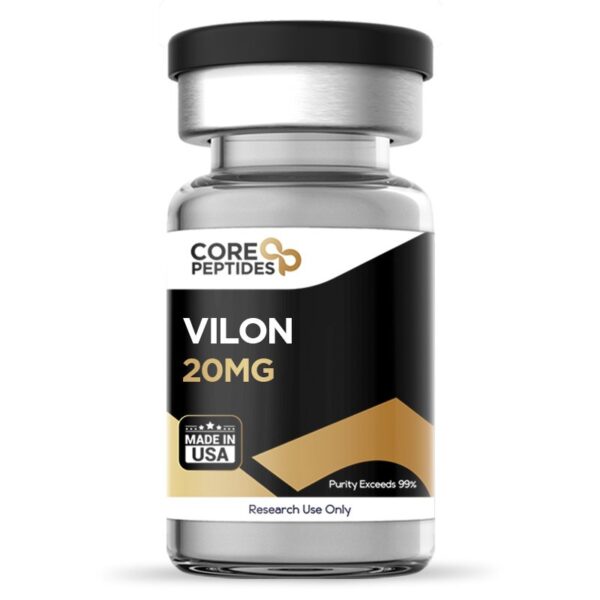
Vilon (20MG)
CHF 66.60
Vilon is a synthetic dipeptide bioregulator with the amino acid sequence Lys-Glu (KE), developed within the Khavinson peptide research program at the St. Petersburg Institute of Bioregulation and Gerontology. Researchers investigate Vilon for its effects on chromatin structure, gene expression modulation, and immune function through proposed interactions with DNA and histone proteins. Studies have explored its potential relevance to T-cell differentiation, immunomodulation, geroprotection, and lifespan extension in preclinical models. Available for laboratory research purposes only. Buy Vilon in Switzerland from Core Peptides, a trusted research peptide supplier.
What Is Vilon?
Vilon is a synthetic dipeptide bioregulator with the amino acid sequence Lysine-Glutamic Acid (Lys-Glu, abbreviated KE). It belongs to the Khavinson peptide series—a family of short-chain peptides developed through research on tissue-specific bioregulators at the St. Petersburg Institute of Bioregulation and Gerontology. Researchers originally identified Vilon from thymic tissue extracts and designed it as a synthetic analog for investigating immune function, chromatin regulation, and cellular regeneration.
As a dipeptide—a peptide composed of exactly two amino acids—Vilon has attracted research interest for its proposed ability to penetrate cellular and nuclear membranes to interact directly with DNA and histone proteins, thereby modulating gene expression through epigenetic mechanisms. Researchers classify Vilon as a tissue-specific bioregulator targeting the thymus and immune system, meaning it may influence cellular processes through chromatin-level gene regulation rather than through classical receptor-mediated signaling. For those looking to buy Vilon in Switzerland, Core Peptides offers high-quality research-grade material for laboratory applications.
Vilon Research Overview
Vilon represents a well-characterized peptide bioregulator within the Khavinson research program, specifically designated as an immunomodulatory bioregulator. The peptide’s design a simple dipeptide sequence of lysine and glutamic acid—belies its proposed biological activity. Researchers have investigated Vilon primarily for its effects on thymic-derived and immune experimental systems, with implications for understanding T-cell differentiation, immune function, chromatin regulation, and age-related immune decline.
Research interest in Vilon centers on its ability to modulate chromatin structure and gene expression in immune cells. Studies have demonstrated that Vilon induces deheterochromatinization the unrolling of condensed chromatin thereby reactivating genes that may become silenced during aging. Specifically, Vilon activates ribosomal genes and releases genes repressed due to age-related chromatin condensation. Consequently, Vilon has generated significant interest as a research tool for investigating immunomodulation, epigenetic regulation, and age-related cellular changes.
When researchers choose to buy Vilon in Switzerland for laboratory studies, they gain access to a compound that may help elucidate mechanisms of chromatin remodeling, gene expression regulation, and immune function at the molecular level.
How Does Vilon Work?
Vilon exerts its proposed biological effects through multiple interconnected pathways, including chromatin remodeling, DNA interaction, gene expression modulation, and immune regulation. The peptide’s mechanism involves several well-characterized steps.
Chromatin Remodeling and Deheterochromatinization
Vilon’s primary proposed mechanism involves the induction of deheterochromatinization the unrolling and reactivation of condensed chromatin. Research has shown that Vilon induces unrolling of total heterochromatin, activates synthetic processes caused by the reactivation of ribosomal genes as a result of deheterochromatinization of nucleolus organizer regions, and releases genes repressed due to the condensation of euchromatic regions forming facultative heterochromatin.
This chromatin remodeling activity is particularly significant in aging research, as age-related heterochromatinization is associated with the silencing of genes essential for cellular function. Vilon’s ability to reverse this process may have implications for understanding cellular rejuvenation and age-related gene expression changes.
DNA Binding and Gene Expression Modulation
Research suggests that Vilon can interact with specific DNA sequences. Studies have shown that the KE peptide (Lys-Glu, Vilon) can interact with the GCGG sequence of double-stranded DNA in the classical B-form and with the GGGC sequence of the curved dsDNA nucleosome. This DNA-binding capability supports the proposed mechanism of direct nuclear interaction and gene expression modulation.
Furthermore, Vilon regulates the expression of genes involved in immune function and cellular aging. Microarray studies have identified 36 genes modulated by Vilon in thymic cells, including immune function regulators, cell cycle genes, and anti-apoptotic factors. The peptide has also been shown to regulate SIRT1, PARP1, and PARP2 gene expression and protein synthesis in human mesenchymal stem cells, demonstrating its effects on aging-related pathways.
Immune System Modulation
Vilon has well-documented immunomodulatory effects, including oncostatic and geroprotective properties. Research has demonstrated that Vilon stimulates cellular immunity and promotes T-cell differentiation. Studies have shown that Vilon influences the differentiation of CD4+ T-helper cells and CD5+ cells, supporting its role as an immunomodulator.
The peptide has also been shown to inhibit apoptosis in immune cells, with more pronounced antiapoptotic activity compared to other bioregulators. Additionally, Vilon has been found to modulate STAT1 and ERK1/2 phosphorylation in the THP-1 human monocyte line, indicating its effects on inflammatory and immune signaling pathways.
Geroprotective and Lifespan Extension Effects
Vilon has demonstrated geroprotective effects in preclinical studies. Research has shown that Vilon inhibits the generation of reactive oxygen species in mitochondria, contributing to its antioxidant and anti-aging properties. In combination with Epithalon, Vilon extended the mean lifespan by 31% in mice and 28% in rats, while reducing tumor incidence by 2.6-fold.
Researchers who buy Vilon in Switzerland for research purposes can investigate these mechanisms across diverse experimental models of immunology, epigenetics, and aging research.
Why Is Vilon Studied?
Researchers study Vilon primarily for its potential relevance to immunomodulation, chromatin regulation, gene expression, and age-related immune decline. The peptide’s ability to induce chromatin deheterochromatinization, modulate gene expression, and support immune function makes it a valuable tool for understanding the molecular basis of immune system regulation and epigenetic mechanisms.
Vilon has been investigated in the context of thymic function and immune aging. The peptide is specifically designed to support thymus function, with research indicating potential applications for immune restoration and T-cell differentiation. Studies have explored its effects on chromatin structure, gene expression, and immune cell function in various experimental models.
Moreover, researchers study Vilon in the context of age-related immune decline and immunosenescence. As thymic involution and immune function naturally decline with age, understanding mechanisms that support immune homeostasis has become increasingly important. Vilon represents one well-documented avenue of research inquiry in this area.
Researchers who buy Vilon in Switzerland from Core Peptides can incorporate this peptide into their studies on immunomodulation, chromatin regulation, gene expression, and age-related immune research.
Vilon Research Areas
| Research Area | Description |
|---|---|
| Chromatin Remodeling | Investigating Vilon’s induction of deheterochromatinization and gene reactivation |
| Immunomodulation | Studying Vilon’s effects on T-cell differentiation and immune function |
| Gene Expression Modulation | Exploring Vilon’s DNA binding and regulation of immune and aging-related genes |
| Epigenetic Regulation | Examining Vilon’s proposed epigenetic mechanisms of gene expression modulation |
| Thymic Function | Investigating Vilon’s effects on thymus function and T-cell development |
| Geroprotection | Preclinical research into Vilon’s anti-aging and lifespan extension effects |
| Antioxidant Research | Studying Vilon’s inhibition of reactive oxygen species in mitochondria |
| Anti-Apoptotic Research | Exploring Vilon’s inhibition of apoptosis in immune cells |
Scientific Research on Vilon
Researchers have conducted scientific studies on Vilon in both in vitro and in vivo settings, deriving evidence from cell cultures, preclinical models, and clinical research. The peptide originates from the Khavinson cytogen research program, which has investigated tissue-specific peptide bioregulators for several decades.
In Vitro Evidence
In vitro studies using lymphocyte cultures from elderly donors have demonstrated that Vilon induces deheterochromatinization, activating ribosomal genes and releasing genes repressed due to age-related chromatin condensation. Research has shown that Vilon modulates the expression of 36 genes in thymic cells, including immune function regulators, cell cycle genes, and anti-apoptotic factors.
Furthermore, studies have demonstrated that Vilon regulates SIRT1, PARP1, and PARP2 gene expression and protein synthesis in human mesenchymal stem cells, indicating its effects on aging-related pathways. The KE peptide has been shown to interact with specific DNA sequences (GCGG and GGGC), supporting its proposed mechanism of direct nuclear interaction.
Preclinical Studies
In animal models, researchers have investigated Vilon’s effects on immune function, aging, and carcinogenesis. Studies have demonstrated that Vilon inhibits the development of induced urinary bladder tumors in rats, reducing the incidence of preneoplastic and early neoplastic changes by 2-fold. Vilon has also been shown to significantly decrease serum concentration of transforming growth factor-beta(1) and permeability of mesenteric microvessels in rats with chronic renal failure.
Research has also explored Vilon’s effects on digestive enzyme activity during aging, with results indicating that Vilon produces positive effects on digestive enzyme activity in aging rats. In Drosophila melanogaster, Vilon inhibited the generation of reactive oxygen species in mitochondria, demonstrating its antioxidant properties.
In lifespan studies, Vilon in combination with Epithalon extended the mean lifespan by 31% in mice and 28% in rats, while reducing tumor incidence by 2.6-fold. Vilon has also been shown to increase the survival of mice bearing transplanted carcinomas when administered at 1 mg/kg.
Human Research
Vilon has been investigated in human clinical research, primarily in the context of immune support and cancer treatment. Clinical studies have explored the application of Vilon as an immunomodulator in the complex treatment of elderly cancer patients, with preliminary results suggesting that Vilon may increase 2-year survival rates.
Nevertheless, researchers should note that Vilon is supplied for laboratory research purposes only. Scientists who buy Vilon in Switzerland should remain aware of these evidence considerations.
Vilon Compared With Related Peptides
| Peptide | Relationship to Vilon | Key Differences |
|---|---|---|
| Thymogen (EW) | Both are Khavinson bioregulators targeting the thymus | Thymogen is the dipeptide Glu-Trp, often combined with Vilon; Vilon is Lys-Glu (KE) |
| Epithalon (AEDG) | Both are Khavinson bioregulators with geroprotective effects | Epithalon is a tetrapeptide targeting the pineal gland; Vilon is a dipeptide targeting the thymus |
| Vesugen (KED) | Shares the N-terminal two residues of Vilon | Vesugen (Lys-Glu-Asp) targets vascular endothelium; Vilon (Lys-Glu) targets the thymus |
| Prostamax (KEDP) | Shares the N-terminal two residues of Vilon | Prostamax (KEDP) targets prostate tissue; Vilon (KE) targets the thymus |
| Cortagen | Both are Khavinson bioregulators | Cortagen targets brain cortex; Vilon targets the thymus |
Research Applications
Researchers utilize Vilon in a variety of laboratory research applications, primarily in the fields of immunology, epigenetics, and aging research. Key research applications include:
- Chromatin Remodeling Studies: Investigating Vilon’s induction of deheterochromatinization and gene reactivation
- Immunomodulation Research: Studying Vilon’s effects on T-cell differentiation and immune function
- Gene Expression Studies: Exploring Vilon’s DNA binding and regulation of immune and aging-related genes
- Epigenetic Regulation Research: Examining Vilon’s proposed epigenetic mechanisms of gene expression modulation
- Thymic Function Studies: Investigating Vilon’s effects on thymus function and T-cell development
- Geroprotection Research: Preclinical research into Vilon’s anti-aging and lifespan extension effects
- Antioxidant Research: Studying Vilon’s inhibition of reactive oxygen species in mitochondria
- Anti-Apoptotic Research: Exploring Vilon’s inhibition of apoptosis in immune cells
Researchers who buy Vilon in Switzerland can incorporate this peptide into their experimental protocols across these diverse research areas.
Vilon Product Specifications
| Specification | Detail |
|---|---|
| Product Name | Vilon (Lys-Glu dipeptide) |
| Amount | 20mg |
| Form | Lyophilized powder |
| Sequence (One-Letter) | KE |
| Sequence (Three-Letter) | Lys-Glu |
| Molecular Formula | C11H21N3O5 |
| Molecular Weight | Approximately 275.30 g/mol |
| CAS Number | 45234-02-4 |
| ChEBI ID | CHEBI:74557 |
| Synonyms | KE, Lys-Glu, Lysylglutamic acid, L-Lys-L-Glu, KE-2, Thymic dipeptide KE |
| Designation | Vilon (Khavinson cytogen) |
| Purity | >99% (HPLC) |
| Research Category | Cellular Research & Signaling |
| Storage | Store desiccated at -20°C, protected from light |
How to Evaluate Vilon Quality
When sourcing Vilon for research purposes, researchers should consider several quality indicators. A reliable Vilon peptide supplier should provide:
- Identity Confirmation: Analytical verification that the peptide matches the expected sequence (Lys-Glu, KE) and molecular weight (approximately 275.30 g/mol)
- Purity Analysis: Documentation of purity through methods such as HPLC – research grade typically provides >99% purity
- Batch Information: Clear lot numbers and batch traceability
- Certificate of Analysis (CoA): Documentation of analytical testing results
- Proper Labeling: Accurate product identification and storage instructions
- Appearance: White to off-white lyophilized powder
- Solubility: Soluble in water and buffered aqueous solutions
Researchers looking to buy Vilon in Switzerland should seek suppliers who provide comprehensive documentation and quality assurance. Core Peptides remains committed to supporting research with properly documented products.
Understanding the Certificate of Analysis
A Certificate of Analysis (CoA) provides analytical data for a specific batch of a research peptide. For Vilon research, a CoA typically includes:
- Identity Confirmation: Mass spectrometry or other analytical methods confirming the peptide’s identity
- Purity Assessment: HPLC chromatograms showing the purity of the peptide
- Batch/Lot Information: Unique identifiers for traceability
- Analytical Methods: Description of the testing methods used
Importantly, researchers should understand that a CoA demonstrates the chemical identity and purity of a peptide but does not establish safety, efficacy, therapeutic effectiveness, or suitability for human use. The CoA serves as a quality control document for research purposes only.
Storage and Stability
Proper storage of research peptides is essential for maintaining their integrity and stability. For Vilon, researchers should refer to the product documentation provided with their order for specific storage recommendations.
General best practices for Vilon storage include keeping the lyophilized peptide desiccated, protected from light, and stored at -20°C or below. The peptide is soluble in water and buffered aqueous solutions. For specific temperature requirements and reconstitution protocols, consult the applicable product documentation or contact Core Peptides for the applicable storage specifications.
Research Considerations
Researchers incorporating Vilon into their studies should be aware of several important considerations:
- Evidence Limitations: Vilon has limited human clinical evidence. While the peptide has been investigated in clinical research for immune support and cancer treatment, evidence is primarily derived from preclinical models.
- Experimental Status: Researchers consider Vilon a well-characterized compound within the Khavinson series, but findings should be interpreted within the context of ongoing research.
- Model Differences: Results from cell cultures, organotypic explant cultures, and preclinical models may not translate directly to complex biological outcomes.
- Regulatory Status: Vilon has not achieved pharmaceutical registration in Western countries and is intended for laboratory research use only.
- Quality Considerations: Researchers should verify the quality and identity of their Vilon through appropriate analytical methods.
- Mechanistic Context: Vilon’s proposed mechanisms involve chromatin deheterochromatinization, DNA binding, gene expression modulation, and immune regulation. Researchers should consider appropriate experimental approaches to investigate these pathways.
- Thymic Specificity: Vilon demonstrates tissue-specific effects on thymic-derived experimental systems. Researchers should consider this specificity when designing experiments.
Researchers who buy Vilon in Switzerland should ensure their studies include appropriate controls and interpret findings with scientific rigor.
Frequently Asked Questions About Vilon
What is Vilon?
Vilon is a synthetic dipeptide bioregulator with the amino acid sequence Lysine-Glutamic Acid (Lys-Glu, KE), developed within the Khavinson peptide research program as a thymus-targeted bioregulator.
What is Vilon researched for?
Researchers primarily investigate Vilon for its effects on chromatin remodeling, immunomodulation, gene expression regulation, T-cell differentiation, and age-related immune decline.
What is the amino acid sequence of Vilon?
The amino acid sequence of Vilon is Lys-Glu (KE).
What is the molecular weight of Vilon?
The molecular weight of Vilon is approximately 275.30 g/mol.
What is the molecular formula of Vilon?
The molecular formula of Vilon is C11H21N3O5.
What is the CAS number for Vilon?
The CAS number for Vilon is 45234-02-4.
What is the proposed mechanism of Vilon?
Vilon is proposed to penetrate cellular and nuclear membranes to interact directly with DNA, inducing deheterochromatinization (chromatin unrolling) and modulating gene expression through epigenetic mechanisms. It also modulates immune function and regulates SIRT1, PARP1, and PARP2 expression.
Does Vilon have human clinical evidence?
Vilon has been investigated in human clinical research for immune support and cancer treatment, but evidence is primarily derived from preclinical models.
Can I buy Vilon in Switzerland?
Yes, researchers can buy Vilon in Switzerland from Core Peptides for laboratory research purposes.
What is the primary research category for Vilon?
Vilon belongs to the Cellular Research & Signaling category, with secondary relevance to Anti-Aging & Longevity research.
What related peptides are studied alongside Vilon?
Related peptides from the Khavinson series include Thymogen (EW), Epithalon (AEDG), Vesugen (KED), Prostamax (KEDP), and Cortagen.
What is the purity of Core Peptides’ Vilon?
Core Peptides provides Vilon with a purity of >99% as verified by HPLC analysis.
Is Vilon soluble in water?
Yes, Vilon is soluble in water and buffered aqueous solutions.
Related Research Peptides
Researchers interested in Vilon may also find the following related peptides relevant to their work:
- Thymogen (Glu-Trp) – A Khavinson dipeptide targeting the thymus; often combined with Vilon for immune research
- Epithalon (Ala-Glu-Asp-Gly) – A Khavinson tetrapeptide targeting the pineal gland, studied for geroprotection
- Vesugen (Lys-Glu-Asp) – A Khavinson tripeptide targeting vascular endothelium; shares the N-terminal two residues of Vilon
- Prostamax (Lys-Glu-Asp-Pro) – A Khavinson tetrapeptide targeting prostate tissue; shares the N-terminal two residues of Vilon
- Cortagen – A Khavinson bioregulator targeting brain cortex
For a comprehensive selection of research peptides in Switzerland, explore the Core Peptides catalog.
Explore Cellular Research & Signaling Peptides
Vilon is part of our Cellular Research & Signaling category, which features a range of research peptides investigated for their effects on cellular function, gene expression, and signaling pathways. Browse our selection to find the right peptides for your laboratory research.
Explore Related Research Categories
Researchers may also find the following related categories relevant to Vilon research:
- Anti-Aging & Longevity – Peptides investigated for age-related immune research applications
- Cognitive & Nootropic Peptides – Peptides studied for neurological and cognitive research
- Healing & Regeneration Peptides – Peptides investigated for tissue repair and regeneration
Further Research
Researchers interested in learning more about Vilon and related peptides should consult the primary scientific literature. Key areas of investigation include chromatin remodeling, immunomodulation, gene expression regulation, and age-related immune decline. The PubMed database is an excellent resource for accessing peer-reviewed research articles on these topics.
Research Disclaimer
Core Peptides supplies Vilon as a research peptide for laboratory research purposes only. All information provided is for educational and scientific reference purposes only and does not constitute medical advice. Researchers are responsible for ensuring compliance with all applicable laws and regulations governing the use of research peptides in their jurisdiction, including Switzerland.
Soyez le premier à laisser votre avis sur “Vilon (20MG)”
Vous devez être connecté pour publier un avis.
Produits similaires
Anti-Aging & Longevity Peptides
Anti-Aging & Longevity Peptides
Anti-Aging & Longevity Peptides
Immunity & Inflammation Peptides
Anti-Aging & Longevity Peptides
Anti-Aging & Longevity Peptides
Anti-Aging & Longevity Peptides
Immunity & Inflammation Peptides
Avis
Il n’y a pas encore d’avis.