
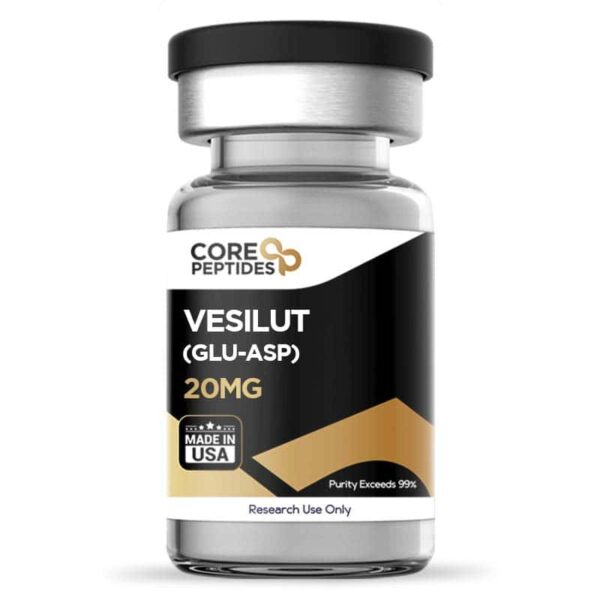
Vesilut (20MG)
CHF 57.60
Vesilut (Vesilute) is a synthetic dipeptide bioregulator with the amino acid sequence Glu-Asp (ED), developed within the Khavinson peptide research program at the St. Petersburg Institute of Bioregulation and Gerontology. Researchers investigate Vesilut for its effects on bladder wall function, urinary tract regulation, and smooth muscle activity through proposed chromatin-level interactions with DNA and gene expression modulation. Studies have explored its potential relevance to urogenital tissue homeostasis, prostate health, and age-related urinary function. Available for laboratory research purposes only. Buy Vesilut in Switzerland from Core Peptides, a trusted research peptide supplier.
What Is Vesilut?
Vesilut (also known as Vesilute) is a synthetic dipeptide bioregulator with the amino acid sequence Glutamic Acid-Aspartic Acid (Glu-Asp, abbreviated ED). It belongs to the Khavinson peptide series a family of short-chain peptides developed through research on tissue-specific bioregulators at the St. Petersburg Institute of Bioregulation and Gerontology. Researchers originally identified Vesilut from bladder tissue extracts and designed it as a synthetic analog for investigating urogenital tissue function and regulation.
As a dipeptide a peptide composed of exactly two amino acids Vesilut has attracted research interest for its proposed ability to penetrate cellular and nuclear membranes to interact directly with DNA and histone proteins, thereby modulating gene expression through epigenetic mechanisms. Researchers classify Vesilut as a tissue-specific bioregulator, meaning it may influence cellular processes through chromatin-level gene regulation rather than through classical receptor-mediated signaling. For those looking to buy Vesilut in Switzerland, Core Peptides offers high-quality research-grade material for laboratory applications.
Vesilut Research Overview
Vesilut represents a well-characterized peptide bioregulator within the Khavinson research program, specifically designated as a bladder and urinary tract bioregulator. The peptide’s design a simple dipeptide sequence of glutamic acid and aspartic acid belies its proposed biological activity. Researchers have investigated Vesilut primarily for its tissue-specific effects on urogenital-derived experimental systems, with implications for understanding bladder wall function, smooth muscle regulation, and age-related urinary changes.
Research interest in Vesilut centers on its ability to modulate gene expression and support tissue homeostasis in the urogenital system. Studies have demonstrated that Vesilut penetrates cell nuclei and interacts with DNA, potentially modulating gene expression linked to urogenital tissue function. Specifically, Vesilut may influence the expression of genes involved in smooth muscle contraction, tissue repair, and cellular regeneration in the bladder wall and prostate.
When researchers choose to buy Vesilut in Switzerland for laboratory studies, they gain access to a compound that may help elucidate mechanisms of urogenital tissue bioregulation, smooth muscle function, and gene expression modulation at the molecular level.
How Does Vesilut Work?
Vesilut exerts its proposed biological effects through multiple interconnected pathways, including chromatin-level gene regulation, DNA interaction, and tissue-specific gene modulation. The peptide’s mechanism involves several well-characterized steps.
DNA Binding and Epigenetic Regulation
Vesilut’s primary proposed mechanism involves penetration of cellular and nuclear membranes to interact directly with DNA. Research suggests that Vesilut may bind to specific DNA sequences, particularly ATTT sequences, potentially influencing chromatin condensation states and gene expression patterns.
Tissue-Specific Gene Regulation
Vesilut is studied as a bladder-directed short-peptide probe, used to examine how a minimal defined peptide signal influences transcriptional, proteomic, and proliferation endpoints in urogenital-derived cell populations. In bladder tissue, this is hypothesized to involve regulation of genes involved in smooth muscle function, tissue repair, and cellular regeneration.
Smooth Muscle and Microcirculation Support
Research indicates that Vesilut may regulate smooth muscle contraction and relaxation in the bladder wall, enhance microcirculation and blood flow in pelvic tissues including the prostate, and support cellular regeneration and tissue repair in the urinary tract. The peptide may also reduce hyperemia and inflammation-related dysfunction through bioregulation pathways characteristic of Khavinson peptides.
Researchers who buy Vesilut in Switzerland for research purposes can investigate these mechanisms across diverse experimental models of urogenital tissue bioregulation, smooth muscle function, and gene expression modulation.
Why Is Vesilut Studied?
Researchers study Vesilut primarily for its potential relevance to urogenital tissue biology, bladder function, smooth muscle regulation, and age-related urinary changes. The peptide’s ability to modulate gene expression and support tissue homeostasis makes it a valuable tool for understanding the molecular basis of tissue-specific bioregulation and epigenetic mechanisms.
Vesilut has been investigated in the context of bladder and urinary tract function. The peptide is specifically designed to support bladder and urinary tract function, with research indicating potential applications for prostate health in men. Studies have explored its effects on smooth muscle function, tissue blood flow, and cellular regeneration in urogenital tissues.
Moreover, researchers study Vesilut in the context of age-related urogenital changes. As bladder and urinary tract function naturally changes with age, understanding mechanisms that support tissue homeostasis has become increasingly important. Vesilut represents one well-documented avenue of research inquiry in this area.
Researchers who buy Vesilut in Switzerland from Core Peptides can incorporate this peptide into their studies on urogenital tissue bioregulation, smooth muscle function, gene expression modulation, and age-related urinary research.
Vesilut Research Areas
| Research Area | Description |
|---|---|
| Bladder Wall Function | Investigating Vesilut’s effects on bladder epithelium and detrusor muscle regulation |
| Urinary Tract Regulation | Studying Vesilut’s role in urinary tract tissue homeostasis and function |
| Smooth Muscle Research | Examining Vesilut’s effects on smooth muscle contraction and relaxation |
| DNA Binding and Epigenetics | Exploring Vesilut’s interaction with DNA and modulation of gene expression |
| Prostate Health Research | Investigating Vesilut’s effects on prostate tissue function in preclinical models |
| Microcirculation Enhancement | Studying Vesilut’s effects on pelvic tissue blood flow and microcirculation |
| Cellular Regeneration | Preclinical research into Vesilut’s potential to support tissue repair and regeneration |
| Age-Related Urogenital Research | Exploring Vesilut’s potential relevance to age-related urinary function changes |
Scientific Research on Vesilut
Researchers have conducted scientific studies on Vesilut in both in vitro and preclinical settings, deriving evidence from cell cultures, organotypic explant cultures, and preclinical models. The peptide originates from the Khavinson research program, which has investigated tissue-specific peptide bioregulators for several decades.
In Vitro Evidence
In vitro studies using fluorescence-labeled peptides have demonstrated that Vesilut penetrates cell nuclei and interacts with DNA. Research has shown that Vesilut may bind to specific DNA sequences, with studies indicating that it may interact with ATTT sequences.
Furthermore, research has demonstrated that Vesilut interacts with chromatin and may modulate gene expression linked to urogenital tissue function. The peptide’s ability to penetrate both cell and nuclear membranes supports its proposed mechanism of direct nuclear interaction.
Epigenetic Studies
Research by Khavinson and colleagues suggests that peptides like Vesilut may have potential in activating heterochromatin and heterochromatinized regions of cell chromosomes in aged cellular models. It is posited that this synthetic short peptide may induce the activation of ribosomal genes by promoting the decondensation of densely packed chromatin fibrils. Consequently, this process potentially facilitates the release of genes that may have been previously repressed due to cellular age-associated heterochromatinization.
Specifically, Vesilute-like peptides in cellular assays seemingly lead to the decondensation of pericentromeric structural chromatin in chromosome 1, while possibly inducing structural alterations in chromosome 9 as well. Such changes suggest a potential selective capacity to decrease the size of specific structural heterochromatin blocks.
Human Research
Vesilut has limited human clinical evidence. No published clinical studies were found on PubMed for Vesilut. Evidence is limited to preclinical research or theoretical mechanisms. The peptide has not achieved pharmaceutical registration in Western countries and is primarily available as a research compound. No clinical trials are registered on ClinicalTrials.gov, and no Western regulatory agency has evaluated Vesilut for any therapeutic indication.
Nevertheless, researchers should note that Vesilut is supplied for laboratory research purposes only. Scientists who buy Vesilut in Switzerland should remain aware of these evidence considerations.
Vesilut Compared With Related Peptides
| Peptide | Relationship to Vesilut | Key Differences |
|---|---|---|
| Vesugen (KED) | Both are Khavinson bioregulators; Vesugen is a tripeptide | Vesugen (Lys-Glu-Asp) targets vascular endothelium; Vesilut (Glu-Asp) targets bladder and urinary tract |
| Prostamax (KEDP) | Both are Khavinson bioregulators | Prostamax targets prostate tissue; Vesilut targets bladder and urinary tract |
| Libidon | Both are Khavinson bioregulators | Libidon targets prostate directly; Vesilut supports bladder function in the context of prostate health |
| Vilon (KE) | Both are Khavinson bioregulators | Vilon is a dipeptide (Lys-Glu) targeting thymus/immune system; Vesilut (Glu-Asp) targets urogenital tissue |
| Livagen (KEDA) | Both are Khavinson bioregulators | Livagen targets liver tissue; Vesilut targets bladder and urinary tract |
Research Applications
Researchers utilize Vesilut in a variety of laboratory research applications, primarily in the fields of urogenital biology, smooth muscle research, and tissue-specific gene regulation. Key research applications include:
- Bladder Wall Studies: Investigating Vesilut’s effects on bladder epithelium and detrusor muscle regulation
- Urinary Tract Research: Studying Vesilut’s role in urinary tract tissue homeostasis and function
- Smooth Muscle Studies: Examining Vesilut’s effects on smooth muscle contraction and relaxation
- DNA Binding and Epigenetic Research: Exploring Vesilut’s interaction with DNA and modulation of gene expression
- Prostate Health Studies: Investigating Vesilut’s effects on prostate tissue function in preclinical models
- Microcirculation Research: Studying Vesilut’s effects on pelvic tissue blood flow and microcirculation
- Cellular Regeneration Studies: Preclinical research into Vesilut’s potential to support tissue repair and regeneration
- Age-Related Urogenital Research: Exploring Vesilut’s potential relevance to age-related urinary function changes
Researchers who buy Vesilut in Switzerland can incorporate this peptide into their experimental protocols across these diverse research areas.
Vesilut Product Specifications
| Specification | Detail |
|---|---|
| Product Name | Vesilut (Vesilute, Glu-Asp peptide) |
| Amount | 20mg |
| Form | Lyophilized powder |
| Sequence (One-Letter) | ED |
| Sequence (Three-Letter) | Glu-Asp |
| Molecular Formula | C9H14N2O7 |
| Molecular Weight | Approximately 262.22 g/mol |
| CAS Number | Not verified / not provided |
| Synonyms | Vesilute, Glu-Asp, ED dipeptide, L-α-Glutamyl-L-aspartic acid |
| Purity | >99% (HPLC) |
| Research Category | Cellular Research & Signaling |
| Storage | Store desiccated at -20°C, protected from light |
How to Evaluate Vesilut Quality
When sourcing Vesilut for research purposes, researchers should consider several quality indicators. A reliable Vesilut peptide supplier should provide:
- Identity Confirmation: Analytical verification that the peptide matches the expected sequence (Glu-Asp, ED) and molecular weight (approximately 262.22 g/mol)
- Purity Analysis: Documentation of purity through methods such as HPLC – research grade typically provides >99% purity
- Batch Information: Clear lot numbers and batch traceability
- Certificate of Analysis (CoA): Documentation of analytical testing results
- Proper Labeling: Accurate product identification and storage instructions
- Appearance: White to off-white lyophilized powder
- Solubility: Soluble in water and buffered aqueous solutions
Researchers looking to buy Vesilut in Switzerland should seek suppliers who provide comprehensive documentation and quality assurance. Core Peptides remains committed to supporting research with properly documented products.
Understanding the Certificate of Analysis
A Certificate of Analysis (CoA) provides analytical data for a specific batch of a research peptide. For Vesilut research, a CoA typically includes:
- Identity Confirmation: Mass spectrometry or other analytical methods confirming the peptide’s identity
- Purity Assessment: HPLC chromatograms showing the purity of the peptide
- Batch/Lot Information: Unique identifiers for traceability
- Analytical Methods: Description of the testing methods used
Importantly, researchers should understand that a CoA demonstrates the chemical identity and purity of a peptide but does not establish safety, efficacy, therapeutic effectiveness, or suitability for human use. The CoA serves as a quality control document for research purposes only.
Storage and Stability
Proper storage of research peptides is essential for maintaining their integrity and stability. For Vesilut, researchers should refer to the product documentation provided with their order for specific storage recommendations.
General best practices for Vesilut storage include keeping the lyophilized peptide desiccated, protected from light, and stored at -20°C or below. The peptide is soluble in water and buffered aqueous solutions. For specific temperature requirements and reconstitution protocols, consult the applicable product documentation or contact Core Peptides for the applicable storage specifications.
Research Considerations
Researchers incorporating Vesilut into their studies should be aware of several important considerations:
- Evidence Limitations: Vesilut has limited human clinical evidence. No published clinical studies were found on PubMed for Vesilut. Evidence is limited to preclinical research or theoretical mechanisms.
- Experimental Status: Researchers consider Vesilut an experimental compound. Therefore, findings should be interpreted within the context of early-stage research.
- Model Differences: Results from cell cultures, organotypic explant cultures, and preclinical models may not translate directly to complex biological outcomes.
- Regulatory Status: Vesilut has not achieved pharmaceutical registration in Western countries and is intended for laboratory research use only.
- Quality Considerations: Researchers should verify the quality and identity of their Vesilut through appropriate analytical methods.
- Mechanistic Context: Vesilut’s proposed mechanisms involve chromatin-level gene regulation, DNA interaction, and tissue-specific gene modulation. Researchers should consider appropriate experimental approaches to investigate these pathways.
- Tissue Specificity: Vesilut demonstrates tissue-specific effects on urogenital-derived experimental systems. Researchers should consider this specificity when designing experiments.
Researchers who buy Vesilut in Switzerland should ensure their studies include appropriate controls and interpret findings with scientific rigor.
Frequently Asked Questions About Vesilut
What is Vesilut?
Vesilut (Vesilute) is a synthetic dipeptide bioregulator with the amino acid sequence Glutamic Acid-Aspartic Acid (Glu-Asp, ED), developed within the Khavinson peptide research program as a bladder and urinary tract-targeted bioregulator.
What is Vesilut researched for?
Researchers primarily investigate Vesilut for its effects on bladder wall function, urinary tract regulation, smooth muscle activity, gene expression modulation, and age-related urogenital changes.
What is the amino acid sequence of Vesilut?
The amino acid sequence of Vesilut is Glu-Asp (ED).
What is the molecular weight of Vesilut?
The molecular weight of Vesilut is approximately 262.22 g/mol.
What is the proposed mechanism of Vesilut?
Vesilut is proposed to penetrate cellular and nuclear membranes to interact directly with DNA, thereby modulating gene expression through epigenetic mechanisms at the chromatin level.
Does Vesilut have human clinical evidence?
Vesilut has limited human clinical evidence. No published clinical studies were found on PubMed for Vesilut.
Can I buy Vesilut in Switzerland?
Yes, researchers can buy Vesilut in Switzerland from Core Peptides for laboratory research purposes.
What is the primary research category for Vesilut?
Vesilut belongs to the Cellular Research & Signaling category, with secondary relevance to Anti-Aging & Longevity research.
What related peptides are studied alongside Vesilut?
Related peptides from the Khavinson series include Vesugen (KED), Prostamax (KEDP), Libidon, Vilon (KE), and Livagen (KEDA).
What is the purity of Core Peptides’ Vesilut?
Core Peptides provides Vesilut with a purity of >99% as verified by HPLC analysis.
Is Vesilut soluble in water?
Yes, Vesilut is soluble in water and buffered aqueous solutions.
What distinguishes Vesilut from Vesugen?
Vesilut (Glu-Asp) targets bladder and urinary tract, while Vesugen (Lys-Glu-Asp) targets vascular endothelium.
Related Research Peptides
Researchers interested in Vesilut may also find the following related peptides relevant to their work:
- Vesugen – A Khavinson tripeptide (KED) targeting vascular endothelium
- Prostamax – A Khavinson tetrapeptide (KEDP) targeting prostate tissue
- Libidon – A Khavinson peptide targeting prostate health
- Vilon – A Khavinson dipeptide (KE) targeting thymus/immune system
- Livagen – A Khavinson tetrapeptide (KEDA) targeting liver tissue
For a comprehensive selection of research peptides in Switzerland, explore the Core Peptides catalog.
Explore Cellular Research & Signaling Peptides
Vesilut is part of our Cellular Research & Signaling category, which features a range of research peptides investigated for their effects on cellular function, gene expression, and signaling pathways. Browse our selection to find the right peptides for your laboratory research.
Explore Related Research Categories
Researchers may also find the following related categories relevant to Vesilut research:
- Anti-Aging & Longevity – Peptides investigated for age-related cellular research applications
- Cognitive & Nootropic Peptides – Peptides studied for neurological and cognitive research
- Healing & Regeneration Peptides – Peptides investigated for tissue repair and regeneration
Further Research
Researchers interested in learning more about Vesilut and related peptides should consult the primary scientific literature. Key areas of investigation include chromatin remodeling, urogenital tissue bioregulation, smooth muscle function, and tissue-specific gene regulation. The PubMed database is an excellent resource for accessing peer-reviewed research articles on these topics.
Research Disclaimer
Core Peptides supplies Vesilut as a research peptide for laboratory research purposes only. All information provided is for educational and scientific reference purposes only and does not constitute medical advice. Researchers are responsible for ensuring compliance with all applicable laws and regulations governing the use of research peptides in their jurisdiction, including Switzerland.
Soyez le premier à laisser votre avis sur “Vesilut (20MG)”
Vous devez être connecté pour publier un avis.
Produits similaires
Anti-Aging & Longevity Peptides
Anti-Aging & Longevity Peptides
Anti-Aging & Longevity Peptides
Anti-Aging & Longevity Peptides
Anti-Aging & Longevity Peptides
Anti-Aging & Longevity Peptides
Anti-Aging & Longevity Peptides
Anti-Aging & Longevity Peptides
Avis
Il n’y a pas encore d’avis.