
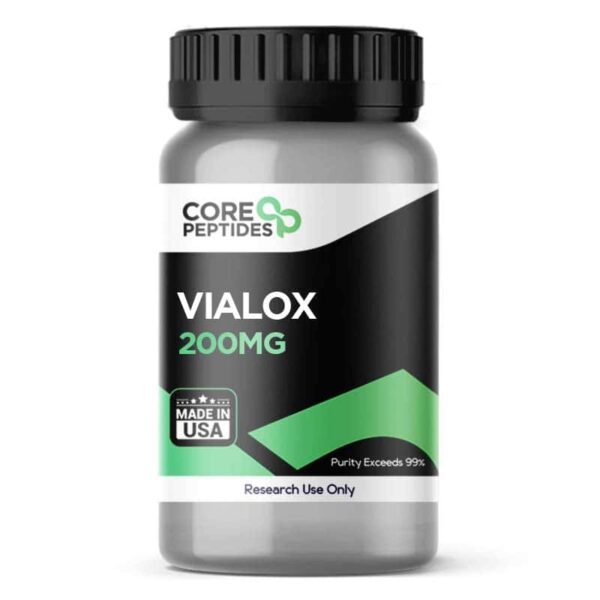
Vialox (Pentapeptide-3V) (200MG)
CHF 158.40
Vialox (Pentapeptide-3V) is a synthetic pentapeptide with the sequence Gly-Pro-Arg-Pro-Ala-NH2 (GPRPA-NH2) that mimics the neuromuscular blocking activity of Waglerin-1 from Temple Viper (Tropidolaemus wagleri) venom. Researchers investigate Vialox for its competitive antagonism of muscular nicotinic acetylcholine receptors (nAChRs) at the postsynaptic membrane blocking acetylcholine binding and preventing sodium ion influx. Studies have explored its effects on muscle contraction frequency, neuromuscular transmission, and receptor binding kinetics. Available for laboratory research purposes only. Buy Vialox in Switzerland from Core Peptides, a trusted research peptide supplier.
What Is Vialox?
Vialox, scientifically known as Pentapeptide-3V or Pentapeptide-3, is a synthetic pentapeptide with the amino acid sequence Gly-Pro-Arg-Pro-Ala-NH2 (GPRPA-NH2). It belongs to a class of biomimetic peptides designed to emulate the neuromuscular blocking activity of Waglerin-1, a peptide found in the venom of the Temple Viper (Tropidolaemus wagleri). For those looking to buy Vialox in Switzerland, Core Peptides offers high-quality research-grade material for laboratory applications.
As a pentapeptide a peptide composed of five amino acids with a C-terminal amidation Vialox features a unique structure that allows it to interact selectively with nicotinic acetylcholine receptors (nAChRs) at the postsynaptic membrane. The peptide is commonly supplied as the diacetate salt and is identified by CAS number 135679-88-8, with a molecular formula of C21H37N9O5 and a molecular weight of approximately 495.58 g/mol. Its INCI name is Pentapeptide-3.
Vialox Research Overview
Vialox has attracted research interest as a tool for investigating neuromuscular junction signaling, nicotinic acetylcholine receptor pharmacology, and synaptic transmission. The peptide’s design a synthetic mimic of the active binding motif of Waglerin-1 enables it to act as a competitive antagonist at muscular nicotinic acetylcholine receptors (nAChRs) at the postsynaptic membrane.
Research interest in Vialox centers on its ability to modulate neuromuscular transmission through competitive inhibition of acetylcholine binding. By binding to the nAChR, Vialox prevents acetylcholine from activating the receptor, thereby reducing muscle contraction frequency. This mechanism positions Vialox as a valuable compound for studying receptor-ligand interactions, neuromuscular modulation, and synaptic transmission. In vitro studies have demonstrated that Vialox can reduce muscle contraction frequency by up to 71% within one minute of application.
When researchers choose to buy Vialox in Switzerland for laboratory studies, they gain access to a compound that may help elucidate mechanisms of nAChR antagonism, neuromuscular junction physiology, and receptor pharmacology at the molecular level.
How Does Vialox Work?
Vialox exerts its biological effects through competitive antagonism of muscular nicotinic acetylcholine receptors (nAChRs) at the postsynaptic membrane. The peptide’s mechanism involves several well-characterized steps.
Nicotinic Acetylcholine Receptor Binding
Vialox acts as a competitive antagonist at the muscular nicotinic acetylcholine receptor (nAChR). Research suggests that the peptide binds to the nicotinic acetylcholine receptor at the postsynaptic membrane, competitively inhibiting acetylcholine from binding to the receptor. As the muscular nicotinic ACh receptors are competitively blocked, the ion channel remains closed, preventing the sodium ion influx that would normally trigger depolarization and subsequent muscle contraction.
Normally, acetylcholine, a neurotransmitter released from nerve endings, binds to nicotinic acetylcholine receptors to trigger sodium ion channel opening, leading to depolarization and subsequent muscle contraction. Vialox, as a non-depolarizing neuromuscular blocker, competes with acetylcholine for binding at these receptor sites. Unlike acetylcholine, Vialox does not appear to initiate receptor activity, potentially blocking signal transmission and preventing muscle contraction.
Neuromuscular Junction Modulation
Vialox is a postsynaptic peptide, meaning it acts on the receiving side of the neuromuscular junction. By occupying receptor sites at the nerve-to-muscle junction, the peptide reduces the frequency of muscle contractions. In muscle cell contraction assays, Vialox has been shown to reduce muscle contraction frequency by up to 71% within one minute of exposure, followed by a 58% reduction after two hours.
Reversible Antagonism
Unlike botulinum toxin, which enzymatically cleaves SNARE proteins and produces irreversible effects, Vialox acts as a reversible competitive antagonist of the neuromuscular postsynaptic nicotinic acetylcholine receptor. This reversible mechanism allows for the study of receptor dynamics and the recovery of function following peptide administration. The mechanism mirrors curaremimetic compounds but remains reversible in controlled laboratory conditions.
Researchers who buy Vialox in Switzerland for research purposes can investigate these mechanisms across diverse experimental models of neuromuscular transmission, receptor pharmacology, and synaptic signaling.
Why Is Vialox Studied?
Researchers study Vialox primarily for its potential relevance to nicotinic acetylcholine receptor pharmacology, neuromuscular junction physiology, and synaptic transmission. The peptide’s ability to competitively antagonize nAChR makes it a valuable tool for understanding the molecular basis of neuromuscular signaling and receptor-ligand interactions.
Vialox’s connection to the Waglerin-1 venom peptide has made it a focus of neuropharmacology and biomimetic research. The peptide represents a synthetic approach to studying the neuromuscular blocking activity of natural venom components without the toxicity of the natural compound. This enables researchers to investigate receptor binding kinetics and structure-activity relationships in a controlled laboratory setting.
Moreover, researchers study Vialox in the context of receptor pharmacology and neuromuscular modulation. The peptide’s unique postsynaptic mechanism blocking acetylcholine receptors at the muscle cell surface distinguishes it from presynaptic inhibitors such as Argireline, which target the SNARE complex. This mechanistic distinction makes Vialox a valuable reference compound for investigating nAChR antagonists and their effects on synaptic transmission.
Recent research has also explored Vialox’s potential in anticancer research. A 2026 study investigated the anticancer potential of Vialox and Leuphasyl peptides against key oncogenic targets, showing significant potential as selective anticancer agents, particularly against EGFR and PI3K pathways.
Researchers who buy Vialox in Switzerland from Core Peptides can incorporate this peptide into their studies on nAChR pharmacology, neuromuscular junction signaling, and receptor-mediated modulation of muscle contraction.
Vialox Research Areas
| Research Area | Description |
|---|---|
| Nicotinic Acetylcholine Receptor Pharmacology | Investigating Vialox’s binding affinity and competitive antagonism of nAChR |
| Neuromuscular Junction Signaling | Studying Vialox’s effects on neuromuscular transmission and muscle contraction |
| Synaptic Transmission | Examining Vialox’s modulation of neurotransmitter release and receptor activation |
| Receptor-Ligand Interactions | Exploring the molecular basis of nAChR binding and antagonism |
| Competitive Neuromuscular Blockade | Preclinical research into reversible nAChR antagonism and receptor dynamics |
| Biomimetic Peptide Research | Investigating synthetic mimics of natural venom peptides |
| Muscle Contraction Modulation | Studying Vialox’s effects on contraction frequency and amplitude |
| Anticancer Research | Exploring Vialox’s potential against EGFR and PI3K oncogenic pathways |
Scientific Research on Vialox
Researchers have conducted scientific studies on Vialox in both in vitro and preclinical settings, deriving evidence from receptor-binding assays, muscle contraction assays, and molecular docking experiments. The peptide originates from research on the Temple Viper venom peptide Waglerin-1 and represents a synthetic biomimetic approach to studying nAChR antagonism.
In Vitro Evidence
In vitro studies using receptor-binding assays have demonstrated that Vialox acts as a competitive antagonist of muscular nicotinic acetylcholine receptors (nAChRs). The peptide binds to the nAChR, inhibiting acetylcholine from binding to the receptor and preventing sodium ion influx. This mechanism has been characterized through electrophysiological and pharmacological studies.
Muscle cell contraction assays have shown that Vialox reduces contraction frequency by up to 71% within one minute of exposure, followed by a 58% reduction after two hours. In vitro co-culture models have demonstrated significant reductions in contraction frequency, supporting its classification as a functional neuromuscular modulator.
Molecular and Computational Studies
A 2025 peer-reviewed study published in the International Journal of Quantum Chemistry performed comprehensive in silico characterization of Pentapeptide-3 (Vialox). Researchers have employed quantum chemical, spectroscopic, and in silico (molecular docking, molecular dynamic, and ADME) studies to characterize the anti-aging pentapeptide.
An integrative in silico and in vitro evaluation of Vialox and Leuphasyl pentapeptides for antiaging applications demonstrated that Vialox preferentially targeted SIRT-1, underscoring its potential to modulate aging-related pathways.
Clinical Research
Research has examined the peptide’s efficacy in long-term exposure. Findings suggest a 49% reduction in wrinkle size and a 47% increase in skin consistency after 28 days of consistent exposure. However, researchers should note that the frequently cited 49% wrinkle reduction and 71% in vitro contraction inhibition data for Pentapeptide-3 (Vialox) originate from the manufacturer’s (Pentapharm/DSM) internal product dossier and have not been independently reproduced in a peer-reviewed clinical trial publication.
Nevertheless, researchers should note that Vialox is supplied for laboratory research purposes only. Scientists who buy Vialox in Switzerland should remain aware of these evidence considerations.
Vialox Compared With Related Peptides
| Peptide | Relationship to Vialox | Key Differences |
|---|---|---|
| Waglerin-1 | Natural venom peptide; Vialox is a synthetic mimic | Waglerin-1 is a 22-amino acid peptide from snake venom; Vialox is a synthetic pentapeptide with similar activity |
| Argireline (Acetyl Hexapeptide-8) | Both studied for neuromuscular modulation | Argireline targets the SNARE complex (presynaptic); Vialox targets nAChR at the postsynaptic membrane (different mechanism) |
| Syn-AKE | Both are snake venom peptide mimetics | Syn-AKE is a dipeptide (β-Ala-Pro-Dab-NHBzl); Vialox is a pentapeptide (GPRPA-NH2) with a different binding motif |
| SNAP-8 | Both are synthetic peptides for neuromodulation research | SNAP-8 inhibits SNARE complex assembly (presynaptic); Vialox is an nAChR antagonist (postsynaptic) |
| Leuphasyl (Pentapeptide-18) | Both studied for neuromodulation | Leuphasyl is an enkephalin analog targeting opioid receptors; Vialox targets nAChR |
Research Applications
Researchers utilize Vialox in a variety of laboratory research applications, primarily in the fields of neuropharmacology, receptor biology, and neuromuscular research. Key research applications include:
- Nicotinic Acetylcholine Receptor Studies: Investigating Vialox’s binding affinity and competitive antagonism of nAChR
- Neuromuscular Junction Research: Studying Vialox’s effects on neuromuscular transmission and muscle contraction
- Synaptic Transmission Studies: Examining Vialox’s modulation of neurotransmitter release and receptor activation
- Receptor-Ligand Interaction Research: Exploring the molecular basis of nAChR binding and antagonism
- Competitive Neuromuscular Blockade Studies: Preclinical research into reversible nAChR antagonism and receptor dynamics
- Biomimetic Peptide Research: Investigating synthetic mimics of natural venom peptides
- Muscle Contraction Modulation Studies: Studying Vialox’s effects on contraction frequency and amplitude
- Anticancer Research: Exploring Vialox’s potential against EGFR and PI3K oncogenic pathways
Researchers who buy Vialox in Switzerland can incorporate this peptide into their experimental protocols across these diverse research areas.
Vialox Product Specifications
| Specification | Detail |
|---|---|
| Product Name | Vialox (Pentapeptide-3V) |
| Amount | 200mg |
| Form | Lyophilized powder |
| Sequence (One-Letter) | GPRPA-NH2 |
| Sequence (Three-Letter) | Gly-Pro-Arg-Pro-Ala-NH2 |
| Molecular Formula | C21H37N9O5 |
| Molecular Weight | Approximately 495.58 g/mol |
| CAS Number | 135679-88-8 |
| INCI Name | Pentapeptide-3 |
| PubChem CID | 67073230 |
| C-Terminal Modification | Amidation (-NH2) |
| Synonyms | Vialox, Pentapeptide-3, Pentapeptide-3V |
| Source | Synthetic (Waglerin-1 mimetic) |
| Mechanism | Competitive antagonist of muscular nicotinic acetylcholine receptor (nAChR) |
| Research Category | Cellular Research & Signaling |
| Purity | >98% (HPLC) |
| Storage | Store desiccated at -20°C, protected from light |
How to Evaluate Vialox Quality
When sourcing Vialox for research purposes, researchers should consider several quality indicators. A reliable Vialox peptide supplier should provide:
- Identity Confirmation: Analytical verification that the peptide matches the expected pentapeptide sequence (Gly-Pro-Arg-Pro-Ala-NH2, GPRPA-NH2) and molecular weight (approximately 495.58 g/mol)
- Purity Analysis: Documentation of purity through methods such as HPLC – research grade typically provides >98% purity
- C-Terminal Amidation Confirmation: Verification of the C-terminal amidation, which is essential for the peptide’s biological activity
- Batch Information: Clear lot numbers and batch traceability
- Certificate of Analysis (CoA): Documentation of analytical testing results
- Proper Labeling: Accurate product identification and storage instructions
- Appearance: White to off-white lyophilized powder
- Solubility: Soluble in water and buffered aqueous solutions
Researchers looking to buy Vialox in Switzerland should seek suppliers who provide comprehensive documentation and quality assurance. Core Peptides remains committed to supporting research with properly documented products.
Understanding the Certificate of Analysis
A Certificate of Analysis (CoA) provides analytical data for a specific batch of a research peptide. For Vialox research, a CoA typically includes:
- Identity Confirmation: Mass spectrometry or other analytical methods confirming the peptide’s identity
- Purity Assessment: HPLC chromatograms showing the purity of the peptide
- Batch/Lot Information: Unique identifiers for traceability
- Analytical Methods: Description of the testing methods used
Importantly, researchers should understand that a CoA demonstrates the chemical identity and purity of a peptide but does not establish safety, efficacy, therapeutic effectiveness, or suitability for human use. The CoA serves as a quality control document for research purposes only.
Storage and Stability
Proper storage of research peptides is essential for maintaining their integrity and stability. For Vialox, researchers should refer to the product documentation provided with their order for specific storage recommendations.
General best practices for Vialox storage include keeping the lyophilized peptide desiccated, protected from light, and stored at -20°C or below. The peptide is soluble in water and buffered aqueous solutions. For specific temperature requirements and reconstitution protocols, consult the applicable product documentation or contact Core Peptides for the applicable storage specifications.
Research Considerations
Researchers incorporating Vialox into their studies should be aware of several important considerations:
- Evidence Limitations: Vialox has been studied in in vitro assays, receptor-binding studies, and computational modeling. However, researchers should note that the frequently cited 49% wrinkle reduction and 71% in vitro contraction inhibition data originate from the manufacturer’s internal product dossier and have not been independently reproduced in a peer-reviewed clinical trial publication.
- Experimental Status: Researchers consider Vialox a well-characterized compound, but findings should be interpreted within the context of ongoing research.
- Model Differences: Results from in vitro assays and cell culture models may not translate directly to all experimental outcomes.
- Regulatory Status: Vialox is not FDA-approved and is intended for laboratory research use only.
- Quality Considerations: Researchers should verify the quality and identity of their Vialox through appropriate analytical methods.
- Mechanistic Context: Vialox’s proposed mechanisms involve nAChR antagonism, neuromuscular modulation, and sodium channel blockade. Researchers should consider appropriate experimental approaches to investigate these pathways.
- Mechanistic Distinction: Vialox acts at the postsynaptic membrane, distinguishing it from presynaptic inhibitors such as Argireline. This distinction may influence research design and combination studies.
Researchers who buy Vialox in Switzerland should ensure their studies include appropriate controls and interpret findings with scientific rigor.
Frequently Asked Questions About Vialox
What is Vialox?
Vialox (Pentapeptide-3V) is a synthetic pentapeptide with the sequence Gly-Pro-Arg-Pro-Ala-NH2 (GPRPA-NH2) that mimics the neuromuscular blocking activity of Waglerin-1 from Temple Viper venom.
What is Vialox researched for?
Researchers primarily investigate Vialox for its competitive antagonism of muscular nicotinic acetylcholine receptors (nAChR), neuromuscular modulation, muscle contraction studies, and receptor pharmacology.
What is the amino acid sequence of Vialox?
The amino acid sequence of Vialox is Gly-Pro-Arg-Pro-Ala-NH2 (GPRPA-NH2).
What is the molecular weight of Vialox?
The molecular weight of Vialox is approximately 495.58 g/mol.
What is the CAS number for Vialox?
The CAS number for Vialox is 135679-88-8.
What is the mechanism of action for Vialox?
Vialox acts as a competitive antagonist of the muscular nicotinic acetylcholine receptor (nAChR) at the postsynaptic membrane, blocking acetylcholine binding and preventing sodium ion influx.
How does Vialox differ from Argireline?
Vialox acts at the postsynaptic membrane (nAChR antagonist), while Argireline acts at the presynaptic membrane (SNARE complex inhibition).
How does Vialox differ from Syn-AKE?
Both are snake venom peptide mimetics, but Vialox is a pentapeptide (GPRPA-NH2) while Syn-AKE is a dipeptide (β-Ala-Pro-Dab-NHBzl).
Is Vialox FDA-approved?
Vialox is not FDA-approved. It is intended for laboratory research use only and is not approved for human consumption or therapeutic use.
Can I buy Vialox in Switzerland?
Yes, researchers can buy Vialox in Switzerland from Core Peptides for laboratory research purposes.
What is the primary research category for Vialox?
Vialox belongs to the Cellular Research & Signaling category, with secondary relevance to Skin, Hair & Beauty Peptides research.
What related peptides are studied alongside Vialox?
Related peptides include Waglerin-1, Argireline, Syn-AKE, SNAP-8, and Leuphasyl.
What is the purity of Core Peptides’ Vialox?
Core Peptides provides Vialox with a purity of >98% as verified by HPLC analysis.
How should Vialox be stored?
Vialox should be stored lyophilized, desiccated, protected from light, at -20°C or below.
Is Vialox soluble in water?
Yes, Vialox is soluble in water and buffered aqueous solutions.
Related Research Peptides
Researchers interested in Vialox may also find the following related peptides relevant to their work:
- Argireline (Acetyl Hexapeptide-8) – A SNARE-targeting peptide studied for presynaptic neuromuscular modulation
- Syn-AKE – A snake venom mimetic dipeptide studied for nAChR antagonism
- SNAP-8 – An extended analog of Argireline for SNARE complex research
- Leuphasyl (Pentapeptide-18) – An enkephalin analog studied for neuromodulation
- BPC-157 – A peptide studied for healing and tissue repair
For a comprehensive selection of research peptides in Switzerland, explore the Core Peptides catalog.
Explore Cellular Research & Signaling Peptides
Vialox is part of our Cellular Research & Signaling category, which features a range of research peptides investigated for their effects on receptor signaling, neuromuscular transmission, and cellular communication. Browse our selection to find the right peptides for your laboratory research.
Explore Related Research Categories
Researchers may also find the following related categories relevant to Vialox research:
- Skin, Hair & Beauty Peptides – Peptides studied for dermatological and tissue research
- Cognitive & Nootropic Peptides – Peptides studied for neurological and synaptic research
- Anti-Aging & Longevity – Peptides investigated for age-related research applications
Further Research
Researchers interested in learning more about Vialox and related peptides should consult the primary scientific literature. Key areas of investigation include nAChR pharmacology, neuromuscular junction signaling, receptor-ligand interactions, and synaptic transmission. The PubMed database is an excellent resource for accessing peer-reviewed research articles on these topics.
Research Disclaimer
Core Peptides supplies Vialox as a research peptide for laboratory research purposes only. It is not approved for human consumption, therapeutic use, or medical treatment. All information provided is for educational and scientific reference purposes only and does not constitute medical advice. Researchers are responsible for ensuring compliance with all applicable laws and regulations governing the use of research peptides in their jurisdiction, including Switzerland.
Recensisci per primo “Vialox (Pentapeptide-3V) (200MG)”
Devi effettuare l’accesso per pubblicare una recensione.
Prodotti correlati
Skin, Hair & Beauty Peptides
Skin, Hair & Beauty Peptides
Skin, Hair & Beauty Peptides
Skin, Hair & Beauty Peptides
Skin, Hair & Beauty Peptides
Skin, Hair & Beauty Peptides
Skin, Hair & Beauty Peptides
Skin, Hair & Beauty Peptides
Recensioni
Ancora non ci sono recensioni.