
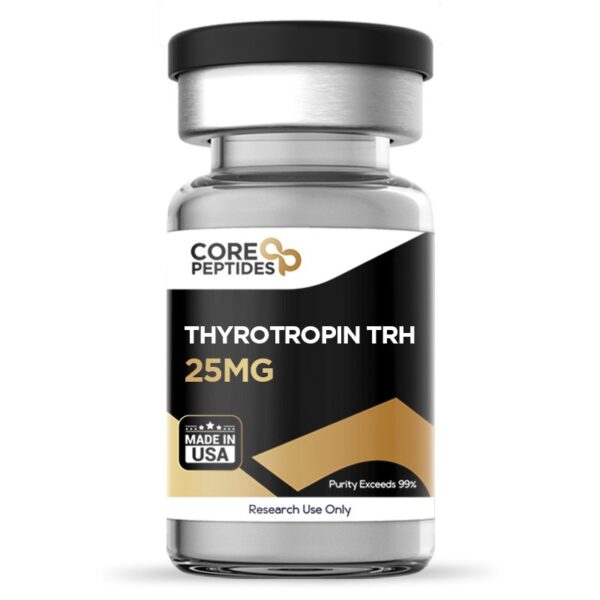
Thyrotropin TRH (25MG)

CHF 65.70
TRH (Thyrotropin-Releasing Hormone), also known as Protirelin, is a synthetic tripeptide with the sequence pGlu-His-Pro-NH2 that replicates the endogenous hypothalamic neurohormone. Researchers investigate TRH for its role in the hypothalamic-pituitary-thyroid (HPT) axis, stimulating thyroid-stimulating hormone (TSH) and prolactin release from the anterior pituitary via Gq/11-coupled TRH receptors. Beyond its endocrine functions, TRH exhibits neuromodulatory effects on feeding, arousal, anxiety, and locomotion, as well as neuroprotective activity against glutamate excitotoxicity and neurodegenerative conditions. Available for laboratory research purposes only. Buy TRH in Switzerland from Core Peptides, a trusted research peptide supplier.
What Is TRH?
TRH (Thyrotropin-Releasing Hormone), also known as Protirelin, is a synthetic tripeptide with the amino acid sequence pGlu-His-Pro-NH2 (pyroglutamyl-histidyl-prolinamide). It is the exact synthetic replicate of the endogenous hypothalamic neurohormone that plays a central role in the neuroendocrine axis. For those looking to buy TRH in Switzerland, Core Peptides offers high-quality research-grade material for laboratory applications.
TRH is a highly conserved neuropeptide that exerts hormonal control of thyroid-stimulating hormone (TSH) levels as well as neuromodulatory functions. The peptide is identified by CAS number 24305-27-9 (free base) or 117217-40-0 (Protirelin), with a molecular formula of C16H22N6O4 and a molecular weight of approximately 362.38 g/mol. This peptide has a rapid plasma half-life of approximately 6.5 minutes, enabling precise temporal control in acute electrophysiology and HPT axis stimulation studies.
TRH Research Overview
TRH has attracted sustained research interest as a well-characterized neuropeptide with dual endocrine and neuromodulatory functions. It serves as the primary regulator of the hypothalamic-pituitary-thyroid (HPT) axis, which is important for maintaining energy homeostasis. Furthermore, neurons also synthesize TRH in extrahypothalamic brain regions, where it is implicated in anorectic, anxiolytic, and antiepileptic effects.
Research interest in TRH centers on its ability to regulate the function of cells in the anterior pituitary and the central and peripheral nervous systems. Studies have demonstrated that TRH binds to G protein-coupled TRH receptors (TRHR), which signal primarily through Gq/11 but may also utilize other G protein classes under certain conditions. Consequently, TRH has generated significant interest as a research tool for investigating neuroendocrine regulation, receptor signaling, neuroprotection, and CNS disorders.
When researchers choose to buy TRH in Switzerland for laboratory studies, they gain access to a compound that may help elucidate mechanisms of HPT axis regulation, Gq/11-mediated signaling, and neuroprotective pathways at the molecular level.
How Does TRH Work?
TRH exerts its biological effects through binding to the thyrotropin-releasing hormone receptor (TRHR), a G-protein coupled receptor. The peptide’s mechanism involves several well-characterized pathways.
TRH Receptor Binding and Gq/11 Signaling
TRH acts as a ligand for the TRH receptor (TRHR), a member of the G-protein coupled receptor (GPCR) superfamily. This receptor signals primarily through the Gq/11 class of G-proteins, which activate phospholipase C (PLC), leading to the production of inositol trisphosphate (IP3) and diacylglycerol (DAG). This cascade then triggers intracellular calcium mobilization and protein kinase C (PKC) activation.
Research has also shown that TRH and its analogs can exhibit biased agonism at the TRH receptor, with differential phosphorylation of numerous proteins suggesting that ligands exhibit some degree of signaling selectivity.
HPT Axis Regulation
TRH is the main positive regulator of thyrotropin (TSH) secretion from the anterior pituitary. By controlling the synthesis and release of thyroid hormones, TRH affects many physiological functions, including energy homeostasis. Additionally, TRH also stimulates prolactin release from the anterior pituitary.
Neuromodulatory and Neuroprotective Effects
Independent from its activity in the HPT axis, TRH exerts strong neuroprotective activity against neurodegenerative diseases such as Alzheimer’s disease, epilepsy, and traumatic brain injury. TRH protects hippocampal neurons against glutamate toxicity via the phosphatidylinositol 3-kinase/AKT pathway and new protein synthesis.
TRH is also a neurotrophic peptide that may halt the development of neurodegenerative diseases and improve mood-related disorders. Researchers have found that TRH can activate brain circuits, stimulate spinal motor neurons, and exhibit modulatory effects in various neurological disorders, such as spinocerebellar degeneration and amyotrophic lateral sclerosis.
Researchers who buy TRH in Switzerland for research purposes can investigate these mechanisms across diverse experimental models of neuroendocrinology, neuroprotection, and CNS disorders.
Why Is TRH Studied?
Researchers study TRH primarily for its potential relevance to neuroendocrine regulation, receptor signaling, neuroprotection, and CNS disorders. The peptide’s ability to regulate TSH and prolactin secretion, modulate neuronal function, and exert neuroprotective effects makes it a valuable tool for understanding the molecular basis of HPT axis function and neurological conditions.
TRH has been extensively studied in the context of the hypothalamic-pituitary-thyroid axis, where it serves as the primary regulator of thyroid function. The peptide is clinically validated for use in diagnostic stimulation tests for thyroid disorders. Moreover, TRH and its analogues have demonstrated neuroprotective effects in models of neurodegeneration by reducing oxidative stress, glutamate excitotoxicity, and apoptosis.
Researchers also study TRH in the context of CNS disorders, including spinal muscular atrophy (SMA), Alzheimer’s disease, epilepsy, and traumatic brain injury. TRH and its analogs have demonstrated therapeutic potential in preclinical models, and the development of CNS-selective and metabolically stable TRH analogs is an area of active research interest.
Researchers who buy TRH in Switzerland from Core Peptides can incorporate this peptide into their studies on neuroendocrine regulation, receptor signaling, neuroprotection, and CNS disorders.
TRH Research Areas
| Research Area | Description |
|---|---|
| HPT Axis Regulation | Investigating TRH’s role in TSH and thyroid hormone regulation |
| TRH Receptor Signaling | Studying Gq/11-mediated signaling and biased agonism at TRHR |
| Neuroprotection | Examining TRH’s protective effects against glutamate excitotoxicity and neurodegeneration |
| Neuromodulation | Exploring TRH’s effects on feeding, arousal, anxiety, and locomotion |
| Spinal Motor Neuron Research | Investigating TRH’s effects on spinal motor neurons in models of SMA and ALS |
| Alzheimer’s Disease | Preclinical research into TRH’s neuroprotective effects in AD models |
| Epilepsy Research | Studying TRH’s antiepileptic effects and modulation of neuronal excitability |
| Energy Homeostasis | Exploring TRH’s role in metabolic regulation and energy balance |
Scientific Research on TRH
Researchers have conducted extensive scientific studies on TRH in both in vitro and in vivo settings, deriving evidence from cell cultures, preclinical models, and clinical research. The peptide has a substantial research history spanning over five decades.
In Vitro Evidence
In vitro studies using pituitary cell cultures have demonstrated that TRH binds to the TRH receptor on thyrotrophs and lactotrophs, activating Gq/11-mediated signaling cascades. This activation leads to increased intracellular calcium, activation of protein kinase C, and subsequent TSH and prolactin secretion.
Research has also shown that TRH protects hippocampal neurons against glutamate toxicity via the PI3K/AKT pathway and new protein synthesis. Importantly, this neuroprotective mechanism is independent of TRH’s endocrine functions and represents a distinct research application.
Preclinical Studies
In animal models, researchers have investigated TRH’s effects on the HPT axis, neuroprotection, and CNS disorders. TRH and its analogues have demonstrated neuroprotective effects in models of neurodegeneration by reducing oxidative stress, glutamate excitotoxicity, and apoptosis.
TRH has also been shown to stimulate spinal motor neurons and exhibit modulatory effects in neurological disorders such as spinocerebellar degeneration and amyotrophic lateral sclerosis. Furthermore, researchers have studied TRH analogues in models of spinal muscular atrophy (SMA) and Parkinson’s disease.
Human Research
TRH has been extensively studied in human clinical research. It is clinically validated as a diagnostic agent for thyroid disorders, with the synthetic version Protirelin used in TRH stimulation tests. TRH is also approved as a therapeutic agent for spinal muscular atrophy in some countries.
Nevertheless, researchers should note that TRH is supplied for laboratory research purposes only. Scientists who buy TRH in Switzerland should remain aware of these evidence considerations.
TRH Compared With Related Peptides
| Peptide | Relationship to TRH | Key Differences |
|---|---|---|
| Taltirelin | Synthetic TRH analog with enhanced stability | Taltirelin is a TRH superagonist with improved metabolic stability and oral bioavailability; TRH has a 6.5-minute half-life |
| MK-771 | TRH analog studied for cognitive enhancement | MK-771 improved spatial memory in rat models of Alzheimer’s disease; TRH is the endogenous tripeptide |
| TRH-Gly | TRH precursor peptide | TRH-Gly is a precursor in TRH biosynthesis; TRH is the active tripeptide |
| Thyroid-Stimulating Hormone (TSH) | Downstream hormone regulated by TRH | TRH stimulates TSH release; TSH acts on the thyroid gland; TRH is the upstream hypothalamic hormone |
| Prolactin | Another hormone stimulated by TRH | TRH stimulates prolactin release; prolactin has distinct physiological functions; TRH is the tripeptide neurohormone |
Research Applications
Researchers utilize TRH in a variety of laboratory research applications, primarily in the fields of endocrinology, neuroscience, and receptor pharmacology. Key research applications include:
- HPT Axis Studies: Investigating TRH’s role in TSH and thyroid hormone regulation
- TRH Receptor Signaling Research: Studying Gq/11-mediated signaling and biased agonism at TRHR
- Neuroprotection Studies: Examining TRH’s protective effects against glutamate excitotoxicity and neurodegeneration
- Neuromodulation Research: Exploring TRH’s effects on feeding, arousal, anxiety, and locomotion
- Spinal Motor Neuron Studies: Investigating TRH’s effects on spinal motor neurons in models of SMA and ALS
- Alzheimer’s Disease Research: Preclinical research into TRH’s neuroprotective effects in AD models
- Epilepsy Research: Studying TRH’s antiepileptic effects and modulation of neuronal excitability
- Energy Homeostasis Studies: Exploring TRH’s role in metabolic regulation and energy balance
Researchers who buy TRH in Switzerland can incorporate this peptide into their experimental protocols across these diverse research areas.
TRH Product Specifications
| Specification | Detail |
|---|---|
| Product Name | TRH (Thyrotropin-Releasing Hormone, Protirelin) |
| Amount | 25mg |
| Form | Lyophilized powder |
| Sequence (One-Letter) | pGlu-His-Pro-NH2 |
| Sequence (Three-Letter) | Pyroglutamyl-Histidyl-Prolinamide |
| Molecular Formula | C16H22N6O4 |
| Molecular Weight | Approximately 362.38 g/mol |
| CAS Number (Free Base) | 24305-27-9 |
| CAS Number (Protirelin) | 117217-40-0 |
| Half-Life | Approximately 6.5 minutes |
| N-Terminal Modification | Pyroglutamyl (pGlu) |
| C-Terminal Modification | Amidation (-NH2) |
| Synonyms | Protirelin, Thyroliberin, Thyrotropin-Releasing Factor, TRF |
| Mechanism | TRH receptor agonist; Gq/11 signaling; TSH and prolactin stimulation |
| Research Category | Cellular Research & Signaling |
| Purity | >99% (HPLC) |
| Storage | Store desiccated at -20°C, protected from light |
How to Evaluate TRH Quality
When sourcing TRH for research purposes, researchers should consider several quality indicators. A reliable TRH peptide supplier should provide:
- Identity Confirmation: Analytical verification that the peptide matches the expected tripeptide sequence (pGlu-His-Pro-NH2) and molecular weight (approximately 362.38 g/mol)
- Purity Analysis: Documentation of purity through methods such as HPLC – research grade typically provides >99% purity
- N-Terminal Pyroglutamyl Confirmation: Verification of the pyroglutamyl modification, which is essential for the peptide’s biological activity
- Batch Information: Clear lot numbers and batch traceability
- Certificate of Analysis (CoA): Documentation of analytical testing results
- Appearance: White to off-white lyophilized powder
- Solubility: Soluble in water and buffered aqueous solutions
Researchers looking to buy TRH in Switzerland should seek suppliers who provide comprehensive documentation and quality assurance. Core Peptides remains committed to supporting research with properly documented products.
Understanding the Certificate of Analysis
A Certificate of Analysis (CoA) provides analytical data for a specific batch of a research peptide. For TRH research, a CoA typically includes:
- Identity Confirmation: Mass spectrometry or other analytical methods confirming the peptide’s identity
- Purity Assessment: HPLC chromatograms showing the purity of the peptide
- Batch/Lot Information: Unique identifiers for traceability
- Analytical Methods: Description of the testing methods used
Importantly, researchers should understand that a CoA demonstrates the chemical identity and purity of a peptide but does not establish safety, efficacy, therapeutic effectiveness, or suitability for human use. The CoA serves as a quality control document for research purposes only.
Storage and Stability
Proper storage of research peptides is essential for maintaining their integrity and stability. For TRH, researchers should refer to the product documentation provided with their order for specific storage recommendations.
General best practices for TRH storage include keeping the lyophilized peptide desiccated, protected from light, and stored at -20°C or below. The peptide is soluble in water and buffered aqueous solutions. Researchers should avoid repeated freeze-thaw cycles. For specific temperature requirements and reconstitution protocols, consult the applicable product documentation or contact Core Peptides for the applicable storage specifications.
Research Considerations
Researchers incorporating TRH into their studies should be aware of several important considerations:
- Clinical Status: TRH has been extensively studied in human clinical research and is clinically validated as a diagnostic agent for thyroid disorders. However, the peptide is supplied for laboratory research purposes only.
- Experimental Status: Researchers consider TRH a well-characterized compound with a substantial evidence base, but findings should be interpreted within the context of ongoing research.
- Model Differences: Results from cell cultures and animal models may not translate directly to human outcomes.
- Regulatory Status: TRH is not FDA-approved for therapeutic use and is intended for laboratory research use only.
- Quality Considerations: Researchers should verify the quality and identity of their TRH through appropriate analytical methods.
- Mechanistic Context: TRH’s proposed mechanisms involve TRH receptor binding, Gq/11 signaling, PI3K/AKT pathway activation, and neuroprotective effects. Researchers should consider appropriate experimental approaches to investigate these pathways.
- Short Half-Life: TRH has a rapid plasma half-life of approximately 6.5 minutes, which may influence experimental design and dosing protocols.
Researchers who buy TRH in Switzerland should ensure their studies include appropriate controls and interpret findings with scientific rigor.
Frequently Asked Questions About TRH
What is TRH?
TRH (Thyrotropin-Releasing Hormone, Protirelin) is a synthetic tripeptide with the sequence pGlu-His-Pro-NH2 that replicates the endogenous hypothalamic neurohormone.
What is TRH researched for?
Researchers primarily investigate TRH for its role in the HPT axis, TRH receptor signaling, neuroprotection, neuromodulation, and CNS disorders such as Alzheimer’s disease, epilepsy, and traumatic brain injury.
What is the amino acid sequence of TRH?
The amino acid sequence of TRH is pGlu-His-Pro-NH2 (pyroglutamyl-histidyl-prolinamide).
What is the molecular weight of TRH?
The molecular weight of TRH is approximately 362.38 g/mol.
What is the CAS number for TRH?
The CAS number for TRH (free base) is 24305-27-9. The CAS number for Protirelin is 117217-40-0.
What is the mechanism of action for TRH?
TRH binds to the TRH receptor (TRHR), a Gq/11-coupled GPCR, activating phospholipase C and downstream signaling cascades that stimulate TSH and prolactin release and exert neuroprotective effects.
What is the half-life of TRH?
TRH has a rapid plasma half-life of approximately 6.5 minutes.
Does TRH have neuroprotective effects?
Yes, TRH exerts neuroprotective activity against glutamate excitotoxicity and neurodegenerative diseases such as Alzheimer’s disease, epilepsy, and traumatic brain injury via the PI3K/AKT pathway.
Is TRH the same as Protirelin?
Yes, Protirelin is the synthetic version of TRH, identical to the endogenous peptide.
Is TRH FDA-approved?
TRH is not FDA-approved for therapeutic use. It is clinically validated as a diagnostic agent and is intended for laboratory research use only.
Can I buy TRH in Switzerland?
Yes, researchers can buy TRH in Switzerland from Core Peptides for laboratory research purposes.
What is the primary research category for TRH?
TRH belongs to the Cellular Research & Signaling category, with secondary relevance to Cognitive & Nootropic Peptides research.
What related peptides are studied alongside TRH?
Related peptides include Taltirelin, MK-771, TRH-Gly, and other TRH analogs with enhanced stability or CNS selectivity.
What is the purity of Core Peptides’ TRH?
Core Peptides provides TRH with a purity of >99% as verified by HPLC analysis.
How should TRH be stored?
TRH should be stored lyophilized, desiccated, protected from light, at -20°C or below. Once reconstituted, store at 2-8°C and avoid repeated freeze-thaw cycles.
Related Research Peptides
Researchers interested in TRH may also find the following related peptides relevant to their work:
- Taltirelin – A synthetic TRH analog with enhanced metabolic stability and oral bioavailability, studied for CNS disorders
- MK-771 – A TRH analog studied for cognitive enhancement and spatial memory in Alzheimer’s disease models
- TRH-Gly – A TRH precursor peptide studied for biosynthesis research
- Semax – A nootropic peptide studied for cognitive enhancement and neuroprotection
- Pinealon – A peptide studied for neuroprotection and cognitive function
For a comprehensive selection of research peptides in Switzerland, explore the Core Peptides catalog.
Explore Cellular Research & Signaling Peptides
TRH is part of our Cellular Research & Signaling category, which features a range of research peptides investigated for their effects on cellular function, receptor signaling, and neuroendocrine pathways. Browse our selection to find the right peptides for your laboratory research.
Explore Related Research Categories
Researchers may also find the following related categories relevant to TRH research:
- Cognitive & Nootropic Peptides – Peptides studied for neurological and cognitive research
- Anti-Aging & Longevity – Peptides investigated for age-related neurodegenerative research
- Healing & Regeneration Peptides – Peptides investigated for neuroprotection and tissue repair
Further Research
Researchers interested in learning more about TRH and related peptides should consult the primary scientific literature. Key areas of investigation include TRH receptor signaling, HPT axis regulation, neuroprotection, and CNS disorders. The PubMed database is an excellent resource for accessing peer-reviewed research articles on these topics.
Research Disclaimer
Core Peptides supplies TRH as a research peptide for laboratory research purposes only. It is not approved for human consumption, therapeutic use, or medical treatment. All information provided is for educational and scientific reference purposes only and does not constitute medical advice. Researchers are responsible for ensuring compliance with all applicable laws and regulations governing the use of research peptides in their jurisdiction, including Switzerland.
Recensisci per primo “Thyrotropin TRH (25MG)”
Devi effettuare l’accesso per pubblicare una recensione.
Prodotti correlati
Fertility & Hormone Research
Fertility & Hormone Research
Fertility & Hormone Research
Fertility & Hormone Research
Recensioni
Ancora non ci sono recensioni.