
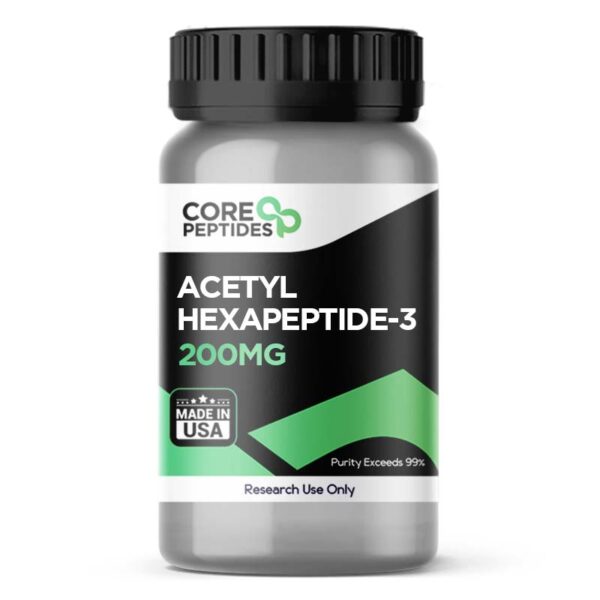
Acetyl Hexapeptide-3 (Argireline) – 200MG
CHF 203.40
Argireline (Acetyl Hexapeptide-3) is a synthetic hexapeptide with the sequence Ac-Glu-Glu-Met-Gln-Arg-Arg-NH₂. This 200mg research peptide is a structural mimetic of the N-terminal end of SNAP-25, a core component of the SNARE complex essential for synaptic vesicle exocytosis. Researchers study Argireline for its ability to competitively inhibit SNARE complex formation and modulate neurotransmitter release at the neuromuscular junction. Buy Argireline 200mg in Switzerland from Core Peptides for your laboratory research needs.
What Is Argireline and Why Buy It for Research?
Buy Argireline 200mg in Switzerland for research into SNARE complex inhibition, neuromuscular transmission, and exocytosis mechanisms. Specifically, Argireline (also known as Acetyl Hexapeptide-3 or Acetyl Hexapeptide-8) is a synthetic hexapeptide composed of six amino acids with the sequence Ac-Glu-Glu-Met-Gln-Arg-Arg-NH₂ (Ac-EEMQRR-NH₂). Structurally, this peptide represents a biomimetic fragment patterned from the N-terminal end of the synaptosomal-associated protein 25 (SNAP-25), a critical component of the neuronal SNARE complex.
In scientific research, Argireline serves as a molecular tool for studying the mechanisms of synaptic vesicle exocytosis and neurotransmitter release. Researchers consider this synthetic peptide particularly valuable for investigating the SNARE complex assembly and its role in calcium-dependent neurotransmitter secretion. Furthermore, Argireline is supplied as a lyophilized powder in a 200mg format for laboratory use. Therefore, researchers seeking to source this peptide for their work will find it readily available through trusted suppliers.
Argireline Research Overview: Buy Argireline 200mg in Switzerland for SNARE Studies
Centrally, research into Argireline has focused on its function as a competitive inhibitor of the SNARE complex. Endogenously, the neuronal SNARE complex is a ternary protein assembly composed of VAMP (vesicle-associated membrane protein) on the synaptic vesicle, syntaxin on the presynaptic membrane, and SNAP-25 on the presynaptic membrane. This protein complex is essential for mediating the fusion of neurotransmitter-containing vesicles with the presynaptic membrane, a calcium-dependent process that results in the release of neurotransmitters like acetylcholine into the synaptic cleft.
Notably, Argireline disrupts this process by mimicking a portion of SNAP-25 and competing for a position within the SNARE complex. This competitive interference destabilizes the complex, preventing efficient vesicle fusion and subsequently reducing acetylcholine release. Investigators have studied this peptide in various research contexts, including in vitro neurotransmitter release assays, cellular models, and clinical investigations of topical formulations. Accordingly, researchers can buy Argireline 200mg in Switzerland from Core Peptides to support their investigations into SNARE complex dynamics and neuromuscular signaling pathways.
How Does Argireline Work in Research?
Mechanistically, Argireline’s proposed action involves functioning as a competitive inhibitor of SNARE complex formation. The peptide’s amino acid sequence Ac-EEMQRR-NH₂ structurally mimics the N-terminal end of SNAP-25, allowing it to integrate into the SNARE complex in place of native SNAP-25. Consequently, when Argireline incorporates into the complex, it introduces instability and prevents the tight bundle formation required for vesicle fusion.
By inhibiting the efficient fusion of synaptic vesicles with the presynaptic membrane, Argireline reduces the calcium-dependent exocytosis of neurotransmitters. This attenuation of neurotransmitter release leads to a reduction in muscle contraction signaling at the neuromuscular junction. Importantly, unlike botulinum neurotoxins (BoNTs), which achieve their effects through proteolytic cleavage of SNAP-25, Argireline’s action is based on competitive interference, making it a reversible mechanism of action.
Furthermore, some studies suggest that Argireline may offer secondary research applications beyond neuromuscular modulation. In aged murine models, topical application of Argireline for six weeks improved the histological structure of skin tissue and increased the amount of type I collagen fibers. These findings indicate that Argireline may influence multiple cellular mechanisms, including collagen synthesis and tissue remodeling pathways.
Why Is Argireline Studied in Switzerland?
Primarily, researchers study Argireline because it represents a well-characterized SNAP-25 mimetic peptide that enables investigation of SNARE complex dynamics and neurotransmitter release mechanisms. In fact, this synthetic peptide offers a focused tool for studying the molecular mechanisms of exocytosis, synaptic transmission, and neuromuscular junction signaling.
In vitro studies have quantified the peptide’s efficacy across several key functional assays. For example, Argireline demonstrated an IC50 of approximately 110 µM for inhibiting norepinephrine release in permeabilized chromaffin cells. Additionally, clinical investigations have reported that topical formulations containing Argireline produced up to 30% reduction in wrinkle depth after 30 days of application. Ultimately, researchers can buy Argireline 200mg in Switzerland to access a research tool that may help uncover mechanisms underlying neuromuscular transmission, exocytosis, and tissue remodeling.
Argireline Research Areas in Laboratory Studies
| Research Area | Focus | Evidence Level |
|---|---|---|
| SNARE Complex Inhibition | Competitive inhibition, complex assembly disruption | Mechanistic / In Vitro |
| Neurotransmitter Release | Acetylcholine exocytosis, calcium-dependent release | Mechanistic / In Vitro |
| Neuromuscular Transmission | Muscle contraction signaling, synaptic vesicle fusion | Mechanistic / In Vitro |
| Exocytosis Mechanisms | Vesicle docking, membrane fusion, SNARE proteins | Mechanistic / In Vitro |
| Skin Tissue Research | Collagen synthesis, tissue remodeling, histological changes | Animal / Preclinical |
| Anti-Wrinkle Research | Expression lines, muscle relaxation, topical formulations | Human / Clinical |
Argireline Compared With Related Research Compounds
| Compound | Research Focus | Mechanism / Target | Key Difference |
|---|---|---|---|
| Argireline | SNARE inhibition, neurotransmitter release | Competitive SNAP-25 inhibition | Synthetic SNAP-25 mimetic; reversible inhibition |
| Botulinum Neurotoxin (BoNT) | Neuromuscular transmission | Proteolytic cleavage of SNARE proteins | Permanent proteolytic effect; irreversible |
| Leuphasyl | Neuromuscular modulation | Enkephalin receptor binding | Different mechanism; enkephalin mimetic |
| Palmitoyl Hexapeptide-12 | Skin research, collagen synthesis | ECM signaling, collagen stimulation | Different target; no SNARE involvement |
Comparatively, Argireline differs from botulinum neurotoxins in its mechanism and duration of action. On the one hand, BoNTs achieve prolonged effects by proteolytically cleaving SNAP-25, leading to irreversible inhibition of neurotransmitter release. On the other hand, Argireline acts through competitive interference, making its effects reversible and transient. In contrast, Leuphasyl modulates neuromuscular transmission through enkephalin receptor pathways, representing a distinctly different research mechanism.
Research Applications for Argireline in Switzerland
Scientists have investigated Argireline across several research domains:
- SNARE Complex Studies: Researchers use Argireline to investigate the molecular mechanisms of SNARE complex assembly, stability, and function in neurotransmitter release.
- Neurotransmitter Release Assays: The peptide serves as a tool for studying calcium-dependent exocytosis and the regulation of acetylcholine secretion.
- Neuromuscular Junction Research: Studies have examined the peptide’s potential to modulate synaptic transmission and muscle contraction signaling.
- Exocytosis Mechanisms: Argireline is used to investigate vesicle docking, membrane fusion, and the role of SNARE proteins in cellular secretion.
- Tissue Remodeling Research: Preclinical studies have explored the peptide’s effects on collagen synthesis and histological changes in skin tissue.
Evidently, researchers can buy Argireline 200mg in Switzerland for these applications, as it is a valuable addition to any laboratory toolkit focused on SNARE complex dynamics and neuromuscular signaling research.
Argireline Product Specifications
| Specification | Details |
|---|---|
| Product Name | Argireline (Acetyl Hexapeptide-3) |
| Alternative Names | Acetyl Hexapeptide-3, Acetyl Hexapeptide-8, Argireline NP |
| Amount | 200mg |
| Form | Lyophilized powder |
| Purity | Not verified |
| Amino Acid Sequence | Ac-Glu-Glu-Met-Gln-Arg-Arg-NH₂ (Ac-EEMQRR-NH₂) |
| Molecular Formula | C34H60N14O12S |
| Molecular Weight | 887.0 g/mol (free base); 888.99 g/mol (acetate salt) |
| CAS Number | 616204-22-9 |
| Research Category | Skin, Hair & Beauty / Cognitive & Nootropic |
| Research Use | Laboratory research use only |
| CoA | Available upon request (not verified) |
| Storage | Lyophilized powder should be stored desiccated at -20°C or below |
How to Evaluate Argireline Quality for Research
When sourcing Argireline peptide for laboratory research, researchers should consider several quality indicators:
- Identity Confirmation: Analytical techniques such as mass spectrometry should confirm the peptide’s molecular weight and sequence (Ac-EEMQRR-NH₂).
- Purity Assessment: High-performance liquid chromatography (HPLC) can provide information about peptide purity.
- Batch Traceability: Lot numbers and batch information enable researchers to track specific production runs.
- Certificate of Analysis: A CoA should accompany the product, detailing analytical testing results.
- Labeling Accuracy: Proper labeling should clearly indicate the product name, amount, sequence, and storage recommendations.
- Storage Conditions: Appropriate storage at -20°C or below in desiccated conditions helps maintain peptide stability.
Understanding the Certificate of Analysis
Typically, a Certificate of Analysis (CoA) accompanies research peptides and provides information about the specific batch’s analytical testing. For example, a CoA may include product identity confirmation, purity percentage as determined by HPLC, batch or lot number for traceability, analytical methods used (e.g., mass spectrometry, HPLC), and a physical description of the product.
Nevertheless, it is important to note that a CoA does not establish safety, efficacy, therapeutic effectiveness, or suitability for human use. Instead, it serves as a quality control document that helps researchers verify the identity and purity of the peptide they are using in their laboratory investigations.
Storage and Stability of Argireline
Core Peptides supplies Argireline as a lyophilized (freeze-dried) powder. To maintain stability and integrity:
- Store the lyophilized powder desiccated at -20°C or below
- Avoid repeated freeze-thaw cycles
- Reconstitute only immediately before use with appropriate sterile solvents
- Gently swirl to dissolve; do not vortex
- Filter sterilize if required (e.g., 0.22 µm) immediately prior to use
- Aliquot and store reconstituted solutions at -20°C (or lower)
- Protect from light and moisture
Frequently Asked Questions About Buying Argireline 200mg in Switzerland
What is Argireline?
Specifically, Argireline (Acetyl Hexapeptide-3) is a synthetic hexapeptide with the amino acid sequence Ac-Glu-Glu-Met-Gln-Arg-Arg-NH₂ (Ac-EEMQRR-NH₂). It is a structural mimetic of the N-terminal end of SNAP-25 and is also referred to as Acetyl Hexapeptide-8.
What is Argireline researched for?
Primarily, researchers study Argireline for its role as a competitive inhibitor of the SNARE complex. Studies have investigated its effects on neurotransmitter release, neuromuscular transmission, and exocytosis mechanisms.
How does Argireline work?
Mechanistically, Argireline functions by mimicking the N-terminal end of SNAP-25 and competing for a position within the SNARE complex. This competition destabilizes the complex, preventing efficient vesicle fusion and reducing neurotransmitter release.
What is the amino acid sequence of Argireline?
The amino acid sequence of Argireline is Ac-Glu-Glu-Met-Gln-Arg-Arg-NH₂ (Ac-EEMQRR-NH₂).
What is the molecular weight of Argireline?
The molecular weight is 887.0 g/mol for the free base and 888.99 g/mol for the acetate salt.
What is the CAS number of Argireline?
The CAS number is 616204-22-9.
Is Argireline synthetic?
Yes, Argireline is a synthetic peptide produced through solid-phase peptide synthesis.
What research exists on Argireline?
Research on Argireline includes in vitro studies on SNARE complex inhibition, neurotransmitter release assays, preclinical animal studies on collagen synthesis, and clinical investigations in human subjects.
What is the difference between Argireline and botulinum neurotoxin?
Argireline acts through competitive interference with SNAP-25, making its effects reversible and transient. Botulinum neurotoxins achieve prolonged effects by proteolytically cleaving SNAP-25, leading to irreversible inhibition.
Is Argireline approved as a medicine?
No. Regulatory authorities have not approved Argireline as a medicine, pharmaceutical, or therapeutic agent.
Is Argireline intended for human use?
No. Argireline is intended for laboratory research use only and is not for human consumption, injection, or therapeutic application.
Where can I buy Argireline 200mg in Switzerland?
You can buy Argireline 200mg in Switzerland from Core Peptides, a trusted research peptide supplier serving the Swiss scientific community.
How should researchers evaluate Argireline quality?
Researchers should look for identity confirmation via mass spectrometry, purity data from HPLC, batch traceability, and a Certificate of Analysis.
Related Research Compounds
Researchers interested in Argireline may also find the following related compounds relevant to their work:
- Leuphasyl — An enkephalin mimetic peptide researched for neuromuscular modulation and neurotransmitter release.
- BPC-157 — A peptide researched for tissue healing, gastrointestinal health, and angiogenesis.
- GHK-Cu — A copper-binding peptide researched for skin regeneration, wound healing, and anti-aging applications.
- TB-500 — A Thymosin Beta 4 fragment researched for tissue repair and wound healing.
Explore Skin, Hair & Beauty
Argireline belongs to the Skin, Hair & Beauty category of research compounds. Skin, Hair & Beauty products are studied for their potential roles in tissue remodeling, collagen synthesis, and dermal research applications. Generally, researchers who buy Argireline 200mg in Switzerland often pair it with related compounds in this category to explore complementary pathways in tissue regeneration and extracellular matrix research.
Further Research
For researchers seeking to deepen their understanding of Argireline and its research applications, the following areas may warrant further investigation:
- The relationship between Argireline-mediated SNARE inhibition and specific downstream signaling pathways
- Comparative studies between Argireline and other SNAP-25 mimetic peptides in various research models
- The potential role of Argireline in modulating collagen synthesis and tissue remodeling
- Mechanistic studies on Argireline’s interaction with different SNARE complex components
- Exploration of Argireline’s effects on different cell types and tissue systems
Research Disclaimer
Argireline is a research peptide supplied for laboratory research use only. Researchers must not use it for human consumption, injection, or any form of therapeutic application. Moreover, this product is not a medicine, pharmaceutical, or medical device. Furthermore, Swissmedic, the FDA, EMA, or any other regulatory authority have not approved it for human use. Researchers should consult Swissmedic for applicable regulations and guidance on research peptide handling in Switzerland.
Generally, the information provided on this page is for educational and scientific reference purposes only. Therefore, it does not constitute medical advice, treatment recommendations, or dosing instructions. Ultimately, researchers bear the responsibility for ensuring that their use of this product complies with all applicable laws, regulations, and institutional guidelines.
Finally, all research involving peptides should be conducted by qualified personnel in appropriate laboratory settings with proper safety protocols.
Recensisci per primo “Acetyl Hexapeptide-3 (Argireline) – 200MG”
Devi effettuare l’accesso per pubblicare una recensione.
Prodotti correlati
Skin, Hair & Beauty Peptides
Skin, Hair & Beauty Peptides
Skin, Hair & Beauty Peptides
Skin, Hair & Beauty Peptides
Skin, Hair & Beauty Peptides
Skin, Hair & Beauty Peptides
Skin, Hair & Beauty Peptides
Skin, Hair & Beauty Peptides
Recensioni
Ancora non ci sono recensioni.