
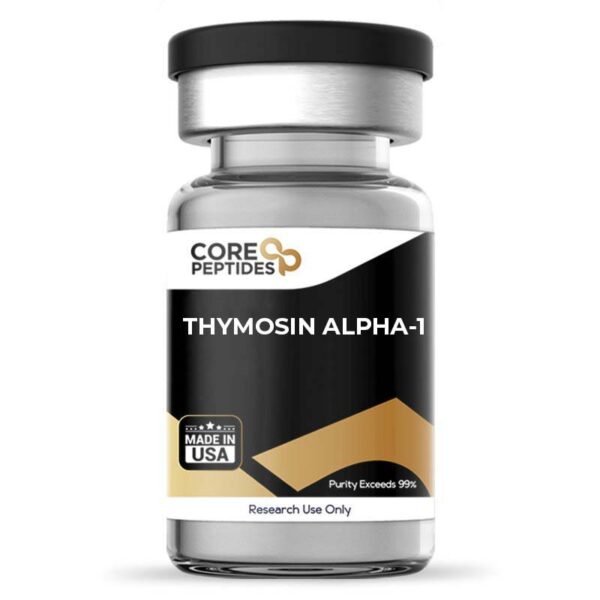
Thymosin Alpha-1 (5MG / 10MG)
Fascia di prezzo: da CHF 72.90 a CHF 134.10
Thymosin Alpha-1 (Tα1), also known as Thymalfasin, is a synthetic 28-amino acid acetylated peptide (Ac-Ser-Asp-Ala-Ala-Val-Asp-Thr-Ser-Ser-Glu-Ile-Thr-Thr-Lys-Asp-Leu-Lys-Glu-Lys-Lys-Glu-Val-Val-Glu-Glu-Ala-Glu-Asn-OH) that replicates the biologically active fragment of prothymosin alpha, a naturally occurring thymic hormone. Researchers investigate Thymosin Alpha-1 for its immunomodulatory properties through Toll-like receptor (TLR3/4/9) signaling, T-cell maturation, Th1 polarization, and natural killer (NK) cell activation. Studies have explored its effects in hepatitis B virus models, infectious disease research, and immune regulation. Available for laboratory research purposes only. Buy Thymosin Alpha-1 in Switzerland from Core Peptides, a trusted research peptide supplier.
What Is Thymosin Alpha-1?
Thymosin Alpha-1 (Tα1), also known as Thymalfasin, is a synthetic 28-amino acid acetylated peptide with the sequence Ac-Ser-Asp-Ala-Ala-Val-Asp-Thr-Ser-Ser-Glu-Ile-Thr-Thr-Lys-Asp-Leu-Lys-Glu-Lys-Lys-Glu-Val-Val-Glu-Glu-Ala-Glu-Asn-OH. It replicates the biologically active fragment of prothymosin alpha, a naturally occurring thymic hormone. Researchers first isolated Tα1 from calf thymus tissue in 1977 at Abraham White’s laboratory, as reported in the Proceedings of the National Academy of Sciences. For those looking to buy Thymosin Alpha-1 in Switzerland, Core Peptides offers high-quality research-grade material for laboratory applications.
Thymosin Alpha-1 derives from the larger precursor protein prothymosin alpha and represents the biologically active fragment responsible for the thymus gland’s role in T-cell education and immune regulation. The synthetic version is structurally identical to the endogenous peptide, and manufacturers produce it through solid-phase synthesis. The peptide is commercially available as thymalfasin under the brand name Zadaxin, approved in more than 35 countries for the treatment of chronic hepatitis B. The peptide is identified by CAS number 62304-98-7, with a molecular formula of C129H215N33O55 and a molecular weight of approximately 3,108.3 g/mol.
Thymosin Alpha-1 Research Overview
Thymosin Alpha-1 has attracted sustained research interest as a well-characterized immunomodulatory peptide with a substantial international clinical literature spanning over four decades. It is approved as Zadaxin in more than 35 countries for chronic hepatitis B, but it is not FDA-approved in the United States. In the US, it holds FDA 503A Category 2 status following the February 2026 reclassification.
Research interest in Thymosin Alpha-1 centers on its ability to modulate immune function through Toll-like receptor (TLR) signaling, T-cell maturation, and Th1 polarization. Studies have demonstrated that Tα1 binds to TLR3, TLR4, and TLR9, activating downstream IRF3 and NF-κB signal pathways. This activation promotes the proliferation and activation of target immune cells. Moreover, TLR2 and TLR7 are also associated with Tα1, with TLR2/NF-κB, TLR2/p38MAPK, or TLR7/MyD88 signaling pathways activated to promote cytokine production, enhancing both innate and adaptive immune responses. Consequently, Thymosin Alpha-1 has generated significant interest as a research tool for investigating immunomodulation, T-cell biology, antiviral mechanisms, and infectious disease models.
When researchers choose to buy Thymosin Alpha-1 in Switzerland for laboratory studies, they gain access to a compound that may help elucidate mechanisms of TLR signaling, T-cell differentiation, and immune regulation at the molecular level.
How Does Thymosin Alpha-1 Work?
Thymosin Alpha-1 exerts its biological effects through multiple interconnected mechanisms involving Toll-like receptor signaling, T-cell maturation, and cytokine modulation. The peptide’s mechanism involves several well-characterized steps.
Toll-Like Receptor Signaling
Thymosin Alpha-1 acts as an immunostimulatory peptide by interacting with various Toll-like receptors (TLRs). Specifically, Tα1 can bind to TLR3, TLR4, and TLR9 and activate downstream IRF3 and NF-κB signal pathways, thereby promoting the proliferation and activation of target immune cells. Moreover, TLR2 and TLR7 are also associated with Tα1. TLR2/NF-κB, TLR2/p38MAPK, or TLR7/MyD88 signaling pathways are activated by Tα1 to promote the production of various cytokines, thereby enhancing the innate and adaptive immune responses. This TLR-mediated mechanism represents the primary molecular pathway through which Tα1 exerts its immunomodulatory effects.
T-Cell Maturation and Th1 Polarization
Thymosin Alpha-1 promotes T-lymphocyte maturation and differentiation, regulating the balance between helper and suppressor T-cell subpopulations. The core mechanism of Tα1 involves activation of TLR9 signaling on dendritic cells, driving Th1 polarization, T-cell maturation, and coordinated adaptive immune responses. This Th1 polarization is critical for the peptide’s immunomodulatory effects and its role in antiviral research models.
Natural Killer Cell and Cytokine Modulation
Tα1 can influence the functions of various immune cells, including T cells, B cells, macrophages, and natural killer (NK) cells. The peptide stimulates NK cell activity and modulates cytokine production by stimulated lymphocytes. These effects contribute to the restoration of immune function in conditions where T-cell function is depressed.
Direct Cellular Effects
Thymosin Alpha-1 is a peptide with a multitude of effects in the organism both from its direct influence on cells, as well as modulation of the immune system. Tα1 also displays antiviral and antitumor activities, and has been shown to stimulate endothelial cell migration, angiogenesis, and wound healing.
Researchers who buy Thymosin Alpha-1 in Switzerland for research purposes can investigate these mechanisms across diverse experimental models of immunology, infectious disease, and antiviral research.
Why Is Thymosin Alpha-1 Studied?
Researchers study Thymosin Alpha-1 primarily for its potential relevance to immunomodulation, T-cell biology, antiviral research, and immune regulation. The peptide’s ability to regulate T-lymphocyte maturation, stimulate NK cell activity, and modulate TLR-mediated signaling makes it a valuable tool for understanding the molecular basis of immune system function and regulation.
Thymosin Alpha-1 has been extensively studied in the context of viral infectious diseases. Tα1 is commonly used as an immune enhancer in viral infectious diseases such as hepatitis B, hepatitis C, and acquired immune deficiency syndrome (AIDS). In a pivotal 1998 randomized controlled trial in 98 hepatitis B patients, Tα1 produced a complete virological response in 40.6% of treated patients versus 9.4% in untreated controls. The peptide has been evaluated in multiple Phase 2 and Phase 3 clinical trials for hepatitis B.
Moreover, researchers study Thymosin Alpha-1 in the context of immunosenescence—the age-related decline in immune function. Preclinical and clinical studies show that Tα1 can improve vaccine response in the elderly and mitigate immunosenescence. The peptide has also demonstrated anti-inflammatory and antioxidant properties.
Recent research has explored Thymosin Alpha-1’s potential in combination with other agents. A 2021 study demonstrated that Thymosin Alpha-1 administration in older patients with severe COVID-19 resulted in more rapid clinical improvement, higher recovery from lymphopenia, faster normalization of inflammatory markers, and halved hospital mortality. However, the 2025 TESTS trial (N=1,089) found no reduction in 28-day sepsis mortality.
Researchers who buy Thymosin Alpha-1 in Switzerland from Core Peptides can incorporate this peptide into their studies on immunomodulation, T-cell biology, TLR signaling, and infectious disease models.
Thymosin Alpha-1 Research Areas
| Research Area | Description |
|---|---|
| Immunomodulation | Investigating Thymosin Alpha-1’s effects on T-cell maturation, differentiation, and immune system regulation |
| TLR Signaling | Studying Tα1’s binding to TLR3/4/9 and activation of IRF3 and NF-κB pathways |
| T-Cell Biology | Examining Tα1’s influence on Th1 polarization and T-cell surface marker expression |
| Antiviral Research | Exploring Tα1’s effects in hepatitis B, hepatitis C, and other viral models |
| Natural Killer Cell Activity | Investigating Tα1’s stimulation of NK cell function and cytotoxic activity |
| Immunosenescence | Preclinical research into Tα1’s effects on age-related immune decline and vaccine response |
| Cytokine Modulation | Studying Tα1’s effects on pro-inflammatory cytokine production and immune balance |
| Antitumor Research | Investigating Tα1’s antitumor activities and role in immunotherapy research |
Scientific Research on Thymosin Alpha-1
Researchers have conducted extensive scientific studies on Thymosin Alpha-1 in both in vitro and in vivo settings, deriving evidence from cell cultures, preclinical models, and clinical research. The peptide has a substantial international clinical literature and has been studied for over four decades.
In Vitro Evidence
In vitro studies have demonstrated that Thymosin Alpha-1 binds to Toll-like receptors TLR3, TLR4, and TLR9, activating downstream IRF3 and NF-κB signal pathways. This activation promotes the proliferation and activation of target immune cells. Research has shown that TLR2 and TLR7 are also associated with Tα1, with TLR2/NF-κB, TLR2/p38MAPK, or TLR7/MyD88 signaling pathways activated to promote the production of various cytokines.
Studies have also investigated Tα1’s effects on immune cell subsets. Tα1 exhibited direct effects on the proliferation and/or transcription of activated CD8+ T cells, while minimally changing cancer cell DEGs and immune-related biological processes.
Preclinical Studies
In animal models, Thymosin Alpha-1 administered in vivo strengthens the immune reaction in a whole variety of animal models. The peptide has demonstrated antiviral and antitumor activities, and has been shown to stimulate endothelial cell migration, angiogenesis, and wound healing.
Research has also explored Tα1’s role in modulating the immune system, with studies showing that the peptide influences the functions of immune cells such as T cells, B cells, macrophages, and natural killer cells.
Human Research
Thymosin Alpha-1 has been extensively studied in human clinical research. A pivotal 1998 randomized controlled trial in 98 hepatitis B patients found complete virological response in 40.6% on Tα1 versus 9.4% in untreated controls. The peptide has been evaluated in multiple Phase 2 and Phase 3 clinical trials for hepatitis B.
As of April 2026, thymosin alpha-1 is not FDA-approved in the United States. However, it is approved internationally under the brand name Zadaxin for chronic hepatitis B in more than 35 countries, including China and Italy. In the US, it holds FDA 503A Category 2 status following the February 2026 reclassification, meaning it is available by prescription only through licensed compounding pharmacies.
Nevertheless, researchers should note that Thymosin Alpha-1 is supplied for laboratory research purposes only. Scientists who buy Thymosin Alpha-1 in Switzerland should remain aware of these evidence considerations.
Thymosin Alpha-1 Compared With Related Peptides
| Peptide/Preparation | Relationship to Thymosin Alpha-1 | Key Differences |
|---|---|---|
| Thymalin | Both are thymic immunomodulators | Thymalin is a polypeptide complex (mixture); Thymosin Alpha-1 is a single defined 28-amino acid peptide |
| Thymogen (Glu-Trp) | Both are thymic peptides | Thymogen is a synthetic dipeptide; Thymosin Alpha-1 is a 28-amino acid peptide |
| Vilon (Lys-Glu) | Both are Khavinson bioregulators | Vilon is a dipeptide; Thymosin Alpha-1 is a 28-amino acid peptide with broader immunomodulatory effects |
| Crystagen (Glu-Asp-Pro) | Both are thymic peptides | Crystagen is a tripeptide targeting thymus-independent immunity; Thymosin Alpha-1 targets TLR signaling and T-cell maturation |
| Thymosin Beta-4 (TB-500) | Both are thymosin family peptides | Thymosin Beta-4 targets actin dynamics and tissue repair; Thymosin Alpha-1 targets immunomodulation and TLR signaling |
Research Applications
Researchers utilize Thymosin Alpha-1 in a variety of laboratory research applications, primarily in the fields of immunology, infectious disease, and cellular signaling. Key research applications include:
- Immunomodulation Studies: Investigating Thymosin Alpha-1’s effects on T-cell maturation, differentiation, and immune system regulation
- TLR Signaling Research: Studying Tα1’s binding to TLR3/4/9 and activation of IRF3 and NF-κB pathways
- T-Cell Biology Studies: Examining Tα1’s influence on Th1 polarization and T-cell surface marker expression
- Antiviral Research: Exploring Tα1’s effects in hepatitis B, hepatitis C, and other viral models
- Natural Killer Cell Studies: Investigating Tα1’s stimulation of NK cell function and cytotoxic activity
- Immunosenescence Research: Preclinical research into Tα1’s effects on age-related immune decline and vaccine response
- Cytokine Modulation Studies: Studying Tα1’s effects on pro-inflammatory cytokine production and immune balance
- Antitumor Research: Investigating Tα1’s antitumor activities and role in immunotherapy research
Researchers who buy Thymosin Alpha-1 in Switzerland can incorporate this peptide into their experimental protocols across these diverse research areas.
Thymosin Alpha-1 Product Specifications
| Specification | Detail |
|---|---|
| Product Name | Thymosin Alpha-1 (Thymalfasin) |
| Amount | 5mg / 10mg |
| Form | Lyophilized powder |
| Sequence (One-Letter) | Ac-SDAAVDTSSEITTKDLKEKKEVVEEAEN-OH |
| Sequence (Three-Letter) | Ac-Ser-Asp-Ala-Ala-Val-Asp-Thr-Ser-Ser-Glu-Ile-Thr-Thr-Lys-Asp-Leu-Lys-Glu-Lys-Lys-Glu-Val-Val-Glu-Glu-Ala-Glu-Asn-OH |
| Length | 28 amino acids |
| Molecular Formula | C129H215N33O55 |
| Molecular Weight | Approximately 3,108.3 g/mol |
| CAS Number | 62304-98-7 |
| PubChem CID | 16130571 |
| N-Terminal Modification | Acetylation |
| C-Terminal Modification | Free acid (-OH) |
| Synonyms | Thymalfasin, Zadaxin, Tα1, thymosin alpha 1 |
| Source | Synthetic (prothymosin alpha fragment) |
| Mechanism | TLR3/4/9 agonist; NF-κB and IRF3 activation; Th1 polarization; T-cell maturation |
| Research Category | Cellular Research & Signaling |
| Purity | >99% (HPLC) |
| Storage | Store desiccated at -20°C, protected from light |
How to Evaluate Thymosin Alpha-1 Quality
When sourcing Thymosin Alpha-1 for research purposes, researchers should consider several quality indicators. A reliable Thymosin Alpha-1 peptide supplier should provide:
- Identity Confirmation: Analytical verification that the peptide matches the expected 28-amino acid sequence (Ac-SDAAVDTSSEITTKDLKEKKEVVEEAEN-OH) and molecular weight (approximately 3,108.3 g/mol)
- Purity Analysis: Documentation of purity through methods such as HPLC – research grade typically provides >99% purity
- N-Terminal Acetylation Confirmation: Verification of the acetylated N-terminus, which is essential for the peptide’s biological activity
- Batch Information: Clear lot numbers and batch traceability
- Certificate of Analysis (CoA): Documentation of analytical testing results
- Appearance: White to off-white lyophilized powder
- Solubility: Soluble in water and buffered aqueous solutions
Researchers looking to buy Thymosin Alpha-1 in Switzerland should seek suppliers who provide comprehensive documentation and quality assurance. Core Peptides remains committed to supporting research with properly documented products.
Understanding the Certificate of Analysis
A Certificate of Analysis (CoA) provides analytical data for a specific batch of a research peptide. For Thymosin Alpha-1 research, a CoA typically includes:
- Identity Confirmation: Mass spectrometry or other analytical methods confirming the peptide’s identity
- Purity Assessment: HPLC chromatograms showing the purity of the peptide
- Batch/Lot Information: Unique identifiers for traceability
- Analytical Methods: Description of the testing methods used
Importantly, researchers should understand that a CoA demonstrates the chemical identity and purity of a peptide but does not establish safety, efficacy, therapeutic effectiveness, or suitability for human use. The CoA serves as a quality control document for research purposes only.
Storage and Stability
Proper storage of research peptides is essential for maintaining their integrity and stability. For Thymosin Alpha-1, researchers should refer to the product documentation provided with their order for specific storage recommendations.
General best practices for Thymosin Alpha-1 storage include keeping the lyophilized peptide desiccated, protected from light, and stored at -20°C or below. The peptide is soluble in water and buffered aqueous solutions. Once reconstituted, the peptide should be stored at 2-8°C (refrigerator), and researchers should discard any solution that becomes discolored or shows signs of contamination. For specific temperature requirements and reconstitution protocols, consult the applicable product documentation or contact Core Peptides for the applicable storage specifications.
Research Considerations
Researchers incorporating Thymosin Alpha-1 into their studies should be aware of several important considerations:
- Clinical Status: Thymosin Alpha-1 has been extensively studied in human clinical research and is approved as Zadaxin in more than 35 countries for chronic hepatitis B. However, it is not FDA-approved in the United States and is supplied for laboratory research purposes only.
- Regulatory Status: In the US, Tα1 holds FDA 503A Category 2 status following the February 2026 reclassification.
- Experimental Status: Researchers consider Thymosin Alpha-1 a well-characterized compound with a substantial evidence base, but findings should be interpreted within the context of ongoing research.
- Model Differences: Results from cell cultures and animal models may not translate directly to human outcomes.
- Quality Considerations: Researchers should verify the quality and identity of their Thymosin Alpha-1 through appropriate analytical methods.
- Mechanistic Context: Tα1’s proposed mechanisms involve TLR3/4/9 signaling, NF-κB and IRF3 activation, Th1 polarization, and T-cell maturation. Researchers should consider appropriate experimental approaches to investigate these pathways.
- Combination Studies: Research suggests that the optimal reaction of Tα1 may be in coordination with other agents. Researchers should consider this when designing combination studies.
Researchers who buy Thymosin Alpha-1 in Switzerland should ensure their studies include appropriate controls and interpret findings with scientific rigor.
Frequently Asked Questions About Thymosin Alpha-1
What is Thymosin Alpha-1?
Thymosin Alpha-1 (Tα1, Thymalfasin) is a synthetic 28-amino acid acetylated peptide that replicates the biologically active fragment of prothymosin alpha, a naturally occurring thymic hormone, with the sequence Ac-SDAAVDTSSEITTKDLKEKKEVVEEAEN-OH.
What is Thymosin Alpha-1 researched for?
Researchers primarily investigate Thymosin Alpha-1 for its immunomodulatory properties, including T-cell maturation, Th1 polarization, TLR signaling (TLR3/4/9), NK cell activation, and antiviral research in hepatitis B and other viral models.
What is the amino acid sequence of Thymosin Alpha-1?
The amino acid sequence of Thymosin Alpha-1 is Ac-Ser-Asp-Ala-Ala-Val-Asp-Thr-Ser-Ser-Glu-Ile-Thr-Thr-Lys-Asp-Leu-Lys-Glu-Lys-Lys-Glu-Val-Val-Glu-Glu-Ala-Glu-Asn-OH.
What is the molecular weight of Thymosin Alpha-1?
The molecular weight of Thymosin Alpha-1 is approximately 3,108.3 g/mol.
What is the CAS number for Thymosin Alpha-1?
The CAS number for Thymosin Alpha-1 is 62304-98-7.
What is the mechanism of action for Thymosin Alpha-1?
Thymosin Alpha-1 binds to TLR3, TLR4, and TLR9, activating downstream IRF3 and NF-κB signal pathways, promoting T-cell maturation, Th1 polarization, and NK cell activation.
Is Thymosin Alpha-1 the same as Thymalfasin?
Yes, Thymalfasin is the synthetic version of Thymosin Alpha-1, identical to the endogenous peptide.
Is Thymosin Alpha-1 FDA-approved?
Thymosin Alpha-1 is not FDA-approved in the United States. However, it is approved as Zadaxin in more than 35 countries for chronic hepatitis B.
Can I buy Thymosin Alpha-1 in Switzerland?
Yes, researchers can buy Thymosin Alpha-1 in Switzerland from Core Peptides for laboratory research purposes.
What is the primary research category for Thymosin Alpha-1?
Thymosin Alpha-1 belongs to the Cellular Research & Signaling category, with secondary relevance to Anti-Aging & Longevity research.
What related peptides are studied alongside Thymosin Alpha-1?
Related peptides include Thymalin, Thymogen (Glu-Trp), Vilon (Lys-Glu), Crystagen (Glu-Asp-Pro), and Thymosin Beta-4 (TB-500).
What is the purity of Core Peptides’ Thymosin Alpha-1?
Core Peptides provides Thymosin Alpha-1 with a purity of >99% as verified by HPLC analysis.
How should Thymosin Alpha-1 be stored?
Thymosin Alpha-1 should be stored lyophilized, desiccated, protected from light, at -20°C or below. Once reconstituted, store at 2-8°C.
Is Thymosin Alpha-1 soluble in water?
Yes, Thymosin Alpha-1 is soluble in water and buffered aqueous solutions.
Related Research Peptides
Researchers interested in Thymosin Alpha-1 may also find the following related peptides relevant to their work:
- Thymalin – A low-molecular-weight thymic polypeptide complex, studied for immunomodulation
- Thymogen (Glu-Trp) – A synthetic dipeptide component of thymic preparations, studied for immunomodulation
- Vilon (Lys-Glu) – A dipeptide studied for immune system research
- Crystagen (Glu-Asp-Pro) – A tripeptide studied for thymus-independent immunity
- Thymosin Beta-4 (TB-500) – A thymosin family peptide targeting actin dynamics and tissue repair
For a comprehensive selection of research peptides in Switzerland, explore the Core Peptides catalog.
Explore Cellular Research & Signaling Peptides
Thymosin Alpha-1 is part of our Cellular Research & Signaling category, which features a range of research peptides investigated for their effects on cellular function, gene expression, and signaling pathways. Browse our selection to find the right peptides for your laboratory research.
Explore Related Research Categories
Researchers may also find the following related categories relevant to Thymosin Alpha-1 research:
- Anti-Aging & Longevity – Peptides investigated for age-related immune research applications
- Cognitive & Nootropic Peptides – Peptides studied for neurological and cognitive research
- Healing & Regeneration Peptides – Peptides investigated for tissue repair and regeneration
Further Research
Researchers interested in learning more about Thymosin Alpha-1 and related peptides should consult the primary scientific literature. Key areas of investigation include TLR signaling, T-cell biology, immunomodulation, and viral infectious disease models. The PubMed database is an excellent resource for accessing peer-reviewed research articles on these topics.
Research Disclaimer
Core Peptides supplies Thymosin Alpha-1 as a research peptide for laboratory research purposes only. It is not approved for human consumption, therapeutic use, or medical treatment. All information provided is for educational and scientific reference purposes only and does not constitute medical advice. Researchers are responsible for ensuring compliance with all applicable laws and regulations governing the use of research peptides in their jurisdiction, including Switzerland.
| Choose | 5mg, 10mg |
|---|
Recensisci per primo “Thymosin Alpha-1 (5MG / 10MG)”
Devi effettuare l’accesso per pubblicare una recensione.
Prodotti correlati
Immunity & Inflammation Peptides

Immunity & Inflammation Peptides
Immunity & Inflammation Peptides
Anti-Aging & Longevity Peptides
Immunity & Inflammation Peptides
Recensioni
Ancora non ci sono recensioni.