
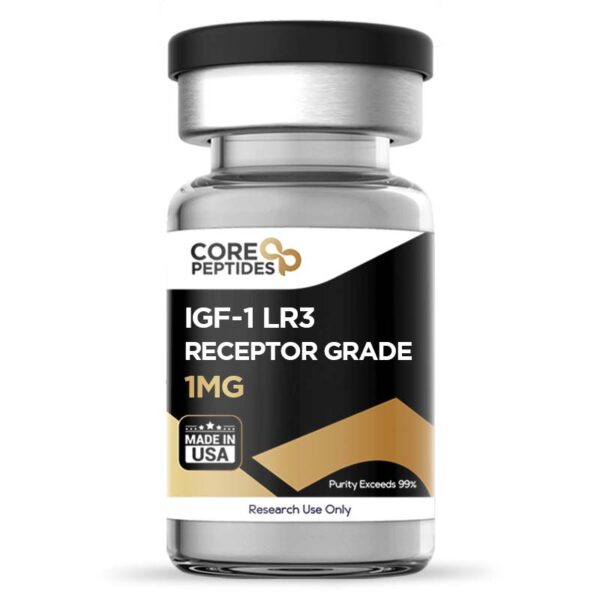
Receptor Grade IGF-1 LR3 (1MG)
CHF 135.00
IGF-1 LR3 (Long R3 Insulin-like Growth Factor-1) is a recombinant 83-amino acid analog of human IGF-1 featuring an arginine substitution at position 3 (Arg3) and a 13-amino acid N-terminal extension. These modifications dramatically reduce binding to IGF-binding proteins (IGFBPs), enhancing bioavailability and extending the functional half-life to approximately 20–30 hours a significant increase over native IGF-1. Researchers investigate IGF-1 LR3 for IGF-1 receptor signaling, cellular proliferation, protein synthesis, and growth factor research. Available for laboratory research purposes only. Buy IGF-1 LR3 in Switzerland from Core Peptides, a trusted research peptide supplier.
What Is IGF-1 LR3?
IGF-1 LR3 (Long R3 Insulin-like Growth Factor-1), also known as Long arginine 3-IGF-1, is a recombinant 83-amino acid analog of human insulin-like growth factor 1 (IGF-1). For researchers looking to buy IGF-1 LR3 in Switzerland for growth factor and receptor signaling studies, this modified peptide offers a uniquely stable and potent tool for investigating IGF-1 receptor biology and downstream anabolic pathways.
Native human IGF-1 is a 70-amino acid single-chain polypeptide that plays a central role in growth, development, and cellular metabolism. However, in circulation, over 95% of IGF-1 is bound to one of six IGF-binding proteins (IGFBPs), which regulate its bioavailability and limit its half-life. IGF-1 LR3 incorporates two critical modifications that overcome these limitations: an arginine substitution at position 3 (replacing glutamic acid) and a 13-amino acid N-terminal extension (MFPAMPLSSLFVN). These modifications significantly reduce IGFBP binding affinity while preserving full receptor agonism, resulting in a peptide with a functional half-life of approximately 20–30 hours—dramatically longer than native IGF-1’s 10–12 minutes in serum. For those looking to buy IGF-1 LR3 in Switzerland, Core Peptides offers high-quality receptor-grade material in 1mg quantities for laboratory applications.
IGF-1 LR3 Research Overview
IGF-1 LR3 has attracted sustained scientific interest as a modified form of endogenous IGF-1 with enhanced pharmacokinetic properties and potent biological activity across multiple tissue types. This peptide’s design—an 83-amino acid recombinant protein with a molecular weight of approximately 9,111 Da (CAS: 946870-92-4)—incorporates structural modifications that collectively alter its interaction with IGF-binding proteins without impairing receptor engagement.
Research interest in IGF-1 LR3 centers on its ability to activate the type 1 IGF receptor (IGF-1R), a transmembrane receptor tyrosine kinase expressed on virtually all mammalian cell types. Studies have demonstrated that IGF-1 LR3 is approximately three times more potent than native IGF-1 and exhibits significantly enhanced bioavailability due to reduced IGFBP sequestration. Consequently, IGF-1 LR3 has generated significant interest as a research tool for investigating IGF-1 receptor signaling, cellular proliferation, protein synthesis, and anabolic pathways.
When researchers choose to buy IGF-1 LR3 in Switzerland for laboratory studies, they gain access to a compound that may help elucidate mechanisms of growth factor signaling, cellular growth regulation, and metabolic control at the molecular level.
How Does IGF-1 LR3 Work?
IGF-1 LR3 exerts its biological effects primarily through binding to the type 1
IGF receptor (IGF-1R), a receptor tyrosine kinase that activates well-characterized intracellular signaling cascades.
IGF-1 Receptor Binding and Activation
IGF-1 LR3 binds to the IGF-1 receptor with similar affinity to wild-type IGF-1. Importantly, the peptide retains the pharmacological activity of IGF-1 as an agonist of the IGF-1 receptor. However, unlike native IGF-1, IGF-1 LR3 has very low affinity for IGF-binding proteins (IGFBPs), which in the native system sequester IGF-1 and limit its bioavailability. This reduced IGFBP binding results in a significantly higher proportion of the peptide remaining in its free, bioactive form.
Studies suggest that IGF-1 LR3 is better able to stimulate the type I IGF receptor and thus induce a higher level of activation of intracellular signaling molecules responsible for promoting cell survival by inhibition of apoptosis. Furthermore, the peptide’s enhanced potency is due to the markedly decreased binding of IGF-1 LR3 to IGF binding proteins, which normally inhibit the biological actions of IGFs.
PI3K/Akt/mTOR Signaling Pathway
Upon IGF-1R activation, insulin receptor substrate (IRS) proteins become phosphorylated, recruiting and activating phosphoinositide 3-kinase (PI3K). PI3K then generates PIP3 at the membrane, which recruits and activates Akt (protein kinase B). Akt phosphorylation drives:
- Protein synthesis — via activation of the mTOR complex (mTORC1), leading to phosphorylation of p70S6K and 4E-BP1
- Anti-apoptotic signaling — through phosphorylation and inactivation of pro-apoptotic factors BAD and caspase-9
- Glucose uptake — via GLUT4 transporter translocation to the cell membrane
MAPK/ERK Signaling Pathway
IGF-1R activation also engages the Ras→Raf→MEK→ERK cascade, which primarily drives cellular proliferation and differentiation, thereby contributing to the mitogenic effects of IGF-1 LR3.
Enhanced Stability and Bioavailability
The structural modifications of IGF-1 LR3—the Arg3 substitution and N-terminal extension—reduce the peptide’s affinity for IGFBPs. For instance, the charge reversal at position 3 (from negative glutamic acid to positive arginine) disrupts electrostatic contacts with the IGFBP binding cleft. Additionally, the N-terminal extension adds steric bulk that creates physical interference with the IGFBP binding interface. As a result, IGF-1 LR3 is approximately three times more potent than IGF-1 and possesses a significantly longer half-life of about 20–30 hours.
Researchers who buy IGF-1 LR3 in Switzerland for research purposes can investigate these mechanisms across diverse experimental models of growth factor signaling and cellular regulation.
Why Is IGF-1 LR3 Studied?
Researchers study IGF-1 LR3 primarily for its potential relevance to IGF-1 receptor signaling, cellular proliferation, protein synthesis, and anabolic pathways. The peptide’s enhanced potency and extended half-life make it a valuable tool for understanding the molecular basis of growth factor signaling and cellular growth regulation.
The peptide’s connection to the IGF-1/IGF-1R axis has made it a focus of endocrinology, cell biology, and metabolic research. Preclinical studies have explored IGF-1 LR3’s effects on cellular proliferation, protein synthesis, and tissue growth in various experimental models, including cell cultures and animal studies.
Moreover, researchers study IGF-1 LR3 in the context of serum-free cell culture optimization. Studies report that IGF-1 LR3 supports higher cell viability and protein production compared to other common cell stimulants, with cultures exposed to IGF-1 LR3 at concentrations above 0.05 μg/mL maintaining around 75–80% viability after 10 days.
Researchers who buy IGF-1 LR3 in Switzerland from Core Peptides can incorporate this peptide into their studies on IGF-1 receptor signaling, cellular growth pathways, protein synthesis, and metabolic regulation.
IGF-1 LR3 Research Areas
| Research Area | Description |
|---|---|
| IGF-1 Receptor Signaling | Investigating IGF-1 LR3’s activation of IGF-1R and downstream signaling cascades |
| Cellular Proliferation | Studying IGF-1 LR3’s effects on cell division and growth in various cell types |
| Protein Synthesis | Examining IGF-1 LR3’s activation of mTORC1 and regulation of protein production |
| Muscle Hypertrophy Research | Exploring IGF-1 LR3’s potential to support muscle growth and satellite cell activation |
| Apoptosis Regulation | Investigating IGF-1 LR3’s anti-apoptotic effects via Akt-mediated signaling |
| Glucose Metabolism | Studying IGF-1 LR3’s effects on glucose uptake and metabolic regulation |
| Serum-Free Cell Culture | Exploring IGF-1 LR3’s utility in supporting cell viability in serum-free conditions |
| Growth Factor Research | Investigating the molecular mechanisms of IGF-1 and related growth factors |
Scientific Research on IGF-1 LR3
Researchers have conducted extensive scientific studies on IGF-1 LR3 in both in vitro and preclinical settings, deriving evidence from cell cultures, receptor-binding assays, and animal models. This peptide originates from research on IGF-1 analogs designed to overcome the limitations of IGFBP binding.
In Vitro Evidence
In vitro studies using CHO cell proliferation assays have demonstrated that IGF-1 LR3 exhibits an ED50 of less than 10 ng/mL, corresponding to a specific activity of greater than 1.0 × 10^5 units/mg. Moreover, the peptide shows substantially higher potency than native IGF-1 due to its reduced IGFBP binding.
Research has shown that IGF-1 LR3 retains the pharmacological activity of IGF-1 as an agonist of the IGF-1 receptor while having very low affinity for IGF-binding proteins. These studies demonstrate that IGF-1 LR3 is better able to stimulate the type I IGF receptor and thus induce a higher level of activation of intracellular signaling molecules responsible for promoting cell survival by inhibition of apoptosis.
Additionally, cell culture studies have demonstrated that IGF-1 LR3 supports higher cell viability and protein production compared to other common cell stimulants, with cultures exposed to IGF-1 LR3 at concentrations above 0.05 μg/mL maintaining around 75–80% viability after 10 days.
Preclinical Animal Studies
In rodent models, researchers have investigated IGF-1 LR3’s effects on growth and tissue development. For instance, studies have examined the anabolic effects of IGF-1 and IGF-1 variants in normal and dexamethasone-treated rats, with LR3IGF-I showing particularly striking responses. Research has also explored the effects of prolonged administration of IGF peptides on gastrointestinal tissues in normal rats.
Studies suggest that IGF-1 LR3’s modified structure prevents binding to IGF-binding proteins, making it more available to interact with anabolic IGF-1 receptors. Therefore, this increased availability of free, bioactive IGF-1 may support IGF-1 receptor activation, leading to a more robust anabolic response in laboratory settings.
Human Research
IGF-1 LR3 has limited human clinical evidence. The peptide is a research-grade compound intended for laboratory use only, and it is not FDA-approved for human consumption, therapeutic use, or medical treatment. Researchers are responsible for ensuring compliance with all applicable laws and regulations governing the use of research peptides in their jurisdiction. Scientists who buy IGF-1 LR3 in Switzerland should remain aware of these evidence considerations.
IGF-1 LR3 Compared With Related Peptides
| Peptide | Relationship to IGF-1 LR3 | Key Differences |
|---|---|---|
| Native IGF-1 | Parent compound; IGF-1 LR3 is a modified analog | Native IGF-1 has 70 amino acids, high IGFBP affinity, 10–12 min half-life; IGF-1 LR3 has 83 amino acids, reduced IGFBP affinity, 20–30 hour half-life |
| IGF-1 DES | Both are IGF-1 analogs | IGF-1 DES lacks the first three amino acids; different receptor binding kinetics and tissue specificity |
| MGF (Mechano Growth Factor) | Both are IGF-1 splice variants/analogs | MGF is a 24-amino acid C-terminal fragment of IGF-1Ec; IGF-1 LR3 is a full-length IGF-1 analog |
| PEG-MGF | Both studied for growth and tissue research | PEG-MGF is PEGylated MGF targeting satellite cells; IGF-1 LR3 is a full-length IGF-1 receptor agonist |
| Growth Hormone (GH) | IGF-1 is the primary mediator of GH effects | GH acts indirectly via IGF-1 production; IGF-1 LR3 acts directly on the IGF-1 receptor |
Research Applications
Researchers utilize IGF-1 LR3 in a variety of laboratory research applications, primarily in the fields of cell biology, endocrinology, and metabolic research. Key research applications include:
- IGF-1 Receptor Signaling Studies: Investigating IGF-1 LR3’s activation of IGF-1R and downstream signaling cascades
- Cellular Proliferation Research: Studying IGF-1 LR3’s effects on cell division and growth in various cell types
- Protein Synthesis Studies: Examining IGF-1 LR3’s activation of mTORC1 and regulation of protein production
- Muscle Hypertrophy Research: Exploring IGF-1 LR3’s potential to support muscle growth and satellite cell activation
- Apoptosis Regulation Studies: Investigating IGF-1 LR3’s anti-apoptotic effects via Akt-mediated signaling
- Glucose Metabolism Research: Studying IGF-1 LR3’s effects on glucose uptake and metabolic regulation
- Serum-Free Cell Culture Studies: Exploring IGF-1 LR3’s utility in supporting cell viability in serum-free conditions
- Growth Factor Research: Investigating the molecular mechanisms of IGF-1 and related growth factors
Researchers who buy IGF-1 LR3 in Switzerland can incorporate this peptide into their experimental protocols across these diverse research areas.
IGF-1 LR3 Product Specifications
| Specification | Detail |
|---|---|
| Product Name | IGF-1 LR3 (Long R3 Insulin-like Growth Factor-1) |
| Amount | 1mg |
| Form | Lyophilized powder |
| Sequence (One-Letter) | MFPAMPLSSLFVNGPRTLCGAELVDALQFVCGDRGFYFNKPTGYGSSSRRAPQTGIVDECCFRSCDLRRLEMYCAPLKPAKSA |
| Length | 83 amino acids |
| Molecular Formula | C400H625N111O115S9 |
| Molecular Weight | Approximately 9,111–9,117.5 g/mol |
| CAS Number | 946870-92-4 |
| Half-Life | Approximately 20–30 hours |
| Modifications | Arg3 substitution + 13-amino acid N-terminal extension |
| Source | E. coli expression system |
| Purity | ≥ 95% (by SDS-PAGE) |
| Endotoxin Level | < 1 EU/μg (by LAL method) |
| Storage | Lyophilized: 6 months at -80°C; reconstituted: 3 months at -20°C |
How to Evaluate IGF-1 LR3 Quality
When sourcing IGF-1 LR3 for research purposes, researchers should consider several quality indicators. A reliable IGF-1 LR3 peptide supplier should provide:
- Identity Confirmation: Analytical verification that the peptide matches the expected 83-amino acid sequence (MFPAMPLSSLFVNGPRTLCGAELVDALQFVCGDRGFYFNKPTGYGSSSRRAPQTGIVDECCFRSCDLRRLEMYCAPLKPAKSA) and molecular weight (approximately 9,111 g/mol)
- Purity Analysis: Documentation of purity through methods such as SDS-PAGE and HPLC – receptor grade typically provides ≥95% purity
- Receptor Grade Designation: Confirmation of “Receptor Grade” status, indicating higher purity compared to alternatives such as Media Grade
- Biological Activity: Documentation of ED50 (typically < 10 ng/mL in CHO cell proliferation assays)
- Endotoxin Level: Verification of low endotoxin levels (< 1 EU/μg)
- Batch Information: Clear lot numbers and batch traceability
- Certificate of Analysis (CoA): Documentation of analytical testing results
- Proper Labeling: Accurate product identification and storage instructions
Researchers looking to buy IGF-1 LR3 in Switzerland should seek suppliers who provide comprehensive documentation and quality assurance. Core Peptides remains committed to supporting research with properly documented products.
Understanding the Certificate of Analysis
A Certificate of Analysis (CoA) provides analytical data for a specific batch of a research peptide. For IGF-1 LR3 research, a CoA typically includes:
- Identity Confirmation: Mass spectrometry or other analytical methods confirming the peptide’s identity
- Purity Assessment: SDS-PAGE and HPLC chromatograms showing the purity of the peptide
- Biological Activity Data: ED50 values from cell-based proliferation assays
- Endotoxin Testing: LAL method results confirming low endotoxin levels
- Batch/Lot Information: Unique identifiers for traceability
- Analytical Methods: Description of the testing methods used
Importantly, researchers should understand that a CoA demonstrates the chemical identity and purity of a peptide but does not establish safety, efficacy, therapeutic effectiveness, or suitability for human use. The CoA serves as a quality control document for research purposes only.
Storage and Stability
Proper storage of research peptides is essential for maintaining their integrity and stability. For IGF-1 LR3, researchers should refer to the product documentation provided with their order for specific storage recommendations.
General best practices for IGF-1 LR3 storage include:
- Lyophilized peptide: Stable for up to 6 months at -80°C from the date of receipt
- Reconstituted stock solution: Can be stored for at least 3 months at -20°C
- Working aliquots: Stable for 1 week at 2-8°C and for 6 months at -20°C to -80°C
- Avoid repeated freeze-thaw cycles: Aliquot reconstituted peptide to prevent degradation
- Reconstitution buffer: Typically reconstituted in 10mM HCl at 1mg/ml
For specific temperature requirements and reconstitution protocols, consult the applicable product documentation or contact Core Peptides for the applicable storage specifications.
Research Considerations
Researchers incorporating IGF-1 LR3 into their studies should be aware of several important considerations:
- Evidence Limitations: IGF-1 LR3 has limited human clinical evidence. The peptide is a research-grade compound intended for laboratory use only and is not FDA-approved for human consumption or therapeutic use.
- Experimental Status: Researchers consider IGF-1 LR3 an experimental compound. Therefore, findings should be interpreted within the context of early-stage research.
- Model Differences: Results from cell cultures and animal models may not translate directly to human outcomes.
- Regulatory Status: IGF-1 LR3 is not FDA-approved and is intended for laboratory research use only.
- Quality Considerations: Researchers should verify the quality and identity of their IGF-1 LR3 through appropriate analytical methods.
- Receptor Specificity: IGF-1 LR3 acts as an agonist of the IGF-1 receptor. Researchers should consider appropriate experimental approaches to investigate IGF-1R signaling pathways.
- Purity Grade: “Receptor Grade” indicates higher purity compared to alternatives such as Media Grade. This higher purity may prove crucial for laboratory studies on cellular growth, IGF receptors, and IGF-binding proteins.
Researchers who buy IGF-1 LR3 in Switzerland should ensure their studies include appropriate controls and interpret findings with scientific rigor.
Frequently Asked Questions About IGF-1 LR3
What is IGF-1 LR3?
IGF-1 LR3 (Long R3 Insulin-like Growth Factor-1) is a recombinant 83-amino acid analog of human IGF-1 with an arginine substitution at position 3 and a 13-amino acid N-terminal extension.
What is IGF-1 LR3 researched for?
Researchers primarily investigate IGF-1 LR3 for its activation of the IGF-1 receptor, downstream PI3K/Akt and MAPK/ERK signaling, cellular proliferation, protein synthesis, and anabolic pathways.
What is the amino acid sequence of IGF-1 LR3?
The amino acid sequence of IGF-1 LR3 is MFPAMPLSSLFVNGPRTLCGAELVDALQFVCGDRGFYFNKPTGYGSSSRRAPQTGIVDECCFRSCDLRRLEMYCAPLKPAKSA.
What is the molecular weight of IGF-1 LR3?
The molecular weight of IGF-1 LR3 is approximately 9,111–9,117.5 g/mol.
What is the CAS number for IGF-1 LR3?
The CAS number for IGF-1 LR3 is 946870-92-4.
How does IGF-1 LR3 differ from native IGF-1?
Native IGF-1 has 70 amino acids, high IGFBP affinity, and a 10–12 minute half-life. IGF-1 LR3 has 83 amino acids, reduced IGFBP affinity, and a 20–30 hour half-life.
What is the mechanism of action for IGF-1 LR3?
IGF-1 LR3 binds to the IGF-1 receptor (IGF-1R), activating PI3K/Akt/mTOR and MAPK/ERK signaling pathways that drive protein synthesis, cell proliferation, and anti-apoptotic signaling.
What is the half-life of IGF-1 LR3?
IGF-1 LR3 has a functional half-life of approximately 20–30 hours, significantly longer than native IGF-1.
What is “Receptor Grade” IGF-1 LR3?
“Receptor Grade” refers to the higher purity of this research reagent compared to alternatives such as Media Grade. This higher purity may prove crucial for laboratory studies on cellular growth, IGF receptors, and IGF-binding proteins.
Is IGF-1 LR3 FDA-approved?
IGF-1 LR3 is not FDA-approved. It is intended for laboratory research use only and is not approved for human consumption or therapeutic use.
Can I buy IGF-1 LR3 in Switzerland?
Yes, researchers can buy IGF-1 LR3 in Switzerland from Core Peptides for laboratory research purposes.
What is the primary research category for IGF-1 LR3?
IGF-1 LR3 belongs to the Cellular Research & Signaling category, with secondary relevance to Growth Hormone Peptides research.
What related peptides are studied alongside IGF-1 LR3?
Related peptides include native IGF-1, IGF-1 DES, MGF, PEG-MGF, and Growth Hormone.
How should IGF-1 LR3 be stored?
Lyophilized IGF-1 LR3 should be stored at -80°C for up to 6 months. Reconstituted stock solutions can be stored at -20°C for up to 3 months. Avoid repeated freeze-thaw cycles.
What is the purity of Core Peptides’ IGF-1 LR3?
Core Peptides provides IGF-1 LR3 with a purity of ≥95% as verified by SDS-PAGE analysis.
Related Research Peptides
Researchers interested in IGF-1 LR3 may also find the following related peptides relevant to their work:
- IGF-1 DES – An IGF-1 analog lacking the first three amino acids, studied for receptor binding research
- MGF (Mechano Growth Factor) – A 24-amino acid splice variant of IGF-1Ec studied for muscle repair
- PEG-MGF – A PEGylated form of MGF with extended half-life
- Growth Hormone – The upstream regulator of IGF-1 production, studied for growth and metabolic research
- CJC-1295 – A growth hormone secretagogue often studied alongside IGF-1 research
For a comprehensive selection of research peptides in Switzerland, explore the Core Peptides catalog.
Explore Cellular Research & Signaling Peptides
IGF-1 LR3 is part of our Cellular Research & Signaling category, which features a range of research peptides investigated for their effects on cellular function, receptor signaling, and growth factor pathways. Browse our selection to find the right peptides for your laboratory research.
Explore Related Research Categories
Researchers may also find the following related categories relevant to IGF-1 LR3 research:
- Growth Hormone Peptides – Peptides studied for growth and metabolic research
- Healing & Regeneration Peptides – Peptides investigated for tissue repair and regeneration
- Muscle & Performance Peptides – Peptides studied for muscle function and performance research
Further Research
Researchers interested in learning more about IGF-1 LR3 and related peptides should consult the primary scientific literature. Key areas of investigation include IGF-1 receptor signaling, PI3K/Akt/mTOR pathways, cellular proliferation, and growth factor biology. The PubMed database is an excellent resource for accessing peer-reviewed research articles on these topics.
Research Disclaimer
Core Peptides supplies IGF-1 LR3 as a research peptide for laboratory research purposes only. It is not approved for human consumption, therapeutic use, or medical treatment. All information provided is for educational and scientific reference purposes only and does not constitute medical advice. Researchers are responsible for ensuring compliance with all applicable laws and regulations governing the use of research peptides in their jurisdiction, including Switzerland.
Recensisci per primo “Receptor Grade IGF-1 LR3 (1MG)”
Devi effettuare l’accesso per pubblicare una recensione.
Prodotti correlati
Cellular Research & Signaling
Anti-Aging & Longevity Peptides
Cellular Research & Signaling
Cellular Research & Signaling
Cellular Research & Signaling
Cellular Research & Signaling
Anti-Aging & Longevity Peptides
Recensioni
Ancora non ci sono recensioni.