
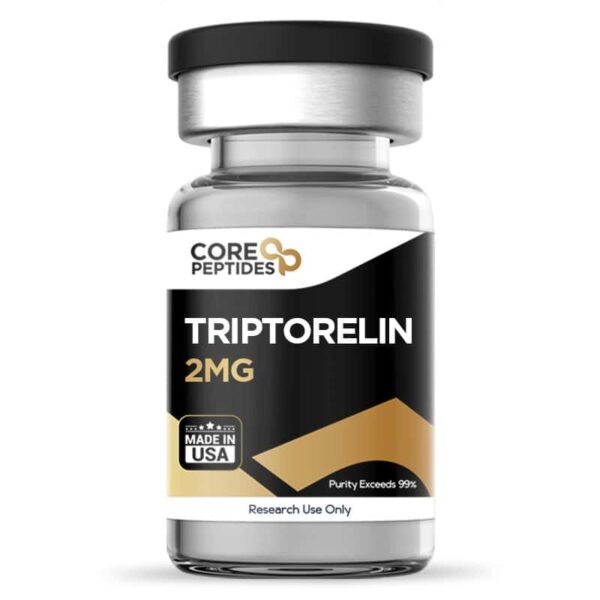
Triptorelin (2MG)
CHF 48.60
Triptorelin is a synthetic decapeptide agonist analog of gonadotropin-releasing hormone (GnRH/LHRH) with the sequence pGlu-His-Trp-Ser-Tyr-D-Trp-Leu-Arg-Pro-Gly-NH2. The D-Trp6 substitution enhances receptor binding affinity and resistance to enzymatic degradation compared to native GnRH. Researchers investigate Triptorelin for its high-affinity binding to GnRH receptors (Ki = 0.3 nM), activation of Gq/11-mediated signaling, and the paradoxical desensitization that occurs with continuous administration leading to suppression of LH and FSH secretion. Available for laboratory research purposes only. Buy Triptorelin in Switzerland from Core Peptides, a trusted research peptide supplier.
What Is Triptorelin?
Triptorelin is a synthetic decapeptide agonist analog of gonadotropin-releasing hormone (GnRH), also known as luteinizing hormone-releasing hormone (LHRH). The peptide has the amino acid sequence pGlu-His-Trp-Ser-Tyr-D-Trp-Leu-Arg-Pro-Gly-NH2 and incorporates a D-tryptophan substitution at position 6 (D-Trp6). This modification distinguishes Triptorelin from native GnRH, which contains glycine at position 6, and significantly enhances the peptide’s receptor binding affinity and resistance to enzymatic degradation. For those looking to buy Triptorelin in Switzerland, Core Peptides offers high-quality research-grade material for laboratory applications.
As a decapeptide—a peptide composed of ten amino acids—Triptorelin is structurally similar to endogenous GnRH but exhibits substantially greater potency and a longer half-life. The peptide is commonly supplied as the acetate salt and is identified by CAS number 57773-63-4 (free base), with a molecular formula of C64H82N18O13 and a molecular weight of approximately 1,311.5 g/mol. The acetate salt form has the molecular formula C64H82N18O13·C2H4O2.
Triptorelin Research Overview
Triptorelin has attracted sustained research interest as a well-characterized GnRH agonist with a substantial body of literature spanning several decades. It is one of the most potent and stable GnRH analogs developed, with the D-Trp6 substitution conferring enhanced receptor binding affinity and resistance to proteolytic cleavage.
Research interest in Triptorelin centers on its high-affinity binding to the GnRH receptor (GnRHR), a G-protein coupled receptor that signals primarily through Gq/11. Studies have demonstrated that Triptorelin binds to GnRHR with a Ki of 0.3 nM in CHO cells expressing the human receptor. The peptide’s mechanism involves a biphasic response: acute administration stimulates LH and FSH secretion, while continuous exposure leads to receptor desensitization and suppression of gonadotropin release. Consequently, Triptorelin has generated significant interest as a research tool for investigating GnRH receptor signaling, endocrine regulation, pituitary function, and hormone-sensitive cancer models.
When researchers choose to buy Triptorelin in Switzerland for laboratory studies, they gain access to a compound that may help elucidate mechanisms of GnRH receptor signaling, pituitary desensitization, and endocrine regulation at the molecular level.
How Does Triptorelin Work?
Triptorelin exerts its biological effects through binding to the GnRH receptor (GnRHR), a G-protein coupled receptor expressed on gonadotrope cells of the anterior pituitary. The peptide’s mechanism involves a well-characterized biphasic response.
GnRH Receptor Binding and Acute Stimulation
Triptorelin binds with high affinity to the GnRH receptor on anterior pituitary gonadotropes. Like native GnRH, Triptorelin acts as an agonist at the receptor, activating Gq/11-mediated signaling cascades that lead to the acute secretion of luteinizing hormone (LH) and follicle-stimulating hormone (FSH) from the anterior pituitary. This initial stimulation produces a transient rise in LH, FSH, and, in males, testosterone levels.
The D-Trp6 substitution at position 6 significantly enhances the peptide’s receptor binding affinity and resistance to enzymatic degradation compared to native GnRH, making Triptorelin substantially more potent.
Receptor Desensitization and Suppression
With prolonged, continuous administration, Triptorelin paradoxically inhibits gonadotropin secretion through desensitization of pituitary GnRH receptors. Continuous exposure leads to down-regulation of GnRH receptors and suppression of pulsatile LH and FSH release. This results in a profound reduction in circulating LH and FSH levels, leading to suppressed gonadal steroidogenesis—a state often referred to as « chemical castration ».
Research has demonstrated that Triptorelin induces desensitization of pituitary gonadotropic cells, and its effects on gonadotropin secretion are mediated through alterations in GnRH receptor gene expression.
Direct Cellular Effects
Beyond its pituitary-mediated endocrine effects, Triptorelin has been shown to exert direct effects on cells that express GnRH receptors outside the pituitary, including certain cancer cell lines. Studies have explored the antiproliferative effects of Triptorelin in prostate cancer cell lines (LNCaP, PC3, DU145) and ovarian cancer cells. Research has also demonstrated that Triptorelin (10 µM) reduces actin polymerization in primary endometrial epithelial cells.
Researchers who buy Triptorelin in Switzerland for research purposes can investigate these mechanisms across diverse experimental models of endocrine regulation, receptor signaling, and oncology research.
Why Is Triptorelin Studied?
Researchers study Triptorelin primarily for its potential relevance to GnRH receptor signaling, endocrine regulation, pituitary function, and hormone-sensitive cancer research. The peptide’s ability to both acutely stimulate and chronically suppress gonadotropin secretion makes it a valuable tool for understanding the molecular basis of the hypothalamic-pituitary-gonadal axis.
Triptorelin has been extensively studied in the context of hormone-sensitive cancers. Research has investigated its effects on prostate cancer cell lines, including LNCaP and PC3 cells, which are respectively responsive and unresponsive to androgen stimulation. The peptide inhibits the growth of DU145, LNCaP, and PC3 prostate cancer cells and OVCAR-3 ovarian cancer cells. Triptorelin has also been studied in endometrial cancer models.
Moreover, researchers study Triptorelin in the context of endocrine disorders and reproductive health. The peptide has been investigated for its effects on pubertal development, as well as its role in luteal phase support in insemination cycles. In animal models, Triptorelin has been shown to cause reversible testicular atrophy while maintaining sperm production.
Researchers who buy Triptorelin in Switzerland from Core Peptides can incorporate this peptide into their studies on GnRH receptor signaling, endocrine regulation, pituitary function, and hormone-sensitive cancer models.
Triptorelin Research Areas
| Research Area | Description |
|---|---|
| GnRH Receptor Signaling | Investigating Triptorelin’s high-affinity binding (Ki = 0.3 nM) and Gq/11-mediated signaling at GnRHR |
| Pituitary Desensitization | Studying the paradoxical suppression of LH/FSH secretion with continuous administration |
| Endocrine Regulation | Examining Triptorelin’s effects on the hypothalamic-pituitary-gonadal axis |
| Prostate Cancer Research | Investigating Triptorelin’s antiproliferative effects on LNCaP, PC3, and DU145 cells |
| Ovarian Cancer Research | Exploring Triptorelin’s effects on OVCAR-3 ovarian cancer cells |
| Endometrial Cancer Research | Studying Triptorelin’s direct effects on endometrial epithelial cells |
| Reproductive Endocrinology | Preclinical research into Triptorelin’s effects on puberty and fertility |
| Receptor-Ligand Interactions | Investigating the molecular basis of GnRH receptor binding and activation |
Scientific Research on Triptorelin
Researchers have conducted extensive scientific studies on Triptorelin in both in vitro and in vivo settings, deriving evidence from cell cultures, preclinical models, and clinical research. The peptide has a substantial research history spanning several decades.
In Vitro Evidence
In vitro studies using receptor-binding assays have demonstrated that Triptorelin binds to the GnRH receptor with high affinity (Ki = 0.3 nM in CHO cells expressing the human receptor). The peptide’s D-Trp6 substitution enhances receptor binding affinity and resistance to proteolysis compared to native GnRH.
Research has shown that Triptorelin inhibits the growth of DU145, LNCaP, and PC3 prostate cancer cells and OVCAR-3 ovarian cancer cells. Studies have also demonstrated that Triptorelin (10 µM) reduces actin polymerization in primary endometrial epithelial cells, suggesting direct cellular effects beyond pituitary-mediated endocrine actions.
Furthermore, molecular docking studies have identified Triptorelin as having the highest binding energy (-12.1 kcal/mol) among tested compounds for STEAP2, a protein implicated in prostate cancer.
Preclinical Studies
In animal models, researchers have investigated Triptorelin’s effects on the hypothalamic-pituitary-gonadal axis. Studies have examined the comparative effects of different GnRH agonists, including Triptorelin, on pubertal development in female rats. Research has also explored Triptorelin’s effects on testicular function, demonstrating that it causes reversible, focal, and partial testicular atrophy in rats while maintaining sperm production.
Triptorelin has been studied in the context of prostate cancer, with research demonstrating that Triptorelin treatment results in a significant decrease in total gland and tumor volume and a reduction in serum levels of PSA and testosterone.
Human Research
Triptorelin has been extensively studied in human clinical research and is approved for use in various indications, including advanced prostate cancer, precocious puberty, and endometriosis. In the United States, it is available as Triptorelin Pamoate for injectable suspension (brand names Trelstar and Diphereline).
Research has also investigated Triptorelin’s role in reproductive medicine, including its use as luteal phase support in insemination cycles.
Nevertheless, researchers should note that Triptorelin is supplied for laboratory research purposes only. Scientists who buy Triptorelin in Switzerland should remain aware of these evidence considerations.
Triptorelin Compared With Related Peptides
| Peptide | Relationship to Triptorelin | Key Differences |
|---|---|---|
| Native GnRH (LHRH) | Parent compound; Triptorelin is a modified analog | Native GnRH has glycine at position 6; Triptorelin has D-Trp6, enhancing potency and stability |
| Leuprolide (Leuprorelin) | Both are GnRH agonists with D-amino acid substitutions | Leuprolide has D-Leu6; Triptorelin has D-Trp6; both are clinically used GnRH agonists |
| Goserelin | Both are GnRH agonists | Goserelin has D-Ser(But)6 and a C-terminal azaglycine amide; Triptorelin has D-Trp6 |
| Buserelin | Both are GnRH agonists | Buserelin has D-Ser(But)6; Triptorelin has D-Trp6; both are GnRH analogs |
| Cetrorelix | Both target GnRH receptors | Cetrorelix is a GnRH antagonist; Triptorelin is an agonist with different mechanism |
Research Applications
Researchers utilize Triptorelin in a variety of laboratory research applications, primarily in the fields of endocrinology, oncology, and receptor pharmacology. Key research applications include:
- GnRH Receptor Studies: Investigating Triptorelin’s high-affinity binding (Ki = 0.3 nM) and signaling at GnRHR
- Pituitary Desensitization Research: Studying the paradoxical suppression of LH/FSH secretion with continuous administration
- Endocrine Regulation Studies: Examining Triptorelin’s effects on the hypothalamic-pituitary-gonadal axis
- Prostate Cancer Research: Investigating Triptorelin’s antiproliferative effects on LNCaP, PC3, and DU145 cells
- Ovarian Cancer Research: Exploring Triptorelin’s effects on OVCAR-3 ovarian cancer cells
- Endometrial Cancer Research: Studying Triptorelin’s direct effects on endometrial epithelial cells
- Reproductive Endocrinology Research: Preclinical research into Triptorelin’s effects on puberty and fertility
- Receptor-Ligand Interaction Studies: Investigating the molecular basis of GnRH receptor binding and activation
Researchers who buy Triptorelin in Switzerland can incorporate this peptide into their experimental protocols across these diverse research areas.
Triptorelin Product Specifications
| Specification | Detail |
|---|---|
| Product Name | Triptorelin (GnRH Agonist) |
| Amount | 2mg |
| Form | Lyophilized powder |
| Sequence (One-Letter) | pGlu-His-Trp-Ser-Tyr-D-Trp-Leu-Arg-Pro-Gly-NH2 |
| Sequence (Three-Letter) | Pyroglutamyl-Histidyl-Tryptophyl-Seryl-Tyrosyl-D-Tryptophyl-Leucyl-Arginyl-Prolyl-Glycinamide |
| Length | 10 amino acids |
| Modification | D-Trp6 substitution (vs. Gly6 in native GnRH) |
| Molecular Formula (Free Base) | C64H82N18O13 |
| Molecular Weight (Free Base) | Approximately 1,311.5 g/mol |
| Molecular Formula (Acetate) | C64H82N18O13·C2H4O2 |
| CAS Number (Free Base) | 57773-63-4 |
| N-Terminal Modification | Pyroglutamyl (pGlu) |
| C-Terminal Modification | Amidation (-NH2) |
| Synonyms | D-Trp6-GnRH, (D-Trp6)-LHRH, Decapeptyl, Diphereline, Trelstar |
| Receptor Binding (Ki) | 0.3 nM (human GnRHR in CHO cells) |
| Mechanism | GnRH receptor agonist; Gq/11 signaling; acute LH/FSH stimulation; chronic receptor desensitization |
| Research Category | Cellular Research & Signaling |
| Purity | >98% (HPLC) |
| Storage | Store desiccated at -20°C, protected from light |
How to Evaluate Triptorelin Quality
When sourcing Triptorelin for research purposes, researchers should consider several quality indicators. A reliable Triptorelin peptide supplier should provide:
- Identity Confirmation: Analytical verification that the peptide matches the expected decapeptide sequence (pGlu-His-Trp-Ser-Tyr-D-Trp-Leu-Arg-Pro-Gly-NH2) and molecular weight (approximately 1,311.5 g/mol)
- Purity Analysis: Documentation of purity through methods such as HPLC – research grade typically provides >98% purity
- D-Trp6 Confirmation: Verification of the D-tryptophan substitution at position 6, which is essential for the peptide’s enhanced potency and stability
- Batch Information: Clear lot numbers and batch traceability
- Certificate of Analysis (CoA): Documentation of analytical testing results
- Appearance: White to off-white lyophilized powder
- Solubility: Soluble in water and dilute acetic acid
Researchers looking to buy Triptorelin in Switzerland should seek suppliers who provide comprehensive documentation and quality assurance. Core Peptides remains committed to supporting research with properly documented products.
Understanding the Certificate of Analysis
A Certificate of Analysis (CoA) provides analytical data for a specific batch of a research peptide. For Triptorelin research, a CoA typically includes:
- Identity Confirmation: Mass spectrometry or other analytical methods confirming the peptide’s identity
- Purity Assessment: HPLC chromatograms showing the purity of the peptide
- Batch/Lot Information: Unique identifiers for traceability
- Analytical Methods: Description of the testing methods used
Importantly, researchers should understand that a CoA demonstrates the chemical identity and purity of a peptide but does not establish safety, efficacy, therapeutic effectiveness, or suitability for human use. The CoA serves as a quality control document for research purposes only.
Storage and Stability
Proper storage of research peptides is essential for maintaining their integrity and stability. For Triptorelin, researchers should refer to the product documentation provided with their order for specific storage recommendations.
General best practices for Triptorelin storage include keeping the lyophilized peptide desiccated, protected from light, and stored at -20°C or below. The peptide is soluble in water and dilute acetic acid. For specific temperature requirements and reconstitution protocols, consult the applicable product documentation or contact Core Peptides for the applicable storage specifications.
Research Considerations
Researchers incorporating Triptorelin into their studies should be aware of several important considerations:
- Clinical Status: Triptorelin has been extensively studied in human clinical research and is approved for various indications globally. However, the peptide is supplied for laboratory research purposes only.
- Experimental Status: Researchers consider Triptorelin a well-characterized compound with a substantial evidence base, but findings should be interpreted within the context of ongoing research.
- Model Differences: Results from cell cultures and animal models may not translate directly to human outcomes.
- Regulatory Status: Triptorelin is not FDA-approved for research applications and is intended for laboratory research use only.
- Quality Considerations: Researchers should verify the quality and identity of their Triptorelin through appropriate analytical methods.
- Mechanistic Context: Triptorelin’s proposed mechanisms involve GnRH receptor binding, Gq/11 signaling, acute LH/FSH stimulation, and chronic receptor desensitization. Researchers should consider appropriate experimental approaches to investigate these pathways.
- Biphasic Response: Triptorelin produces a biphasic response—acute stimulation followed by chronic suppression—which may influence experimental design and interpretation.
Researchers who buy Triptorelin in Switzerland should ensure their studies include appropriate controls and interpret findings with scientific rigor.
Frequently Asked Questions About Triptorelin
What is Triptorelin?
Triptorelin is a synthetic decapeptide agonist analog of gonadotropin-releasing hormone (GnRH/LHRH) with the sequence pGlu-His-Trp-Ser-Tyr-D-Trp-Leu-Arg-Pro-Gly-NH2 and a D-Trp6 substitution that enhances potency and stability.
What is Triptorelin researched for?
Researchers primarily investigate Triptorelin for its high-affinity GnRH receptor binding (Ki = 0.3 nM), Gq/11-mediated signaling, acute LH/FSH stimulation, chronic receptor desensitization, and applications in hormone-sensitive cancer research.
What is the amino acid sequence of Triptorelin?
The amino acid sequence of Triptorelin is pGlu-His-Trp-Ser-Tyr-D-Trp-Leu-Arg-Pro-Gly-NH2.
What is the molecular weight of Triptorelin?
The molecular weight of Triptorelin is approximately 1,311.5 g/mol.
What is the CAS number for Triptorelin?
The CAS number for Triptorelin (free base) is 57773-63-4.
What is the mechanism of action for Triptorelin?
Triptorelin binds to the GnRH receptor on pituitary gonadotropes, acutely stimulating LH and FSH secretion. With continuous administration, it desensitizes receptors and suppresses gonadotropin release, reducing gonadal steroidogenesis.
What is the significance of the D-Trp6 substitution?
The D-Trp6 substitution at position 6 enhances receptor binding affinity and resistance to enzymatic degradation compared to native GnRH, making Triptorelin substantially more potent.
What cancer cell lines has Triptorelin been studied in?
Triptorelin has been studied in prostate cancer cell lines (LNCaP, PC3, DU145) and ovarian cancer cells (OVCAR-3).
Is Triptorelin the same as Decapeptyl?
Yes, Decapeptyl is a brand name for Triptorelin.
Can I buy Triptorelin in Switzerland?
Yes, researchers can buy Triptorelin in Switzerland from Core Peptides for laboratory research purposes.
What is the primary research category for Triptorelin?
Triptorelin belongs to the Cellular Research & Signaling category, with secondary relevance to Anti-Aging & Longevity research.
What related peptides are studied alongside Triptorelin?
Related peptides include native GnRH, Leuprolide, Goserelin, Buserelin, and Cetrorelix.
What is the purity of Core Peptides’ Triptorelin?
Core Peptides provides Triptorelin with a purity of >98% as verified by HPLC analysis.
How should Triptorelin be stored?
Triptorelin should be stored lyophilized, desiccated, protected from light, at -20°C or below.
Related Research Peptides
Researchers interested in Triptorelin may also find the following related peptides relevant to their work:
- Leuprolide (Leuprorelin) – A GnRH agonist with D-Leu6 substitution, studied for GnRH receptor research
- Goserelin – A GnRH agonist with D-Ser(But)6, studied for GnRH receptor research
- Buserelin – A GnRH agonist with D-Ser(But)6, studied for GnRH receptor research
- Cetrorelix – A GnRH antagonist studied for receptor blockade research
- Native GnRH – The endogenous decapeptide studied for hypothalamic-pituitary-gonadal axis research
For a comprehensive selection of research peptides in Switzerland, explore the Core Peptides catalog.
Explore Cellular Research & Signaling Peptides
Triptorelin is part of our Cellular Research & Signaling category, which features a range of research peptides investigated for their effects on receptor signaling, endocrine regulation, and cellular communication. Browse our selection to find the right peptides for your laboratory research.
Explore Related Research Categories
Researchers may also find the following related categories relevant to Triptorelin research:
- Anti-Aging & Longevity – Peptides investigated for age-related endocrine research
- Fertility & Hormone Research – Peptides studied for reproductive and hormonal research
- Cognitive & Nootropic Peptides – Peptides studied for neurological and cognitive research
Further Research
Researchers interested in learning more about Triptorelin and related peptides should consult the primary scientific literature. Key areas of investigation include GnRH receptor biology, Gq/11 signaling, pituitary desensitization, and hormone-sensitive cancer research. The PubMed database is an excellent resource for accessing peer-reviewed research articles on these topics.
Research Disclaimer
Core Peptides supplies Triptorelin as a research peptide for laboratory research purposes only. All information provided is for educational and scientific reference purposes only and does not constitute medical advice. Researchers are responsible for ensuring compliance with all applicable laws and regulations governing the use of research peptides in their jurisdiction, including Switzerland.
Soyez le premier à laisser votre avis sur “Triptorelin (2MG)”
Vous devez être connecté pour publier un avis.
Produits similaires
Fertility & Hormone Research
Fertility & Hormone Research
Fertility & Hormone Research
Fertility & Hormone Research
Avis
Il n’y a pas encore d’avis.