
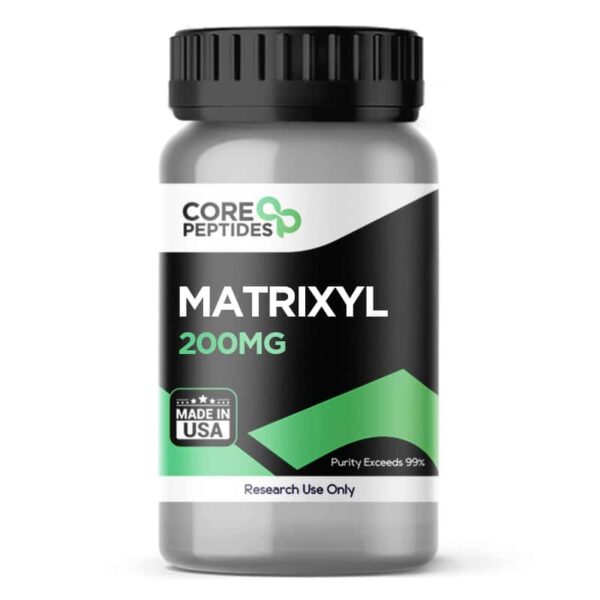
Matrixyl (200MG)

CHF 153.90
Matrixyl (Palmitoyl Pentapeptide-4, Pal-KTTKS) is a synthetic palmitoylated pentapeptide with the sequence Palmitoyl-Lys-Thr-Thr-Lys-Ser-OH (Pal-KTTKS). This 200mg research peptide is a matrikine a signaling peptide fragment derived from the C-terminal propeptide of type I collagen that stimulates fibroblasts to produce extracellular matrix components. Researchers study Matrixyl for its ability to upregulate collagen types I, III, and IV, fibronectin, and glycosaminoglycans, making it a valuable tool for dermatological research, wound healing studies, and extracellular matrix biology. Buy Matrixyl 200mg in Switzerland from Core Peptides for your laboratory research needs.
What Is Matrixyl and Why Buy It for Research?
Buy Matrixyl 200mg in Switzerland for research into extracellular matrix biology, collagen synthesis, and fibroblast signaling pathways. Specifically, Matrixyl (also known as Palmitoyl Pentapeptide-4, Pal-KTTKS, or Palmitoyl-Lys-Thr-Thr-Lys-Ser) is a synthetic palmitoylated pentapeptide composed of five amino acids with the sequence Palmitoyl-Lys-Thr-Thr-Lys-Ser-OH (Pal-KTTKS). Furthermore, the peptide is a matrikine—a signaling peptide fragment derived from the extracellular matrix that regulates cell activities such as proliferation and matrix remodeling.
Researchers at the University of Tennessee identified the specific pentapeptide sequence Lys-Thr-Thr-Lys-Ser (KTTKS) as a subfragment of the procollagen type I propeptide that retained approximately 80% of the collagen-stimulating activity of the larger parent peptide. Consequently, French ingredient supplier Sederma, in collaboration with Procter & Gamble, developed the palmitoylated version to enhance stability and skin penetration, launching it under the trade name Matrixyl in 2000.
The peptide has a molecular weight of 802.05 g/mol and the molecular formula C₃₉H₇₅N₇O₁₀. Additionally, the CAS number for Matrixyl is 214047-00-4. In scientific research, Matrixyl serves as a molecular tool for studying fibroblast activation, extracellular matrix remodeling, and collagen synthesis. Furthermore, Core Peptides supplies Matrixyl as a lyophilized powder in a 200mg format exclusively for laboratory use. Therefore, researchers seeking to source this compound for their work will find it readily available when they buy Matrixyl 200mg in Switzerland.
Matrixyl Research Overview: Buy Matrixyl 200mg in Switzerland for ECM Studies
Centrally, research into Matrixyl has focused on its function as a signaling peptide that mimics natural collagen fragments to stimulate fibroblast activity and extracellular matrix production. Researchers classify Matrixyl as a matrikine—a messenger peptide that may regulate cell activities by interacting with their specific receptors. Furthermore, the conjugation with the palmitoyl group introduces the potential for more consistent delivery and better stability to proteases.
Studies suggest that Matrixyl may act as a signal peptide fragment of the C-terminal propeptide of type I collagen, signaling fibroblasts to stimulate feedback regulation of new collagen synthesis and ECM proteins. When incorporated into sparse ECM environments, Matrixyl triggers cellular responses that inhibit collagen degradation while promoting ECM synthesis.
In vitro studies demonstrate Matrixyl’s ability to upregulate the production of collagen types I, III, and IV, fibronectin, and glycosaminoglycans in dermal fibroblasts. Furthermore, the presence of proline residues facilitates hydroxylation, a critical process for collagen maturation. Consequently, these molecular interactions contribute to measurable improvements in skin elasticity and surface topography. Accordingly, researchers who buy Matrixyl 200mg in Switzerland from Core Peptides can support their investigations into extracellular matrix remodeling, collagen synthesis, and fibroblast signaling.
How Does Matrixyl Work in Research?
Mechanistically, Matrixyl’s proposed action involves functioning as a signaling molecule that mimics a natural feedback loop in the skin’s repair process. When collagen degrades, naturally occurring peptide fragments signal to fibroblasts to produce more collagen. Researchers designed Matrixyl to imitate these natural fragments, thereby stimulating the synthesis of key extracellular matrix components. The peptide operates through several interconnected mechanisms.
Fibroblast Activation and ECM Stimulation
Matrixyl stimulates fibroblasts to produce essential extracellular matrix components, including collagen types I, III, and IV, elastin, fibronectin, and hyaluronic acid and other glycosaminoglycans. This stimulation promotes structural integrity, firmness, elasticity, and hydration of the dermal matrix.
TGF-β Signaling Pathway
Researchers believe the signaling pathway involves the activation of Transforming Growth Factor-β (TGF-β), a key cytokine in the regulation of ECM production. This pathway mediates the cellular response to Matrixyl, driving the synthesis of collagen and other matrix components.
Self-Assembly and Collagen Production
Studies suggest that Matrixyl may stimulate collagen production in a concentration-dependent manner close to the critical aggregation concentration, indicating that self-assembly and collagen production are interrelated. Self-assembly of peptides involves hydrogen bonds, electrostatic interactions, hydrophobic interactions, aromatic interactions (π–π stacking), and van der Waals forces.
Enhanced Skin Penetration
The attachment of a 16-carbon palmitic acid chain to the N-terminus of the KTTKS peptide increases the lipophilicity of the molecule, facilitating its delivery into deeper tissue layers. This palmitoylation overcomes the hydrophilic nature of the KTTKS peptide, which otherwise struggles to traverse the lipid-rich stratum corneum.
Why Is Matrixyl Studied in Switzerland?
Primarily, researchers study Matrixyl because it represents the world’s most extensively studied and commercially successful cosmetic signal peptide, enabling investigation of extracellular matrix remodeling, fibroblast activation, and collagen synthesis. In fact, this compound offers a focused tool for studying the molecular mechanisms underlying skin structural support, wound healing, and dermatological research.
Research has demonstrated Matrixyl’s relevance across multiple domains. Several studies have examined its potential in research models of bilateral exposure to Matrixyl peptide and placebo, with the peptide appearing to reduce overall wrinkle depth compared to placebo controls. Additionally, an additional study involving twice-daily application to the periorbital area for 8 weeks indicated improvements in skin texture and wrinkle depth.
Furthermore, investigators have examined Matrixyl for its potential role in scar formation, with studies reporting that Matrixyl reduces the expression of α-smooth muscle actin (α-SMA) and inhibits fibroblast contractility. A double-blind, randomized trial comparing Matrixyl to Acetylhexapeptide-3 for crow’s feet demonstrated that Matrixyl appeared to demonstrate better results based on measured data. Ultimately, researchers who buy Matrixyl 200mg in Switzerland gain access to a comprehensive research tool for investigating extracellular matrix remodeling, collagen synthesis, and dermatological research.
Matrixyl Research Areas in Laboratory Studies
| Research Area | Focus | Evidence Level |
|---|---|---|
| Extracellular Matrix Remodeling | Collagen I/III/IV synthesis, fibronectin production, elastin stimulation | Mechanistic / In Vitro |
| Fibroblast Signaling | Fibroblast activation, TGF-β pathway, cell signaling | Mechanistic / In Vitro |
| Dermatological Research | Skin texture, wrinkle reduction, anti-aging mechanisms | In Vitro / Clinical |
| Wound Healing | Fibroblast contractility, scar formation, α-SMA expression | In Vitro / Preclinical |
| Collagen Biochemistry | Procollagen processing, hydroxylation, collagen maturation | Mechanistic |
| Peptide Self-Assembly | Concentration-dependent aggregation, molecular interactions | Biophysical |
Matrixyl Compared With Related Research Compounds
| Compound | Research Focus | Mechanism / Target | Key Difference |
|---|---|---|---|
| Matrixyl (Pal-KTTKS) | ECM remodeling, collagen synthesis, fibroblast activation | Collagen fragment mimic, TGF-β pathway | Pentapeptide; procollagen type I fragment; most extensively studied |
| Lipopeptide (Pal-GQPR) | ECM remodeling, anti-inflammatory, skin research | IgG fragment, IL-6 modulation | Different peptide sequence; tetrapeptide; IgG-derived |
| Palmitoyl Tripeptide-1 | Skin regeneration, wound healing, collagen stimulation | ECM signaling, copper-binding | Different mechanism; tripeptide |
| GHK-Cu | Skin regeneration, wound healing, anti-aging | Copper delivery, gene expression modulation | Different mechanism; no palmitoylation |
Comparatively, Matrixyl differs from other palmitoylated peptides in its specific derivation from procollagen type I and its mechanism of action. On the one hand, Matrixyl (Pal-KTTKS) is a pentapeptide fragment of the C-terminal propeptide of type I collagen that stimulates fibroblast activity and ECM production. On the other hand, Lipopeptide (Pal-GQPR) is an IgG-derived fragment that modulates IL-6 secretion and inflammatory responses. In contrast, GHK-Cu operates through copper-mediated gene expression modulation without palmitoylation.
Research Applications for Matrixyl in Switzerland
Scientists have investigated Matrixyl across several research domains:
- Extracellular Matrix Research: Researchers use Matrixyl to study collagen I/III/IV synthesis, fibronectin production, and elastin stimulation in fibroblast cultures.
- Fibroblast Signaling Studies: The peptide serves as a tool for investigating fibroblast activation, TGF-β pathway signaling, and cellular responses to matrix fragments.
- Dermatological Research: Matrixyl has been studied for its effects on skin texture, wrinkle reduction, and anti-aging mechanisms in preclinical and clinical models.
- Wound Healing Studies: Investigations have explored Matrixyl’s effects on fibroblast contractility, scar formation, and α-SMA expression.
- Collagen Biochemistry Research: Matrixyl is used to study procollagen processing, hydroxylation, and collagen maturation pathways.
- Peptide Self-Assembly Studies: Research has examined Matrixyl’s concentration-dependent aggregation and molecular interactions.
Evidently, researchers who buy Matrixyl 200mg in Switzerland gain a valuable addition to any laboratory toolkit focused on extracellular matrix biology, collagen synthesis, and dermatological research.
Matrixyl Product Specifications
| Specification | Details |
|---|---|
| Product Name | Matrixyl (Palmitoyl Pentapeptide-4) |
| Alternative Names | Pal-KTTKS, Palmitoyl Pentapeptide-4, Palmitoyl-Lys-Thr-Thr-Lys-Ser, Palmitoyl Pentapeptide-3 (prior to 2006) |
| Amount | 200mg |
| Form | Lyophilized powder |
| Purity | Not verified (>99% reported by Core Peptides) |
| Amino Acid Sequence | Palmitoyl-Lys-Thr-Thr-Lys-Ser-OH (Pal-KTTKS) |
| Sequence (1-letter) | Pal-KTTKS |
| Peptide Length | 5 amino acids (pentapeptide) |
| Molecular Formula | C₃₉H₇₅N₇O₁₀ |
| Molecular Weight | 802.05 g/mol |
| CAS Number | 214047-00-4 |
| SKU | P-Matrixyl |
| Research Category | Skin, Hair & Beauty / Healing & Regeneration |
| Research Use | Laboratory research use only |
| CoA | Available upon request (not verified) |
| Storage | Lyophilized powder should be stored desiccated at -20°C or below, protected from light |
| Solubility | Soluble in water, DMSO, and appropriate solvents for topical formulations |
How to Evaluate Matrixyl Quality for Research
When sourcing Matrixyl peptide for laboratory research, researchers should consider several quality indicators:
- Identity Confirmation: Analytical techniques such as mass spectrometry should confirm the compound’s molecular weight (802.05 g/mol) and sequence (Palmitoyl-Lys-Thr-Thr-Lys-Ser-OH).
- Purity Assessment: High-performance liquid chromatography (HPLC) should verify purity, with ≥98% considered standard for research-grade material.
- Palmitoylation Confirmation: Analytical methods should confirm the presence of the palmitic acid moiety attached to the N-terminus.
- Batch Traceability: Lot numbers and batch information enable researchers to track specific production runs.
- Certificate of Analysis: A CoA should accompany the product, detailing analytical testing results including HPLC purity and identity confirmation.
- Labeling Accuracy: Proper labeling should clearly indicate the product name, amount (200mg), sequence, molecular formula, CAS number, and storage recommendations.
- Storage Conditions: Appropriate storage at -20°C or below in desiccated, dark conditions helps maintain peptide stability.
Understanding the Certificate of Analysis
Typically, a Certificate of Analysis (CoA) accompanies research peptides and provides information about the specific batch’s analytical testing. For example, a CoA may include product identity confirmation, purity percentage as determined by HPLC, batch or lot number for traceability, analytical methods used (e.g., mass spectrometry, HPLC), and a physical description of the product.
Nevertheless, it is important to note that a CoA does not establish safety, efficacy, therapeutic effectiveness, or suitability for human use. Instead, it serves as a quality control document that helps researchers verify the identity and purity of the peptide they are using in their laboratory investigations.
Storage and Stability of Matrixyl
Core Peptides supplies Matrixyl as a lyophilized (freeze-dried) powder. To maintain stability and integrity:
- Store the lyophilized powder desiccated at -20°C or below for long-term storage
- Store at 4°C for short-term storage if frequent access is required
- Avoid repeated freeze-thaw cycles
- Weigh under dry conditions; the peptide is hygroscopic
- Reconstitute only immediately before use with appropriate sterile solvents
- Inject solvent slowly against the inner wall of the vial; avoid vigorous agitation during dissolution
- Filter sterilize if required (e.g., 0.22 µm) immediately prior to use
- Aliquot and store reconstituted solutions at -20°C or below to minimize degradation
- Protect from light and moisture; prolonged exposure to light, elevated temperature, or aqueous environments may reduce stability
Frequently Asked Questions About Buying Matrixyl 200mg in Switzerland
What is Matrixyl?
Specifically, Matrixyl (Palmitoyl Pentapeptide-4, Pal-KTTKS) is a synthetic palmitoylated pentapeptide with the sequence Palmitoyl-Lys-Thr-Thr-Lys-Ser-OH. It is a matrikine—a signaling peptide fragment derived from the C-terminal propeptide of type I collagen.
What is Matrixyl researched for?
Primarily, researchers study Matrixyl for its role in extracellular matrix remodeling, collagen synthesis, and fibroblast activation. Studies have investigated its effects on collagen I/III/IV production, fibronectin synthesis, wound healing, and dermatological applications.
How does Matrixyl work?
Mechanistically, Matrixyl functions as a signaling molecule that mimics natural collagen fragments, stimulating fibroblasts to produce extracellular matrix components including collagen types I, III, and IV, elastin, fibronectin, and glycosaminoglycans. The signaling pathway involves activation of TGF-β.
What is the amino acid sequence of Matrixyl?
The amino acid sequence is Palmitoyl-Lys-Thr-Thr-Lys-Ser-OH (Pal-KTTKS).
What is the molecular weight of Matrixyl?
The molecular weight is 802.05 g/mol.
What is the molecular formula of Matrixyl?
The molecular formula is C₃₉H₇₅N₇O₁₀.
What is the CAS number of Matrixyl?
The CAS number is 214047-00-4.
Is Matrixyl synthetic?
Yes, Matrixyl is a synthetic peptide produced through solid-phase peptide synthesis.
How does Matrixyl differ from Lipopeptide (Pal-GQPR)?
Matrixyl (Pal-KTTKS) is a pentapeptide fragment of procollagen type I that stimulates fibroblast activity and ECM production. Lipopeptide (Pal-GQPR) is an IgG-derived tetrapeptide that modulates IL-6 secretion and inflammatory responses.
What research exists on Matrixyl?
Research on Matrixyl includes in vitro studies demonstrating upregulation of collagen types I, III, and IV, fibronectin, and glycosaminoglycans, clinical studies showing improvements in skin texture and wrinkle reduction, and investigations into fibroblast contractility and scar formation.
Is Matrixyl approved as a medicine?
No. Regulatory authorities have not approved Matrixyl as a medicine, pharmaceutical, or therapeutic agent. It is a research tool for laboratory use only.
Is Matrixyl intended for human use?
No. Matrixyl is intended for laboratory research use only and is not for human consumption, injection, or therapeutic application.
Where can I buy Matrixyl 200mg in Switzerland?
You can buy Matrixyl 200mg in Switzerland from Core Peptides, a trusted research peptide supplier serving the Swiss scientific community.
How should researchers evaluate Matrixyl quality?
Researchers should look for identity confirmation via mass spectrometry, purity data from HPLC, palmitoylation confirmation, batch traceability, and a Certificate of Analysis.
Related Research Compounds
Researchers interested in Matrixyl may also find the following related compounds relevant to their work:
- Lipopeptide (Pal-GQPR) — A palmitoylated tetrapeptide researched for ECM remodeling and anti-inflammatory pathways.
- Palmitoyl Tripeptide-1 — A palmitoylated peptide researched for skin regeneration and wound healing.
- GHK-Cu — A copper-binding peptide researched for skin regeneration, wound healing, and anti-aging applications.
- BPC-157 — A peptide researched for tissue healing, gastrointestinal protection, and angiogenesis.
Explore Skin, Hair & Beauty
Matrixyl belongs to the Skin, Hair & Beauty category of research compounds. Skin, Hair & Beauty products are studied for their potential roles in dermatological research, extracellular matrix remodeling, and skin health. Generally, researchers who buy Matrixyl 200mg in Switzerland often pair it with related compounds in this category to explore complementary pathways in skin and dermatological research.
Explore Healing & Regeneration
Researchers studying tissue repair, wound healing, and regenerative mechanisms may also find relevant compounds in the Healing & Regeneration category. Matrixyl’s effects on ECM remodeling and fibroblast activation make it a valuable tool for investigating tissue repair and regeneration.
Further Research
For researchers seeking to deepen their understanding of Matrixyl and its research applications, the following areas may warrant further investigation:
- The relationship between Matrixyl-mediated fibroblast activation and specific downstream effects on collagen synthesis and ECM remodeling
- Comparative studies between Matrixyl and other palmitoylated peptides in various dermatological and skin models
- The potential role of Matrixyl in modulating TGF-β signaling and its functional consequences for fibroblast activity
- Mechanistic studies on Matrixyl’s interaction with fibroblasts and its effects on procollagen processing and maturation
- Exploration of Matrixyl’s effects on different cell types and tissue systems beyond dermatological models
Research Disclaimer
Matrixyl is a research peptide supplied for laboratory research use only. Researchers must not use it for human consumption, injection, or any form of therapeutic application. Moreover, this product is not a medicine, pharmaceutical, or medical device. Furthermore, Swissmedic, the FDA, EMA, or any other regulatory authority have not approved it for human use. Researchers should consult Swissmedic for applicable regulations and guidance on research peptide handling in Switzerland.
Generally, the information provided on this page is for educational and scientific reference purposes only. Therefore, it does not constitute medical advice, treatment recommendations, or dosing instructions. Ultimately, researchers bear the responsibility for ensuring that their use of this product complies with all applicable laws, regulations, and institutional guidelines.
Finally, all research involving peptides should be conducted by qualified personnel in appropriate laboratory settings with proper safety protocols.
Soyez le premier à laisser votre avis sur “Matrixyl (200MG)”
Vous devez être connecté pour publier un avis.
Produits similaires
Skin, Hair & Beauty Peptides
Skin, Hair & Beauty Peptides
Skin, Hair & Beauty Peptides
Skin, Hair & Beauty Peptides
Skin, Hair & Beauty Peptides
Skin, Hair & Beauty Peptides
Skin, Hair & Beauty Peptides
Skin, Hair & Beauty Peptides
Avis
Il n’y a pas encore d’avis.