
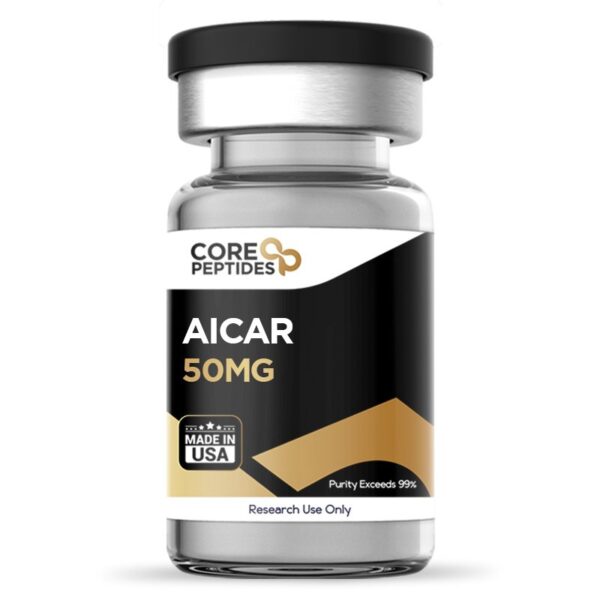
AICAR (50MG)
CHF 55.80
AICAR (Acadesine, AICA-Riboside) is a synthetic purine nucleoside analog and cell-permeable activator of AMP-activated protein kinase (AMPK). This 50mg research compound is taken up into cells by adenosine transporters and phosphorylated to ZMP, which mimics the stimulatory effects of AMP on AMPK. Researchers study AICAR for its ability to regulate glucose uptake, fatty acid oxidation, mitochondrial biogenesis, and metabolic adaptation. Buy AICAR 50mg in Switzerland from Core Peptides for your laboratory research needs.
What Is AICAR and Why Buy It for Research?
Buy AICAR 50mg in Switzerland for research into AMPK activation, metabolic regulation, and cellular energy homeostasis. Specifically, AICAR (also known as Acadesine, AICA-Riboside, or 5-Aminoimidazole-4-carboxamide ribonucleoside) is a synthetic purine nucleoside analog that serves as a cell-permeable activator of AMP-activated protein kinase (AMPK). Structurally, it resembles adenosine monophosphate (AMP) and functions as an AMP mimetic, allowing researchers to investigate the cellular pathways that regulate energy balance and metabolic adaptation.
In scientific research, AICAR is a standard pharmacological tool for studying AMPK-mediated signaling pathways. Researchers consider this compound particularly valuable for investigating glucose uptake, fatty acid oxidation, mitochondrial biogenesis, and the metabolic adaptations associated with endurance exercise. Furthermore, Core Peptides supplies AICAR as a lyophilized powder in a 50mg format exclusively for laboratory use. Therefore, researchers seeking to source this compound for their work will find it readily available through trusted suppliers.
AICAR Research Overview: Buy AICAR 50mg in Switzerland for AMPK Studies
Centrally, research into AICAR has focused on its function as a pharmacological activator of AMPK, the cell’s central energy sensor. Endogenously, AMPK becomes activated when cellular energy is low, specifically when the AMP:ATP ratio is elevated. AICAR mimics this energy-depleted state through a unique mechanism: adenosine transporters take it up into cells, and adenosine kinase phosphorylates it to the active nucleotide ZMP (5-aminoimidazole-4-carboxamide ribonucleotide). ZMP then binds to AMPK and allosterically activates it without actually reducing cellular ATP levels.
This activation of AMPK triggers a coordinated suite of adaptive responses in research models, including increased glucose uptake into skeletal muscle, enhanced fatty acid oxidation, suppression of energy-consuming biosynthetic pathways, and over time, mitochondrial biogenesis. Notably, a landmark 2008 study by Narkar et al. published in Cell demonstrated that AICAR produced a 44% increase in running endurance in sedentary mice, leading to its prohibition by WADA in 2009. Accordingly, researchers can buy AICAR 50mg in Switzerland from Core Peptides to support their investigations into AMPK signaling, metabolic regulation, and exercise physiology.
How Does AICAR Work in Research?
Mechanistically, AICAR’s proposed action involves functioning as an AMP mimetic that activates AMPK through intracellular conversion to ZMP. The compound’s purine nucleoside structure allows it to be recognized and transported into cells by adenosine transporters. Once inside the cell, adenosine kinase phosphorylates AICAR at the 5′ position, converting it to ZMP (also known as AICAR monophosphate or AICARP).
ZMP structurally resembles AMP and binds to the same regulatory sites on AMPK. This binding induces a conformational change that exposes the activation loop of the kinase domain, allowing upstream kinases such as LKB1 and CaMKK2 to phosphorylate AMPK at Thr172. Consequently, activated AMPK phosphorylates numerous downstream targets involved in metabolism, including ACC (for fatty acid synthesis inhibition), GLUT4 (for glucose uptake), and PGC-1α (for mitochondrial biogenesis).
In addition to its canonical AMPK-dependent effects, research has identified important AMPK-independent actions of AICAR. A systematic review published in Cells highlighted that many of AICAR’s effects are in fact AMPK-independent, calling for caution in the interpretation of AICAR-based studies. These AMPK-independent effects include modulation of hypoxia signaling, nucleotide synthesis, and cancer cell metabolism. Therefore, AICAR remains a valuable but complex tool for researchers investigating cellular energy sensing and metabolic regulation.
Why Is AICAR Studied in Switzerland?
Primarily, researchers study AICAR because it represents a well-characterized AMPK activator that enables investigation of metabolic regulation, exercise adaptation, and cellular energy homeostasis. In fact, this compound offers a focused tool for studying the molecular mechanisms underlying glucose metabolism, lipid oxidation, and mitochondrial function.
In vitro and in vivo studies have demonstrated AICAR’s efficacy across multiple research domains. For example, it inhibits hepatic gluconeogenesis at the level of fructose-1,6-bisphosphatase, making it relevant for diabetes research. Additionally, AICAR induces fatty acid oxidation in muscle and inhibits cholesterol synthesis in the liver. The compound also has established cardioprotective effects in ischemia/reperfusion models. In oncology research, AICAR inhibits the growth of mantle cell lymphoma cell lines with IC50 values ranging from 0.14 to 0.98 mM. Ultimately, researchers can buy AICAR 50mg in Switzerland to access a research tool that may help uncover mechanisms underlying metabolic diseases, exercise physiology, and cellular energy regulation.
AICAR Research Areas in Laboratory Studies
| Research Area | Focus | Evidence Level |
|---|---|---|
| Metabolic Regulation | Glucose uptake, fatty acid oxidation, gluconeogenesis inhibition | Mechanistic / In Vitro / In Vivo |
| Exercise Physiology | Endurance adaptation, exercise mimetic, mitochondrial biogenesis | Animal / Preclinical |
| Cardioprotection | Ischemia-reperfusion injury, adenosine production, cardiac protection | Animal / Preclinical |
| Oncology Research | Cancer cell metabolism, apoptosis, lymphoma and leukemia | In Vitro / Animal |
| Neuroprotection | Neuroinflammation, cognitive function, AMPK in the brain | Emerging Research |
| Autophagy and Mitophagy | Mitochondrial quality control, cellular recycling | Mechanistic / In Vitro |
| Aging and Longevity | Metabolic health, age-related decline, lifespan regulation | Emerging Research |
AICAR Compared With Related Research Compounds
| Compound | Research Focus | Mechanism / Target | Key Difference |
|---|---|---|---|
| AICAR | AMPK activation, metabolic regulation | ZMP-mediated AMPK activation (AMP mimetic) | Cell-permeable nucleoside; converted to ZMP intracellularly |
| Metformin | Type 2 diabetes, metabolic syndrome | AMPK activation via mitochondrial complex I inhibition | Different mechanism; indirect AMPK activation |
| Resveratrol | Anti-aging, metabolic health | SIRT1 activation, AMPK activation | Different primary target; natural polyphenol |
| Compound 991 | AMPK activation | Direct allosteric AMPK activator | Synthetic small molecule; direct binding to AMPK |
Comparatively, AICAR differs from other AMPK activators in its mechanism and research applications. On the one hand, AICAR acts as an AMP mimetic that requires intracellular conversion to ZMP for activity, making it a more physiologically relevant tool for studying AMPK signaling. On the other hand, metformin activates AMPK indirectly through mitochondrial complex I inhibition, while resveratrol primarily targets SIRT1 with secondary AMPK effects. In contrast, direct AMPK activators like Compound 991 bind directly to AMPK, offering a different approach to pathway activation.
Research Applications for AICAR in Switzerland
Scientists have investigated AICAR across several research domains:
- Metabolic Research: Researchers use AICAR to study AMPK-mediated glucose uptake, fatty acid oxidation, and hepatic gluconeogenesis inhibition.
- Exercise Physiology: AICAR serves as a pharmacological tool for investigating the metabolic adaptations associated with endurance exercise and mitochondrial biogenesis.
- Cardioprotection Studies: The compound is used to study ischemia-reperfusion injury, cardiac adenosine production, and myocardial protection.
- Oncology Research: Investigations have explored AICAR’s effects on cancer cell metabolism, apoptosis, and tumor growth in hematological malignancies.
- Neuroprotection and Aging: Studies have examined AICAR’s role in neuroinflammation, cognitive function, and age-related metabolic decline.
- Autophagy and Mitophagy: AICAR is used to investigate mitochondrial quality control and cellular recycling pathways.
Evidently, researchers can buy AICAR 50mg in Switzerland for these applications, as it is a valuable addition to any laboratory toolkit focused on metabolic regulation and AMPK signaling research.
AICAR Product Specifications
| Specification | Details |
|---|---|
| Product Name | AICAR (Acadesine) |
| Alternative Names | Acadesine, AICA-Riboside, NSC 105823, 5-Aminoimidazole-4-carboxamide ribonucleoside |
| Amount | 50mg |
| Form | Lyophilized powder |
| Purity | Not verified (≥98% reported by some suppliers) |
| Molecular Formula | C₉H₁₄N₄O₅ |
| Molecular Weight | 258.23 g/mol |
| CAS Number | 2627-69-2 |
| PubChem ID | 17513 |
| Research Category | Weight Management & Metabolism / Muscle & Performance |
| Research Use | Laboratory research use only |
| CoA | Available upon request (not verified) |
| Storage | Lyophilized powder should be stored desiccated at -20°C or below |
How to Evaluate AICAR Quality for Research
When sourcing AICAR compound for laboratory research, researchers should consider several quality indicators:
- Identity Confirmation: Analytical techniques such as mass spectrometry and HPLC should confirm the compound’s molecular weight (258.23 g/mol) and structure.
- Purity Assessment: High-performance liquid chromatography (HPLC) should verify purity, with ≥98% considered standard for research-grade material.
- Batch Traceability: Lot numbers and batch information enable researchers to track specific production runs.
- Certificate of Analysis: A CoA should accompany the product, detailing analytical testing results including HPLC purity and identity confirmation.
- Labeling Accuracy: Proper labeling should clearly indicate the product name, amount, molecular formula, CAS number, and storage recommendations.
- Storage Conditions: Appropriate storage at -20°C or below in desiccated conditions helps maintain compound stability.
Understanding the Certificate of Analysis
Typically, a Certificate of Analysis (CoA) accompanies research compounds and provides information about the specific batch’s analytical testing. For example, a CoA may include product identity confirmation, purity percentage as determined by HPLC, batch or lot number for traceability, analytical methods used (e.g., mass spectrometry, HPLC), and a physical description of the product.
Nevertheless, it is important to note that a CoA does not establish safety, efficacy, therapeutic effectiveness, or suitability for human use. Instead, it serves as a quality control document that helps researchers verify the identity and purity of the compound they are using in their laboratory investigations.
Storage and Stability of AICAR
Core Peptides supplies AICAR as a lyophilized (freeze-dried) powder. To maintain stability and integrity:
- Store the lyophilized powder desiccated at -20°C or below for long-term storage
- Store at 4°C for short-term storage if frequent access is required
- Avoid repeated freeze-thaw cycles
- Reconstitute only immediately before use with appropriate sterile solvents (e.g., DMSO or water)
- Prepare and use solutions on the same day whenever possible
- If stock solutions are required, store as aliquots in tightly sealed vials at -20°C
- Protect from light and moisture
Frequently Asked Questions About Buying AICAR 50mg in Switzerland
What is AICAR?
Specifically, AICAR (Acadesine, AICA-Riboside) is a synthetic purine nucleoside analog and cell-permeable activator of AMP-activated protein kinase (AMPK).
What is AICAR researched for?
Primarily, researchers study AICAR for its role as an AMPK activator in metabolic regulation, exercise adaptation, and cellular energy homeostasis. Studies have investigated its effects on glucose uptake, fatty acid oxidation, cardioprotection, and cancer metabolism.
How does AICAR work?
Mechanistically, AICAR is taken up into cells by adenosine transporters and phosphorylated to ZMP, which mimics the stimulatory effects of AMP on AMPK. This activates AMPK and triggers downstream metabolic adaptations.
What is the molecular weight of AICAR?
The molecular weight is 258.23 g/mol.
What is the molecular formula of AICAR?
The molecular formula is C₉H₁₄N₄O₅.
What is the CAS number of AICAR?
The CAS number is 2627-69-2.
Is AICAR synthetic?
Yes, AICAR is a synthetic compound produced through chemical synthesis.
What research exists on AICAR?
Research on AICAR includes the landmark 2008 Narkar Cell study demonstrating a 44% increase in running endurance in sedentary mice, studies on cardioprotection in ischemia-reperfusion models, and investigations in mantle cell lymphoma with IC50 values ranging from 0.14 to 0.98 mM.
Is AICAR on the WADA prohibited list?
Yes, WADA added AICAR to its prohibited list in 2009 due to its exercise-mimetic properties.
Is AICAR approved as a medicine?
No. Regulatory authorities have not approved AICAR as a medicine, pharmaceutical, or therapeutic agent. It was previously in Phase 3 clinical development.
Is AICAR intended for human use?
No. AICAR is intended for laboratory research use only and is not for human consumption, injection, or therapeutic application.
Where can I buy AICAR 50mg in Switzerland?
You can buy AICAR 50mg in Switzerland from Core Peptides, a trusted research compound supplier serving the Swiss scientific community.
How should researchers evaluate AICAR quality?
Researchers should look for identity confirmation via mass spectrometry, purity data from HPLC, batch traceability, and a Certificate of Analysis.
Related Research Compounds
Researchers interested in AICAR may also find the following related compounds relevant to their work:
- Metformin — An indirect AMPK activator researched for type 2 diabetes, metabolic syndrome, and longevity.
- Resveratrol — A natural polyphenol that activates SIRT1 and AMPK, researched for anti-aging and metabolic health.
- BPC-157 — A peptide researched for tissue healing, gastrointestinal health, and angiogenesis.
- AOD-9604 — A peptide researched for weight management and metabolic regulation.
Explore Weight Management & Metabolism
AICAR belongs to the Weight Management & Metabolism category of research compounds. Weight Management & Metabolism products are studied for their potential roles in metabolic regulation, energy homeostasis, and metabolic disease research. Generally, researchers who buy AICAR 50mg in Switzerland often pair it with related compounds in this category to explore complementary pathways in metabolic research and AMPK signaling.
Explore Muscle & Performance
Researchers studying exercise physiology, muscle adaptation, and performance-related mechanisms may also find relevant compounds in the Muscle & Performance category. AICAR’s exercise-mimetic properties and effects on muscle metabolism make it a valuable tool for investigating muscle function and adaptation.
Further Research
For researchers seeking to deepen their understanding of AICAR and its research applications, the following areas may warrant further investigation:
- The relationship between AICAR-mediated AMPK activation and specific downstream signaling pathways in different cell types
- Comparative studies between AICAR and exercise in various metabolic and physiological models
- The potential role of AICAR in modulating autophagy, mitophagy, and mitochondrial quality control
- Mechanistic studies on AICAR’s AMPK-independent effects and their biological significance
- Exploration of AICAR’s effects on different tissue systems beyond skeletal muscle and liver
Research Disclaimer
AICAR is a research compound supplied for laboratory research use only. Researchers must not use it for human consumption, injection, or any form of therapeutic application. Moreover, this product is not a medicine, pharmaceutical, or medical device. Furthermore, Swissmedic, the FDA, EMA, or any other regulatory authority have not approved it for human use. Researchers should consult Swissmedic for applicable regulations and guidance on research compound handling in Switzerland.
Generally, the information provided on this page is for educational and scientific reference purposes only. Therefore, it does not constitute medical advice, treatment recommendations, or dosing instructions. Ultimately, researchers bear the responsibility for ensuring that their use of this product complies with all applicable laws, regulations, and institutional guidelines.
Finally, all research involving AICAR should be conducted by qualified personnel in appropriate laboratory settings with proper safety protocols.
Soyez le premier à laisser votre avis sur “AICAR (50MG)”
Vous devez être connecté pour publier un avis.
Produits similaires
Weight Management & Metabolism Peptides
Cellular Research & Signaling
Weight Management & Metabolism Peptides
Weight Management & Metabolism Peptides
Weight Management & Metabolism Peptides
Avis
Il n’y a pas encore d’avis.