
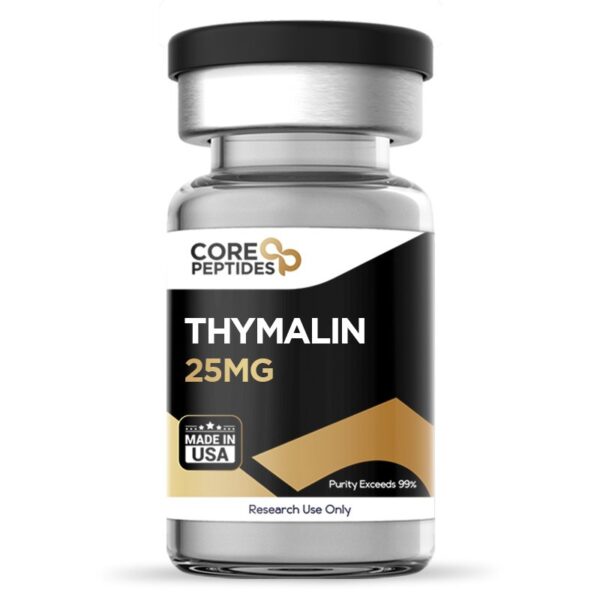
Thymalin (25MG)
CHF 124.20
Thymalin is a low-molecular-weight polypeptide complex isolated from calf thymus and developed within the Khavinson bioregulator program at the St. Petersburg Institute of Bioregulation and Gerontology. Researchers investigate Thymalin for its immunomodulatory properties, including regulation of T-lymphocyte differentiation, stimulation of natural killer (NK) cell activity, and activation of hematopoietic stem cell differentiation. The complex contains short bioactive peptides (including KE, EW, and EDP) that can bind to DNA and histone proteins to modulate gene expression. Available for laboratory research purposes only. Buy Thymalin in Switzerland from Core Peptides, a trusted research peptide supplier.
What Is Thymalin?
Thymalin is a low-molecular-weight polypeptide complex that researchers isolated from calf thymus. Professor Vladimir Khavinson and his colleagues at the Military Medical Academy in Leningrad (now St. Petersburg) developed this preparation in the 1970s. It belongs to the Khavinson bioregulator series—a family of tissue-specific peptide preparations that emerged from research on cytomedins—and represents one of the earliest and most studied products of this program. For those looking to buy Thymalin in Switzerland, Core Peptides offers high-quality research-grade material for laboratory applications.
Thymalin is a peptide complex rather than a single defined sequence, containing peptides in the rough mass range of 1 to 10 kDa, dominated by smaller fragments thought to influence T-lymphocyte differentiation. The preparation contains short bioactive peptides, including the dipeptides Lys-Glu (KE) and Glu-Trp (EW), and the tripeptide Glu-Asp-Pro (EDP). Researchers consider the dipeptide Glu-Trp as the active fragment, and manufacturers separately market it as Thymogen. The peptide complex is identified by CAS number 63958-90-7, with a molecular formula of C33H54N12O15 and a molecular weight of approximately 858.86 g/mol.
Thymalin Research Overview
Thymalin has attracted sustained research interest as an immunomodulatory peptide preparation with a decades-long history of use in Russia and Eastern European countries. The Russian Ministry of Health registered Thymalin as an immunomodulator (registration number LS-000267 dated February 26, 2010), and clinicians have used it for various conditions associated with immune dysfunction.
Research interest in Thymalin centers on its ability to regulate T-lymphocyte maturation and differentiation, modulate the balance between helper and suppressor T-cell subpopulations, and stimulate natural killer (NK) cell activity. The preparation has been investigated for its effects on immune system function, hematopoietic stem cell differentiation, and gene expression modulation through peptide-DNA and peptide-histone interactions. Consequently, Thymalin has generated significant interest as a research tool for investigating immunomodulation, thymus function, stem cell biology, and age-related immune decline.
When researchers choose to buy Thymalin in Switzerland for laboratory studies, they gain access to a compound that may help elucidate mechanisms of immune regulation, T-cell differentiation, and gene expression at the molecular level.
How Does Thymalin Work?
Thymalin exerts its biological effects through multiple interconnected mechanisms involving short bioactive peptides that interact with DNA, histone proteins, and cellular signaling pathways. The preparation’s mechanism involves several well-characterized steps.
Short Peptide Composition and DNA Binding
Thymalin contains short bioactive peptides, including the dipeptides Lys-Glu (KE) and Glu-Trp (EW), and the tripeptide Glu-Asp-Pro (EDP). These short peptides can specifically bind to double-stranded DNA and/or histone proteins, regulating gene expression and the synthesis of immune system proteins. This mechanism allows Thymalin to influence transcription, chromatin-associated regulation, and cell-cycle-related signaling pathways.
Regulation of Gene Expression
Thymalin-derived peptides regulate the expression of genes involved in immune function, including those encoding heat-shock proteins, cytokines, and proteins involved in fibrinolysis. The peptides also influence the activity of gerontogenes—genes associated with aging—and stimulate stem cell differentiation.
In human hematopoietic blood stem cells (HSCs), Thymalin decreases the expression of CD44 (a stem cell marker) 2.8-fold and CD117 2.2-fold. These molecular changes are associated with the activation of HSC differentiation.
Immune System Modulation
Thymalin promotes T-lymphocyte maturation and differentiation, regulating the balance between helper and suppressor T-cell subpopulations. The preparation stimulates natural killer (NK) cell activity and modulates cytokine production by stimulated lymphocytes. These effects contribute to the restoration of immune function in conditions where T-cell function is depressed.
Zinc Cofactor Requirement
Thymalin (specifically its active component thymulin, a nonapeptide with the sequence pGlu-Ala-Lys-Ser-Gln-Gly-Gly-Ser-Asn) requires zinc as a cofactor for full biological activity. This zinc dependence is a characteristic feature of the thymic nonapeptide component of the preparation.
Researchers who buy Thymalin in Switzerland for research purposes can investigate these mechanisms across diverse experimental models of immunology, stem cell biology, and gene regulation.
Why Is Thymalin Studied?
Researchers study Thymalin primarily for its potential relevance to immunomodulation, T-cell biology, hematopoietic stem cell differentiation, and age-related immune decline. The preparation’s ability to regulate T-lymphocyte maturation, stimulate NK cell activity, and modulate gene expression makes it a valuable tool for understanding the molecular basis of immune system function and regulation.
Thymalin has been investigated in the context of various immunopathologies, including acute respiratory diseases, pneumonia, viral and bacterial infections, and conditions associated with immune dysfunction. Studies have demonstrated that Thymalin reduces the incidence of acute respiratory infections in older populations 2.0–2.4-fold and reduces mortality in older patients over a 6-year observation period.
Moreover, researchers study Thymalin in the context of immunosenescence—the age-related decline in immune function.
Recent research has also explored Thymalin’s potential in the context of severe COVID-19. A 2021 study demonstrated that Thymalin administration in older patients with severe COVID-19 resulted in more rapid clinical improvement, higher recovery from lymphopenia, faster normalization of inflammatory markers, and halved hospital mortality.
Researchers who buy Thymalin in Switzerland from Core Peptides can incorporate this peptide into their studies on immunomodulation, T-cell biology, stem cell differentiation, and age-related immune decline.
Thymalin Research Areas
| Research Area | Description |
|---|---|
| Immunomodulation | Investigating Thymalin’s effects on T-lymphocyte maturation, differentiation, and immune system regulation |
| T-Cell Biology | Studying Thymalin’s influence on helper/suppressor T-cell balance and T-cell surface marker expression |
| Hematopoietic Stem Cell Differentiation | Examining Thymalin’s activation of stem cell differentiation and modulation of CD44 and CD117 expression |
| Gene Expression Regulation | Exploring Thymalin’s peptide-DNA and peptide-histone interactions and effects on transcription |
| Natural Killer Cell Activity | Investigating Thymalin’s stimulation of NK cell function and cytotoxic activity |
| Immunosenescence | Preclinical research into Thymalin’s effects on age-related immune decline and thymic involution |
| Cytokine Modulation | Studying Thymalin’s effects on pro-inflammatory cytokine production and immune balance |
| Thymus Function Restoration | Exploring Thymalin’s potential to support thymus function in models of thymic involution |
Scientific Research on Thymalin
Researchers have conducted scientific studies on Thymalin in both in vitro and in vivo settings, deriving evidence from cell cultures, preclinical models, and clinical research. The preparation originates from the Khavinson cytomedin program at the Military Medical Academy in Leningrad.
In Vitro Evidence
In vitro studies using human hematopoietic blood stem cells have demonstrated that Thymalin decreases the expression of CD44 (a stem cell marker) 2.8-fold and CD117 2.2-fold. These molecular changes are associated with the activation of HSC differentiation.
Research has shown that the short peptides in Thymalin’s composition (KE, EW, EDP) can specifically bind to double-stranded DNA and/or histone proteins, regulating gene expression and the synthesis of immune system proteins. These peptides regulate the expression of genes encoding heat-shock proteins, cytokines, fibrinolysis proteins, gerontogenes, and proteins involved in cell differentiation, proliferation, and apoptosis.
Furthermore, studies have investigated the effects of the EW, KE, and EDP peptides on the expression of markers of receptor and mitochondrial apoptosis in cultures of human blood lymphocytes.
Preclinical Studies
In animal models, researchers have investigated Thymalin’s effects on immune function and thymus activity. The preparation has been shown to normalize thymus functions during the aging process. Studies have also examined the effects of Thymalin on lymphocyte differentiation and functional activity, demonstrating that it normalizes the LDH isoenzyme spectrum and cyclase system in lymphocytes.
Research has also explored Thymalin’s protective effects in experimental respiratory influenzal infection and its ability to reduce the intensity of intravascular coagulation.
Human Research
Thymalin has been extensively studied in human clinical research and is registered in Russia as an immunomodulator. Clinical studies have demonstrated Thymalin’s effectiveness in various infectious diseases, including hepatitis A and B, erysipelas, meningococcal infection, typhoid fever, acute respiratory diseases, and pneumonia.
In older populations, Thymalin administration reduces the incidence of acute respiratory infections 2.0–2.4-fold and reduces mortality over a 6-year observation period.
A 2021 study on severe COVID-19 in older patients demonstrated that Thymalin administration resulted in more rapid clinical improvement, higher recovery from lymphopenia, faster normalization of C-reactive protein, D-dimer, lymphocyte and NK-cell counts, and halved hospital mortality.
Nevertheless, researchers should note that Thymalin is supplied for laboratory research purposes only. Scientists who buy Thymalin in Switzerland should remain aware of these evidence considerations.
Thymalin Compared With Related Peptides
| Peptide/Preparation | Relationship to Thymalin | Key Differences |
|---|---|---|
| Thymogen (Glu-Trp) | Short synthetic analog of Thymalin’s active fragment | Thymogen is a defined dipeptide; Thymalin is a complex mixture of peptides |
| Vilon (Lys-Glu) | Dipeptide component found in Thymalin | Vilon is a minimalist expression of the same immunoregulatory logic; Thymalin is the complex mixture |
| Crystagen (Glu-Asp-Pro) | Tripeptide component found in Thymalin | Crystagen targets thymus-independent immunity; Thymalin has broader immunomodulatory effects |
| Thymosin Alpha-1 | Both are thymus-derived immunomodulators | Thymosin alpha-1 is a defined 28-amino acid peptide; Thymalin is a polypeptide complex |
| Cortexin | Both are Khavinson bioregulators | Cortexin is derived from brain cortex; Thymalin is derived from thymus |
Research Applications
Researchers utilize Thymalin in a variety of laboratory research applications, primarily in the fields of immunology, stem cell biology, and gene regulation. Key research applications include:
- Immunomodulation Studies: Investigating Thymalin’s effects on T-lymphocyte maturation, differentiation, and immune system regulation
- T-Cell Biology Research: Studying Thymalin’s influence on helper/suppressor T-cell balance and T-cell surface marker expression
- Hematopoietic Stem Cell Studies: Examining Thymalin’s activation of stem cell differentiation and modulation of CD44 and CD117 expression
- Gene Expression Research: Exploring Thymalin’s peptide-DNA and peptide-histone interactions and effects on transcription
- Natural Killer Cell Studies: Investigating Thymalin’s stimulation of NK cell function and cytotoxic activity
- Immunosenescence Research: Preclinical research into Thymalin’s effects on age-related immune decline and thymic involution
- Cytokine Modulation Studies: Studying Thymalin’s effects on pro-inflammatory cytokine production and immune balance
- Thymus Function Research: Exploring Thymalin’s potential to support thymus function in models of thymic involution
Researchers who buy Thymalin in Switzerland can incorporate this peptide into their experimental protocols across these diverse research areas.
Thymalin Product Specifications
| Specification | Detail |
|---|---|
| Product Name | Thymalin (Thymus Polypeptide Complex) |
| Amount | 25mg |
| Form | Lyophilized powder |
| Composition | Low-molecular-weight thymic peptide complex (contains KE, EW, EDP) |
| Molecular Formula | C33H54N12O15 |
| Molecular Weight | Approximately 858.86 g/mol |
| CAS Number | 63958-90-7 |
| PubChem CID | 3085284 |
| Synonyms | Thymulin, Nonathymulin, Serum thymic factor, Thymus peptide complex |
| Active Fragment | Glu-Trp (EW, Thymogen) |
| Mechanism | Immunomodulation; T-cell differentiation; gene expression regulation; stem cell differentiation |
| Research Category | Cellular Research & Signaling |
| Purity | ≥98% (HPLC) |
| Storage | Store desiccated at -20°C, protected from light |
How to Evaluate Thymalin Quality
When sourcing Thymalin for research purposes, researchers should consider several quality indicators. A reliable Thymalin peptide supplier should provide:
- Identity Confirmation: Analytical verification that the peptide complex matches the expected composition and molecular weight (approximately 858.86 g/mol)
- Purity Analysis: Documentation of purity through methods such as HPLC – research grade typically provides ≥98% purity
- Peptide Composition Confirmation: Verification of the presence of bioactive short peptides (KE, EW, EDP)
- Batch Information: Clear lot numbers and batch traceability
- Certificate of Analysis (CoA): Documentation of analytical testing results
- Appearance: White to off-white lyophilized powder
- Solubility: Soluble in water and buffered aqueous solutions
Researchers looking to buy Thymalin in Switzerland should seek suppliers who provide comprehensive documentation and quality assurance. Core Peptides remains committed to supporting research with properly documented products.
Understanding the Certificate of Analysis
A Certificate of Analysis (CoA) provides analytical data for a specific batch of a research peptide. For Thymalin research, a CoA typically includes:
- Identity Confirmation: Mass spectrometry or other analytical methods confirming the peptide complex’s identity
- Purity Assessment: HPLC chromatograms showing the purity of the preparation
- Batch/Lot Information: Unique identifiers for traceability
- Analytical Methods: Description of the testing methods used
Importantly, researchers should understand that a CoA demonstrates the chemical identity and purity of a peptide but does not establish safety, efficacy, therapeutic effectiveness, or suitability for human use. The CoA serves as a quality control document for research purposes only.
Storage and Stability
Proper storage of research peptides is essential for maintaining their integrity and stability. For Thymalin, researchers should refer to the product documentation provided with their order for specific storage recommendations.
General best practices for Thymalin storage include keeping the lyophilized peptide complex desiccated, protected from light, and stored at -20°C or below. The preparation is soluble in water and bacteriostatic water. For specific temperature requirements and reconstitution protocols, consult the applicable product documentation or contact Core Peptides for the applicable storage specifications.
Research Considerations
Researchers incorporating Thymalin into their studies should be aware of several important considerations:
- Clinical Status: Thymalin has been extensively studied in human clinical research and is registered in Russia as an immunomodulator. However, the preparation is supplied for laboratory research purposes only.
- Experimental Status: Researchers consider Thymalin a well-characterized preparation, but findings should be interpreted within the context of ongoing research.
- Model Differences: Results from cell cultures and animal models may not translate directly to human outcomes.
- Regulatory Status: Thymalin is not FDA-approved and is intended for laboratory research use only.
- Quality Considerations: Researchers should verify the quality and identity of their Thymalin through appropriate analytical methods.
- Complex Nature: Thymalin is a peptide complex rather than a single defined sequence, which may influence experimental design and interpretation.
- Zinc Requirement: Thymalin requires zinc as a cofactor for full biological activity. Researchers should consider zinc availability in their experimental models.
Researchers who buy Thymalin in Switzerland should ensure their studies include appropriate controls and interpret findings with scientific rigor.
Frequently Asked Questions About Thymalin
What is Thymalin?
Thymalin is a low-molecular-weight polypeptide complex isolated from calf thymus, developed by Vladimir Khavinson and colleagues in the 1970s as an immunomodulatory bioregulator.
What is Thymalin researched for?
Researchers primarily investigate Thymalin for its immunomodulatory properties, including T-lymphocyte maturation and differentiation, natural killer cell activity, hematopoietic stem cell differentiation, and gene expression regulation.
What is the composition of Thymalin?
Thymalin is a complex mixture of short thymic peptides, including the dipeptides Lys-Glu (KE) and Glu-Trp (EW), and the tripeptide Glu-Asp-Pro (EDP).
What is the molecular weight of Thymalin?
The molecular weight of Thymalin is approximately 858.86 g/mol.
What is the CAS number for Thymalin?
The CAS number for Thymalin is 63958-90-7.
What is the mechanism of action for Thymalin?
Thymalin’s short peptides (KE, EW, EDP) bind to DNA and histone proteins, regulating gene expression and the synthesis of immune system proteins. This modulates T-cell differentiation, cytokine production, and stem cell activity.
Does Thymalin require zinc?
Yes, Thymalin (specifically its active component thymulin) requires zinc as a cofactor for full biological activity.
How does Thymalin differ from Thymogen?
Thymogen is the synthetic dipeptide Glu-Trp, considered the active fragment of Thymalin. Thymalin is the original complex mixture of peptides, while Thymogen is a simplified synthetic analog.
Can I buy Thymalin in Switzerland?
Yes, researchers can buy Thymalin in Switzerland from Core Peptides for laboratory research purposes.
What is the primary research category for Thymalin?
Thymalin belongs to the Cellular Research & Signaling category, with secondary relevance to Anti-Aging & Longevity research.
What related peptides are studied alongside Thymalin?
Related peptides include Thymogen (Glu-Trp), Vilon (Lys-Glu), Crystagen (Glu-Asp-Pro), and Thymosin Alpha-1.
What is the purity of Core Peptides’ Thymalin?
Core Peptides provides Thymalin with a purity of ≥98% as verified by HPLC analysis.
Is Thymalin soluble in water?
Yes, Thymalin is soluble in water and bacteriostatic water.
Related Research Peptides
Researchers interested in Thymalin may also find the following related peptides relevant to their work:
- Thymogen (Glu-Trp) – The synthetic dipeptide analog of Thymalin’s active fragment, studied for immunomodulation
- Vilon (Lys-Glu) – A dipeptide component of Thymalin, studied for immune system research
- Crystagen (Glu-Asp-Pro) – A tripeptide component of Thymalin, studied for thymus-independent immunity
- Thymosin Alpha-1 – A defined 28-amino acid thymic peptide studied for immunomodulation
- Cortexin – A Khavinson bioregulator derived from brain cortex
For a comprehensive selection of research peptides in Switzerland, explore the Core Peptides catalog.
Explore Cellular Research & Signaling Peptides
Thymalin is part of our Cellular Research & Signaling category, which features a range of research peptides investigated for their effects on cellular function, gene expression, and signaling pathways. Browse our selection to find the right peptides for your laboratory research.
Explore Related Research Categories
Researchers may also find the following related categories relevant to Thymalin research:
- Anti-Aging & Longevity – Peptides investigated for age-related immune research applications
- Cognitive & Nootropic Peptides – Peptides studied for neurological and cognitive research
- Healing & Regeneration Peptides – Peptides investigated for tissue repair and regeneration
Further Research
Researchers interested in learning more about Thymalin and related peptides should consult the primary scientific literature. Key areas of investigation include immunomodulation, T-cell biology, hematopoietic stem cell differentiation, and gene expression regulation. The PubMed database is an excellent resource for accessing peer-reviewed research articles on these topics.
Research Disclaimer
Core Peptides supplies Thymalin as a research peptide for laboratory research purposes only. All information provided is for educational and scientific reference purposes only and does not constitute medical advice. Researchers are responsible for ensuring compliance with all applicable laws and regulations governing the use of research peptides in their jurisdiction, including Switzerland.
Be the first to review “Thymalin (25MG)”
You must be logged in to post a review.
Related products
Cellular Research & Signaling
Anti-Aging & Longevity Peptides
Anti-Aging & Longevity Peptides
Anti-Aging & Longevity Peptides
Cellular Research & Signaling
Anti-Aging & Longevity Peptides

Anti-Aging & Longevity Peptides
Cellular Research & Signaling
Reviews
There are no reviews yet.