
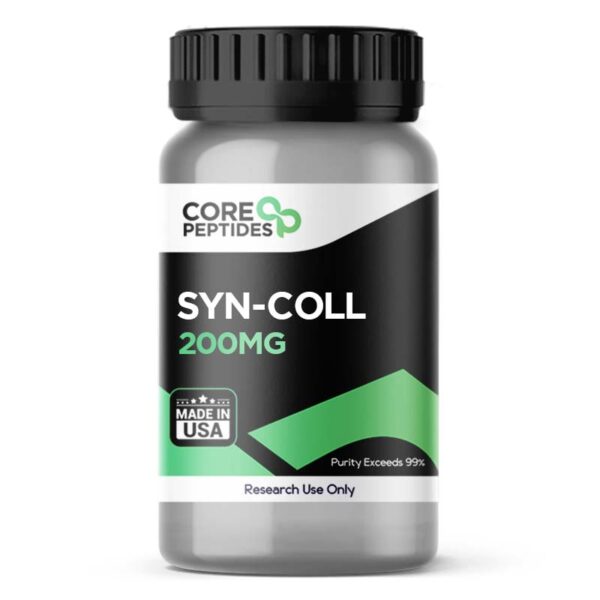
Syn-Coll (Palmitoyl Tripeptide-5) (200MG)
CHF 158.40
Syn-Coll (Palmitoyl Tripeptide-5) is a synthetic palmitoylated tripeptide with the sequence Pal-Lys-Val-Lys-OH (Pal-KVK), developed as a biomimetic of thrombospondin-1 (TSP-1). Researchers investigate Syn-Coll for its ability to activate latent transforming growth factor-β (TGF-β) in the extracellular matrix, thereby stimulating dermal fibroblasts to upregulate procollagen I and III synthesis while inhibiting matrix metalloproteinase (MMP) activity. Studies have explored its effects on extracellular matrix remodeling, collagen biosynthesis, and fibroblast signaling pathways. Available for laboratory research purposes only. Buy Syn-Coll in Switzerland from Core Peptides, a trusted research peptide supplier.
What Is Syn-Coll?
Syn-Coll, also known as Palmitoyl Tripeptide-5, is a synthetic palmitoylated tripeptide with the amino acid sequence Pal-Lys-Val-Lys-OH (Pal-KVK). It belongs to a class of biomimetic lipopeptides developed to replicate the biological activity of thrombospondin-1 (TSP-1), a large multifunctional glycoprotein (~450 kDa) that plays a critical role in activating latent transforming growth factor-β (TGF-β) in the extracellular space. For those looking to buy Syn-Coll in Switzerland, Core Peptides offers high-quality research-grade material for laboratory applications.
As a tripeptide—a peptide composed of three amino acids—Syn-Coll features N-terminal palmitoylation, which enhances its lipophilicity and facilitates transport through lipid-rich barriers. The palmitoyl moiety serves a dual purpose: it increases skin penetration by enhancing lipophilicity and anchors the peptide in cell membranes, prolonging its local activity. The peptide is commonly supplied as the bistrifluoroacetate salt with the molecular formula C33H65N5O5·2(C2HF3O2) and a molecular weight of approximately 839.96 g/mol. Its INCI name is Palmitoyl Tripeptide-5, and it is identified by CAS number 623172-56-5.
Syn-Coll Research Overview
Syn-Coll has attracted research interest as a tool for investigating TGF-β signaling, fibroblast biology, and extracellular matrix remodeling. The peptide’s design—a palmitoylated tripeptide mimicking the active region of thrombospondin-1—enables it to activate latent TGF-β and stimulate collagen synthesis in dermal fibroblasts. Developed by DSM under the SYN-COLL brand name, it captures the key TGF-β-activating sequence in a small, cell-permeable format.
Research interest in Syn-Coll centers on its ability to activate the TGF-β signaling pathway, a primary driver of collagen synthesis. Studies have demonstrated that Palmitoyl Tripeptide-5 stimulates procollagen I synthesis in a dose-dependent manner, with reported increases of up to 119% compared to untreated controls at concentrations achievable through topical application. Consequently, Syn-Coll has generated interest as a research tool for investigating fibroblast activation, collagen biosynthesis, extracellular matrix remodeling, and TGF-β pathway biology.
When researchers choose to buy Syn-Coll in Switzerland for laboratory studies, they gain access to a compound that may help elucidate mechanisms of TGF-β signaling, collagen regulation, and fibroblast function at the molecular level.
How Does Syn-Coll Work?
Syn-Coll exerts its biological effects through activation of the TGF-β signaling pathway, mimicking the action of thrombospondin-1 (TSP-1). The peptide’s mechanism involves several well-characterized steps.
Thrombospondin-1 Mimicry and Latent TGF-β Activation
Syn-Coll mimics the KRFK sequence region of thrombospondin-1 responsible for activating latent TGF-β. In the extracellular matrix, TGF-β is secreted as a latent complex bound to the latency-associated peptide (LAP). TSP-1—and by extension its mimetic peptide—interacts with LAP to release active TGF-β. The specific amino acid sequence Lys-Val-Lys was identified as a key motif for this activity.
Once liberated, active TGF-β binds to type II TGF-β receptors on fibroblast surfaces, initiating phosphorylation of Smad2/Smad3 transcription factors. The activated Smad complex then translocates to the nucleus, where it upregulates transcription of procollagen I—the precursor to the most abundant dermal collagen—as well as tissue inhibitors of metalloproteinases (TIMPs) and other extracellular matrix glycoproteins.
Collagen Synthesis Stimulation
This signaling cascade triggers fibroblasts to increase the synthesis of extracellular matrix components, most notably collagen types I and III. In vitro studies on human dermal fibroblasts have demonstrated that Palmitoyl Tripeptide-5 stimulates procollagen I synthesis in a dose-dependent manner. The peptide stimulates the production of type I and type III collagen by dermal fibroblasts.
MMP Inhibition and Collagen Preservation
In addition to stimulating collagen synthesis, Syn-Coll inhibits the activity of matrix metalloproteinases (MMPs) responsible for collagen degradation. The peptide interferes with the degradation of MMP-1 and MMP-3 collagen to enhance collagen synthesis and reduce collagen breakdown. Furthermore, the upregulation of TIMPs reduces MMP-mediated collagen degradation.
This dual-action mechanism—promoting collagen synthesis while reducing degradation—distinguishes the TSP-1 mimetic approach from simple signal peptides.
Researchers who buy Syn-Coll in Switzerland for research purposes can investigate these mechanisms across diverse experimental models of fibroblast biology, TGF-β signaling, and extracellular matrix remodeling.
Why Is Syn-Coll Studied?
Researchers study Syn-Coll primarily for its potential relevance to TGF-β signaling, fibroblast biology, and extracellular matrix remodeling. The peptide’s ability to activate latent TGF-β and stimulate collagen synthesis makes it a valuable tool for understanding the molecular basis of connective tissue maintenance and repair.
Syn-Coll’s connection to the thrombospondin-1/TGF-β axis has made it a focus of dermal and matrix biology research. Preclinical studies have explored Syn-Coll’s effects on collagen biosynthesis, fibroblast proliferation, and matrix organization in various experimental models.
Moreover, researchers study Syn-Coll in the context of extracellular matrix homeostasis and age-related matrix changes. In vitro studies have demonstrated that the peptide’s effects are mediated through TGF-β pathway activation; neutralizing antibodies against TGF-β abolish the procollagen-stimulating effect of the peptide in fibroblast cultures, confirming the TSP-1 mimetic mechanism.
Researchers who buy Syn-Coll in Switzerland from Core Peptides can incorporate this peptide into their studies on TGF-β signaling, fibroblast activation, collagen synthesis, and extracellular matrix biology.
Syn-Coll Research Areas
| Research Area | Description |
|---|---|
| TGF-β Signaling | Investigating Syn-Coll’s activation of latent TGF-β and downstream Smad2/Smad3 signaling |
| Collagen Synthesis | Studying Syn-Coll’s stimulation of procollagen I and III production in fibroblasts |
| Fibroblast Activation | Examining Syn-Coll’s effects on fibroblast proliferation and extracellular matrix production |
| Extracellular Matrix Remodeling | Exploring Syn-Coll’s influence on ECM composition and structural integrity |
| MMP Inhibition | Investigating Syn-Coll’s effects on matrix metalloproteinase activity and collagen degradation |
| Thrombospondin-1 Mimicry | Studying Syn-Coll as a biomimetic of TSP-1 for latent TGF-β activation |
| Dermal Fibroblast Research | Preclinical research into Syn-Coll’s effects on dermal fibroblast function |
| Connective Tissue Biology | Exploring Syn-Coll’s potential relevance to connective tissue maintenance and repair |
Scientific Research on Syn-Coll
Researchers have conducted scientific studies on Syn-Coll in both in vitro and clinical settings, deriving evidence from cell cultures, preclinical models, and human studies. The peptide originates from thrombospondin-1 mimetic research and was developed by DSM under the SYN-COLL brand name.
In Vitro Evidence
In vitro studies using human dermal fibroblasts have demonstrated that Palmitoyl Tripeptide-5 stimulates procollagen I synthesis in a dose-dependent manner. At concentrations achievable through topical application, the peptide increased procollagen production by up to 119% compared to untreated controls.
Mechanistic studies confirmed that the anti-aging effects of Palmitoyl Tripeptide-5 are mediated through TGF-β pathway activation. For instance, neutralizing antibodies against TGF-β abolished the procollagen-stimulating effect of the peptide in fibroblast cultures, confirming the TSP-1 mimetic mechanism rather than a nonspecific mitogenic effect.
Furthermore, Syn-Coll has been shown to stimulate the production of type I and type III collagen by dermal fibroblasts while interfering with the degradation of MMP-1 and MMP-3 collagen, thereby enhancing collagen synthesis and reducing collagen breakdown. The peptide effectively signals fibroblasts to increase the production of collagen types I and III.
Clinical Studies
Double-blind, placebo-controlled clinical studies evaluating SYN-COLL at 4 ppm in a cream base applied twice daily for 84 days demonstrated significant improvements in wrinkle parameters. Profilometric analysis showed reductions in wrinkle depth and volume, with visible improvements noted by expert graders and self-assessment panels. The effect was progressive, with continued improvement observed through the study duration.
Additionally, clinical studies by DSM showed that 4% SYN-COLL cream reduced wrinkle depth by up to 35% and increased skin firmness by 25% after 84 days of use.
Transdermal Research
Research has also explored the transdermal permeation of Palmitoyl Tripeptide-5. A 2023 study investigated the delivery of active peptides by self-healing, biocompatible supramolecular hydrogels, analyzing the transdermal permeation of Palmitoyl Tripeptide-5 using Franz diffusion cells. The study found that almost no transdermal permeation of Palmitoyl Tripeptide-5 was observed, consistent with its lipophilic nature and intended topical application.
Nevertheless, researchers should note that Syn-Coll is supplied for laboratory research purposes only. Scientists who buy Syn-Coll in Switzerland should remain aware of these evidence considerations.
Syn-Coll Compared With Related Peptides
| Peptide | Relationship to Syn-Coll | Key Differences |
|---|---|---|
| Palmitoyl Tripeptide-1 (Pal-GHK) | Both are palmitoylated tripeptides | Syn-Coll targets TGF-β via TSP-1 mimicry; Pal-GHK is a matrikine peptide with different signaling mechanism |
| Palmitoyl Pentapeptide-4 (Matrixyl) | Both studied for collagen stimulation | Syn-Coll acts via TGF-β pathway activation; Matrixyl acts via collagen fragment signaling |
| Thrombospondin-1 (TSP-1) | Natural protein; Syn-Coll is a synthetic mimetic | TSP-1 is a ~450 kDa glycoprotein; Syn-Coll is a small tripeptide capturing the key active sequence |
| Palmitoyl Tetrapeptide-7 | Both are palmitoylated peptides for skin research | Palmitoyl Tetrapeptide-7 targets IL-6 and inflammation; Syn-Coll targets TGF-β and collagen synthesis |
| GHK-Cu | Both studied for skin and cellular research | GHK-Cu is a copper complex with different mechanism; Syn-Coll is a TSP-1 mimetic activating TGF-β |
Research Applications
Researchers utilize Syn-Coll in a variety of laboratory research applications, primarily in the fields of cell biology, dermatology, and extracellular matrix research. Key research applications include:
- TGF-β Signaling Studies: Investigating Syn-Coll’s activation of latent TGF-β and downstream Smad2/Smad3 signaling
- Collagen Synthesis Research: Studying Syn-Coll’s stimulation of procollagen I and III production in fibroblasts
- Fibroblast Activation Studies: Examining Syn-Coll’s effects on fibroblast proliferation and extracellular matrix production
- Extracellular Matrix Remodeling Research: Exploring Syn-Coll’s influence on ECM composition and structural integrity
- MMP Inhibition Studies: Investigating Syn-Coll’s effects on matrix metalloproteinase activity and collagen degradation
- Thrombospondin-1 Mimicry Research: Studying Syn-Coll as a biomimetic of TSP-1 for latent TGF-β activation
- Dermal Fibroblast Research: Preclinical research into Syn-Coll’s effects on dermal fibroblast function
- Connective Tissue Biology Studies: Exploring Syn-Coll’s potential relevance to connective tissue maintenance and repair
Researchers who buy Syn-Coll in Switzerland can incorporate this peptide into their experimental protocols across these diverse research areas.
Syn-Coll Product Specifications
| Specification | Detail |
|---|---|
| Product Name | Syn-Coll (Palmitoyl Tripeptide-5) |
| Amount | 200mg |
| Form | Lyophilized powder |
| Sequence (One-Letter) | Pal-KVK-OH |
| Sequence (Three-Letter) | Palmitoyl-Lys-Val-Lys-OH |
| Molecular Formula | C33H65N5O5·2(C2HF3O2) |
| Molecular Weight | Approximately 839.96 g/mol |
| CAS Number | 623172-56-5 |
| INCI Name | Palmitoyl Tripeptide-5 |
| Synonyms | SYN-COLL, Palmitoyl-Lys-Val-Lys, SYN®-COLL |
| N-Terminal Modification | Palmitoylation (C16 fatty acid chain) |
| Mechanism | TSP-1 mimetic; latent TGF-β activation; collagen I and III synthesis stimulation |
| Research Category | Skin, Hair & Beauty Peptides |
| Purity | ≥95% (HPLC) |
| Storage | Store desiccated at -20°C, protected from light |
How to Evaluate Syn-Coll Quality
When sourcing Syn-Coll for research purposes, researchers should consider several quality indicators. A reliable Syn-Coll peptide supplier should provide:
- Identity Confirmation: Analytical verification that the peptide matches the expected sequence (Pal-Lys-Val-Lys-OH) and molecular weight (approximately 839.96 g/mol as the bistrifluoroacetate salt)
- Purity Analysis: Documentation of purity through methods such as HPLC – research grade typically provides ≥95% purity
- N-Terminal Palmitoylation Confirmation: Verification of the palmitoyl modification, which is critical for the peptide’s lipophilicity and membrane interactions
- Batch Information: Clear lot numbers and batch traceability
- Certificate of Analysis (CoA): Documentation of analytical testing results
- Appearance: White to off-white lyophilized powder
- Solubility: Clear, colourless solution in acetic acid (1%)
Researchers looking to buy Syn-Coll in Switzerland should seek suppliers who provide comprehensive documentation and quality assurance. Core Peptides remains committed to supporting research with properly documented products.
Understanding the Certificate of Analysis
A Certificate of Analysis (CoA) provides analytical data for a specific batch of a research peptide. For Syn-Coll research, a CoA typically includes:
- Identity Confirmation: Mass spectrometry confirming the peptide’s identity
- Purity Assessment: HPLC chromatograms showing the purity of the peptide
- Batch/Lot Information: Unique identifiers for traceability
- Analytical Methods: Description of the testing methods used
Importantly, researchers should understand that a CoA demonstrates the chemical identity and purity of a peptide but does not establish safety, efficacy, therapeutic effectiveness, or suitability for human use. The CoA serves as a quality control document for research purposes only.
Storage and Stability
Proper storage of research peptides is essential for maintaining their integrity and stability. For Syn-Coll, researchers should refer to the product documentation provided with their order for specific storage recommendations.
General best practices for peptide storage include keeping the lyophilized peptide desiccated, protected from light, and stored at -20°C or below. The peptide is soluble in acetic acid (1%). For specific temperature requirements and reconstitution protocols, consult the applicable product documentation or contact Core Peptides for the applicable storage specifications.
Research Considerations
Researchers incorporating Syn-Coll into their studies should be aware of several important considerations:
- Evidence Limitations: Syn-Coll has been studied in in vitro assays, preclinical models, and clinical research. However, researchers should note that the peptide is supplied for laboratory research purposes only.
- Experimental Status: Researchers consider Syn-Coll a well-characterized compound, but findings should be interpreted within the context of ongoing research.
- Model Differences: Results from cell cultures and clinical studies may not translate directly to all experimental outcomes.
- Regulatory Status: Syn-Coll is not FDA-approved and is intended for laboratory research use only.
- Quality Considerations: Researchers should verify the quality and identity of their Syn-Coll through appropriate analytical methods.
- Mechanistic Context: Syn-Coll’s proposed mechanisms involve TSP-1 mimicry, latent TGF-β activation, and collagen synthesis stimulation. Researchers should consider appropriate experimental approaches to investigate these pathways.
- Palmitoylation Effects: The palmitoyl moiety significantly alters the peptide’s lipophilicity and membrane interactions compared to unmodified peptides, which may influence experimental design.
- Selectivity of TGF-β Activation: Syn-Coll activates TGF-β locally and transiently at the application site; systemic or prolonged TGF-β activation would be undesirable due to potential fibrotic effects, but the low concentrations and topical delivery route ensure that signaling remains confined to the dermal microenvironment.
Researchers who buy Syn-Coll in Switzerland should ensure their studies include appropriate controls and interpret findings with scientific rigor.
Frequently Asked Questions About Syn-Coll
What is Syn-Coll?
Syn-Coll (Palmitoyl Tripeptide-5) is a synthetic palmitoylated tripeptide with the sequence Pal-Lys-Val-Lys-OH that mimics thrombospondin-1 (TSP-1) to activate latent TGF-β and stimulate collagen synthesis.
What is Syn-Coll researched for?
Researchers primarily investigate Syn-Coll for its activation of the TGF-β signaling pathway, stimulation of collagen types I and III synthesis, inhibition of MMP activity, and effects on fibroblast biology and extracellular matrix remodeling.
What is the amino acid sequence of Syn-Coll?
The amino acid sequence of Syn-Coll is Pal-Lys-Val-Lys-OH (Pal-KVK).
What is the molecular weight of Syn-Coll?
The molecular weight of Syn-Coll (as the bistrifluoroacetate salt) is approximately 839.96 g/mol. The free base has a molecular weight of approximately 611.9 g/mol.
What is the CAS number for Syn-Coll?
The CAS number for Syn-Coll is 623172-56-5.
What is the mechanism of action for Syn-Coll?
Syn-Coll mimics thrombospondin-1 to activate latent TGF-β, which then binds to fibroblast receptors, initiating Smad2/Smad3 phosphorylation and upregulating procollagen I and III synthesis while inhibiting MMP-mediated collagen degradation.
How does Syn-Coll differ from other collagen-stimulating peptides?
Syn-Coll operates through a fundamentally different pathway than Palmitoyl Tripeptide-1 (matrikine signaling) or Palmitoyl Pentapeptide-4 (collagen fragment signaling). It acts through TSP-1 mimicry and TGF-β activation rather than direct collagen fragment signaling.
Does Syn-Coll have human clinical evidence?
Syn-Coll has been studied in double-blind, placebo-controlled clinical studies demonstrating reductions in wrinkle depth and improvements in skin firmness. However, no published clinical studies were found on PubMed for SYN-COLL.
Is Syn-Coll FDA-approved?
Syn-Coll is not FDA-approved. It is intended for laboratory research use only and is not approved for human consumption or therapeutic use.
Can I buy Syn-Coll in Switzerland?
Yes, researchers can buy Syn-Coll in Switzerland from Core Peptides for laboratory research purposes.
What is the primary research category for Syn-Coll?
Syn-Coll belongs to the Skin, Hair & Beauty Peptides category, with secondary relevance to Cellular Research & Signaling research.
What related peptides are studied alongside Syn-Coll?
Related peptides include Palmitoyl Tripeptide-1 (Pal-GHK), Palmitoyl Pentapeptide-4 (Matrixyl), Palmitoyl Tetrapeptide-7, and GHK-Cu.
What is the purity of Core Peptides’ Syn-Coll?
Core Peptides provides Syn-Coll with a purity of ≥95% as verified by HPLC analysis.
How should Syn-Coll be stored?
Syn-Coll should be stored lyophilized, desiccated, protected from light, at -20°C or below.
What is the role of palmitoylation in Syn-Coll?
The palmitoyl (C16 fatty acid) chain serves a dual purpose: it enhances skin penetration by increasing lipophilicity (allowing transit through lipid-rich barriers) and anchors the peptide in cell membranes, prolonging its local activity.
Related Research Peptides
Researchers interested in Syn-Coll may also find the following related peptides relevant to their work:
- Palmitoyl Tripeptide-1 (Pal-GHK) – A matrikine peptide studied for cellular signaling and collagen research
- Palmitoyl Pentapeptide-4 (Matrixyl) – A peptide studied for collagen stimulation via collagen fragment signaling
- Palmitoyl Tetrapeptide-7 – A peptide studied for anti-inflammatory and matrix remodeling research
- GHK-Cu – A copper peptide studied for skin and cellular research
- BPC-157 – A peptide studied for healing and tissue repair
For a comprehensive selection of research peptides in Switzerland, explore the Core Peptides catalog.
Explore Skin, Hair & Beauty Peptides
Syn-Coll is part of our Skin, Hair & Beauty Peptides category, which features a range of research peptides investigated for their effects on cellular signaling, extracellular matrix biology, and tissue remodeling. Browse our selection to find the right peptides for your laboratory research.
Explore Related Research Categories
Researchers may also find the following related categories relevant to Syn-Coll research:
- Cellular Research & Signaling – Peptides studied for TGF-β signaling and fibroblast biology
- Anti-Aging & Longevity – Peptides investigated for age-related extracellular matrix research
- Healing & Regeneration Peptides – Peptides investigated for tissue repair and regeneration
Further Research
Researchers interested in learning more about Syn-Coll and related peptides should consult the primary scientific literature. Key areas of investigation include TGF-β signaling, thrombospondin-1 biology, collagen synthesis regulation, and extracellular matrix remodeling. The PubMed database is an excellent resource for accessing peer-reviewed research articles on these topics.
Research Disclaimer
Core Peptides supplies Syn-Coll as a research peptide for laboratory research purposes only. It is not approved for human consumption, therapeutic use, or medical treatment. All information provided is for educational and scientific reference purposes only and does not constitute medical advice. Researchers are responsible for ensuring compliance with all applicable laws and regulations governing the use of research peptides in their jurisdiction, including Switzerland.
Be the first to review “Syn-Coll (Palmitoyl Tripeptide-5) (200MG)”
You must be logged in to post a review.
Related products

Skin, Hair & Beauty Peptides
Skin, Hair & Beauty Peptides
Skin, Hair & Beauty Peptides
Skin, Hair & Beauty Peptides
Skin, Hair & Beauty Peptides
Skin, Hair & Beauty Peptides
Skin, Hair & Beauty Peptides
Skin, Hair & Beauty Peptides
Reviews
There are no reviews yet.