
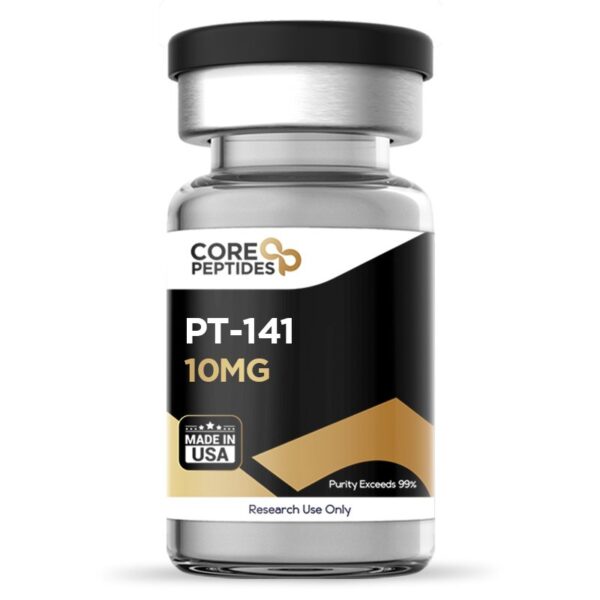
PT-141 (Bremelanotide) (10MG)
CHF 38.70
PT-141 (Bremelanotide) is a synthetic cyclic heptapeptide melanocortin receptor agonist derived from α-melanocyte-stimulating hormone (α-MSH). Researchers investigate PT-141 for its non-selective agonism at melanocortin receptors MC1R, MC3R, MC4R, and MC5R, with primary research focus on MC3R and MC4R activation in the central nervous system. The peptide’s mechanism involves Gαs protein coupling, downstream cAMP signaling, and modulation of hypothalamic and limbic circuits. Available for laboratory research purposes only. Buy PT-141 in Switzerland from Core Peptides, a trusted research peptide supplier.
What Is PT-141?
Buy PT-141 in Switzerland, also known as Bremelanotide, is a synthetic cyclic heptapeptide and melanocortin receptor agonist derived from α-melanocyte-stimulating hormone (α-MSH). The peptide features a cyclic structure with the amino acid sequence Ac-Nle-c[Asp-His-D-Phe-Arg-Trp-Lys]-OH, incorporating a lactam bridge between the side chains of aspartic acid and lysine that creates a 23-membered macrocyclic ring.
Researchers originally developed PT-141 as a metabolite of Melanotan II—a peptide initially investigated for melanogenesis and UV-free tanning. During clinical development of Melanotan II, researchers observed unexpected pro-sexual effects in human subjects, which led to the rational design and optimization of PT-141 as a targeted melanocortin receptor agonist. For those looking to buy PT-141 in Switzerland, Core Peptides offers high-quality research-grade material for laboratory applications.
PT-141 Research Overview
PT-141 has attracted significant research interest as a non-selective agonist of melanocortin receptors, with primary activity at MC3R and MC4R in the central nervous system. The peptide’s design draws from decades of structure-activity relationship studies of α-MSH, incorporating specific modifications that enhance metabolic stability, receptor selectivity, and pharmacokinetic properties compared to the endogenous ligand.
Research interest in PT-141 centers on its ability to activate melanocortin receptors in the hypothalamus and limbic system, modulating neural circuits involved in sexual motivation and arousal. Studies have demonstrated that PT-141 activates the medial preoptic area (mPOA) and other hypothalamic and limbic regions involved in sexual behavior. Consequently, PT-141 has generated significant interest as a research tool for investigating melanocortin receptor pharmacology, GPCR signaling, and CNS-mediated behavioral effects.
When researchers choose to buy PT-141 in Switzerland for laboratory studies, they gain access to a compound that may help elucidate mechanisms of melanocortin receptor signaling, hypothalamic circuit modulation, and behavioral pharmacology at the molecular level.
How Does PT-141 Work?
PT-141 exerts its biological effects through activation of melanocortin receptors, primarily MC3R and MC4R, in the central nervous system. The peptide’s mechanism involves several interconnected steps.
Melanocortin Receptor Binding
PT-141 acts as a non-selective agonist of melanocortin receptors, with a binding potency order of MC1R > MC4R > MC3R > MC5R > MC2R. The peptide binds to the orthosteric site of the melanocortin receptors, primarily MC3R and MC4R, which are expressed primarily in the central nervous system.
The critical pharmacophore for melanocortin receptor binding is the tetrapeptide sequence His-D-Phe-Arg-Trp (positions 3-6). Key features include the D-configuration at position 4 (D-Phenylalanine), which is essential for receptor binding affinity, and the tryptophan indole side chain, which makes critical contacts with the receptor.
Gαs Protein Coupling and Signaling
Upon binding to MC3R or MC4R, PT-141 initiates intracellular signaling cascades through coupling to the Gαs protein. This activation leads to downstream cAMP signaling and modulation of neuronal excitability in hypothalamic and limbic circuits.
Dopaminergic and Oxytocinergic Pathways
MC4R activation by PT-141 stimulates downstream release of dopamine in the mesolimbic pathway and oxytocin from hypothalamic neurons. These neurotransmitter systems are established mediators of sexual motivation and pair-bonding behavior.
Central vs. Peripheral Mechanism
A key pharmacological distinction of PT-141 is its central site of action. Unlike PDE5 inhibitors such as sildenafil, which act peripherally on vascular smooth muscle, PT-141 acts through the central nervous system (hypothalamus) to influence sexual motivation and desire.
Researchers who buy PT-141 in Switzerland for research purposes can investigate these mechanisms across diverse experimental models of melanocortin receptor pharmacology and CNS-mediated behavioral research.
Why Is PT-141 Studied?
Researchers study PT-141 primarily for its potential relevance to melanocortin receptor pharmacology, GPCR signaling, and CNS-mediated behavioral effects. The peptide’s ability to selectively activate MC3R and MC4R in the central nervous system makes it a valuable tool for understanding the molecular basis of melanocortin receptor signaling and hypothalamic circuit modulation.
The peptide’s connection to the α-MSH/melanocortin system has made it a focus of neuroscience and behavioral pharmacology research. Preclinical studies have explored PT-141’s effects on receptor binding kinetics, downstream signaling pathways, and behavioral outcomes in various experimental models.
Moreover, researchers study PT-141 in the context of GPCR signaling and drug development. As a well-characterized melanocortin receptor agonist with FDA approval for clinical use in HSDD (2019), PT-141 serves as a valuable reference compound for investigating receptor-ligand interactions and structure-activity relationships in the melanocortin receptor system.
Researchers who buy PT-141 in Switzerland from Core Peptides can incorporate this peptide into their studies on melanocortin receptor biology, GPCR signaling, and CNS-mediated behavioral pharmacology.
PT-141 Research Areas
| Research Area | Description |
|---|---|
| Melanocortin Receptor Pharmacology | Investigating PT-141’s binding affinity and selectivity for MC1R, MC3R, MC4R, and MC5R |
| GPCR Signaling | Studying PT-141’s activation of Gαs protein coupling and downstream cAMP signaling |
| Hypothalamic Circuit Modulation | Examining PT-141’s effects on mPOA and hypothalamic neural circuits |
| Dopamine and Oxytocin Release | Exploring PT-141’s stimulation of mesolimbic dopamine and hypothalamic oxytocin |
| Sexual Behavior Research | Preclinical research into PT-141’s effects on sexual motivation and behavior |
| CNS-Mediated Behavioral Effects | Investigating PT-141’s central nervous system mechanisms of action |
| Structure-Activity Relationships | Studying the pharmacophore requirements for melanocortin receptor activation |
| Receptor-Ligand Interactions | Exploring the molecular basis of melanocortin receptor binding and activation |
Scientific Research on PT-141
Researchers have conducted extensive scientific studies on PT-141 in both in vitro and in vivo settings, deriving evidence from cell cultures, preclinical models, and clinical research. The peptide originates from the Melanotan II research program, which identified the pro-sexual effects of melanocortin receptor agonists.
In Vitro Evidence
In vitro studies using receptor-binding assays have demonstrated that PT-141 binds to melanocortin receptors with a potency order of MC1R > MC4R > MC3R > MC5R > MC2R. Competitive binding studies have shown affinity of approximately 10 nM for MC3R and MC4R.
Furthermore, research has characterized PT-141’s structure using NMR spectroscopy. In aqueous solution, PT-141 contains three alpha-helical domains connected by loop structures, forming a cyclic conformation stabilized by a lactam bridge between the side chains of aspartic acid and lysine.
Preclinical Animal Studies
In rodent models, researchers have investigated PT-141’s effects on behavior and neurochemical processes. Studies have demonstrated that PT-141 induces appetitive sexual behaviors, female mounting behavior, and repetitive self-grooming in animal models.
Research has shown that PT-141 (100 or 200 μg/kg) significantly increased proceptive solicitations in female rodents. These behavioral effects are consistent with the peptide’s mechanism of action through MC4R activation in the hypothalamus and limbic system.
Human Research
PT-141 has been extensively studied in human clinical trials. In 2019, the U.S. Food and Drug Administration approved Bremelanotide (Vyleesi) for the treatment of premenopausal women with hypoactive sexual desire disorder (HSDD).
Clinical studies have demonstrated that PT-141 produces a rapid dose-dependent increase in erectile activity in men with erectile dysfunction. The peptide has also shown efficacy in enhancing sexual desire and reducing distress associated with HSDD in premenopausal women.
Nevertheless, researchers should note that PT-141’s mechanism of action—how agonism of melanocortin receptors translates to clinical effects—is still not fully understood. Scientists who buy PT-141 in Switzerland should remain aware of these evidence considerations.
PT-141 Compared With Related Peptides
| Peptide | Relationship to PT-141 | Key Differences |
|---|---|---|
| Melanotan II | Parent compound; PT-141 is a metabolite | Melanotan II has C-terminal amide and induces melanogenesis; PT-141 lacks C-terminal amide and has reduced melanogenic effects |
| α-MSH | Endogenous ligand; PT-141 is a synthetic analog | α-MSH has shorter half-life and broader receptor profile; PT-141 has enhanced stability and CNS penetration |
| Setmelanotide | Both are melanocortin receptor agonists | Setmelanotide is MC4R-selective for obesity research; PT-141 is non-selective with broader receptor profile |
| Flibanserin | Both studied for HSDD | Flibanserin targets serotonin receptors; PT-141 targets melanocortin receptors (different mechanism) |
| Sildenafil (Viagra) | Both studied for sexual dysfunction | Sildenafil is a PDE5 inhibitor acting peripherally on vascular smooth muscle; PT-141 acts centrally via melanocortin receptors |
Research Applications
Researchers utilize PT-141 in a variety of laboratory research applications, primarily in the fields of receptor pharmacology, neuroscience, and behavioral research. Key research applications include:
- Melanocortin Receptor Studies: Investigating PT-141’s binding affinity and selectivity for MC1R, MC3R, MC4R, and MC5R
- GPCR Signaling Research: Studying PT-141’s activation of Gαs protein coupling and downstream cAMP signaling
- Hypothalamic Circuit Studies: Examining PT-141’s effects on mPOA and hypothalamic neural circuits
- Dopamine and Oxytocin Release Research: Exploring PT-141’s stimulation of mesolimbic dopamine and hypothalamic oxytocin
- Sexual Behavior Studies: Preclinical research into PT-141’s effects on sexual motivation and behavior
- CNS Pharmacology Research: Investigating PT-141’s central nervous system mechanisms of action
- Structure-Activity Relationship Studies: Examining the pharmacophore requirements for melanocortin receptor activation
- Receptor-Ligand Interaction Research: Exploring the molecular basis of melanocortin receptor binding and activation
Researchers who buy PT-141 in Switzerland can incorporate this peptide into their experimental protocols across these diverse research areas.
PT-141 Product Specifications
| Specification | Detail |
|---|---|
| Product Name | PT-141 (Bremelanotide) |
| Amount | 10mg |
| Form | Lyophilized powder |
| Sequence (One-Letter) | Ac-Nle-c[Asp-His-D-Phe-Arg-Trp-Lys]-OH |
| Sequence (Three-Letter) | Acetyl-norleucine-cyclo[aspartate-histidine-D-phenylalanine-arginine-tryptophan-lysine]-carboxyl |
| Molecular Formula | C50H68N14O10 |
| Molecular Weight | Approximately 1025.18 g/mol |
| CAS Number (Free Base) | 189691-06-3 |
| CAS Number (Acetate Salt) | 1607799-13-2 |
| Half-Life | Approximately 2.7 hours |
| Structure | Cyclic heptapeptide with lactam bridge (Asp-Lys) |
| Research Category | Cellular Research & Signaling |
| Purity | Greater than 97% |
| Storage | Store desiccated below -18°C |
How to Evaluate PT-141 Quality
When sourcing PT-141 for research purposes, researchers should consider several quality indicators. A reliable PT-141 peptide supplier should provide:
- Identity Confirmation: Analytical verification that the peptide matches the expected sequence (Ac-Nle-c[Asp-His-D-Phe-Arg-Trp-Lys]-OH) and molecular weight (approximately 1025.18 g/mol)
- Purity Analysis: Documentation of purity through methods such as RP-HPLC (Reverse-Phase High-Performance Liquid Chromatography) – Core Peptides provides >97% purity
- Batch Information: Clear lot numbers and batch traceability
- Certificate of Analysis (CoA): Documentation of analytical testing results
- Proper Labeling: Accurate product identification and storage instructions
- Cyclization Confirmation: Verification of the lactam bridge between aspartic acid and lysine, as this is critical for the peptide’s biological activity and structural stability
Researchers looking to buy PT-141 in Switzerland should seek suppliers who provide comprehensive documentation and quality assurance. Core Peptides remains committed to supporting research with properly documented products.
Understanding the Certificate of Analysis
A Certificate of Analysis (CoA) provides analytical data for a specific batch of a research peptide. For PT-141 research, a CoA typically includes:
- Identity Confirmation: Mass spectrometry or other analytical methods confirming the peptide’s identity
- Purity Assessment: HPLC chromatograms showing the purity of the peptide
- Batch/Lot Information: Unique identifiers for traceability
- Analytical Methods: Description of the testing methods used
Importantly, researchers should understand that a CoA demonstrates the chemical identity and purity of a peptide but does not establish safety, efficacy, therapeutic effectiveness, or suitability for human use. The CoA serves as a quality control document for research purposes only.
Storage and Stability
Proper storage of research peptides is essential for maintaining their integrity and stability. For PT-141, researchers should refer to the product documentation provided with their order for specific storage recommendations.
General best practices for peptide storage include keeping lyophilized peptides in a cool, dry environment, protected from light and moisture. The lyophilized peptide is stable at room temperature for up to 3 weeks but should be stored desiccated below -18°C for long-term storage. Upon reconstitution, the peptide should be stored at 4°C for 2-7 days and below -18°C for future use. For long-term storage, it is recommended to add a carrier protein (0.1% HSA or BSA). Please prevent freeze-thaw cycles.
Research Considerations
Researchers incorporating PT-141 into their studies should be aware of several important considerations:
- Evidence Base: PT-141 has been extensively studied in clinical trials and received FDA approval in 2019 for HSDD in premenopausal women. However, the precise mechanism by which melanocortin receptor agonism translates to clinical effects remains incompletely understood.
- Experimental Status: While PT-141 is FDA-approved for clinical use, researchers should note that the peptide is supplied for laboratory research purposes only.
- Receptor Selectivity: PT-141 is a non-selective agonist at melanocortin receptors MC1R, MC3R, MC4R, and MC5R. Researchers should consider this receptor profile when designing experiments.
- Regulatory Status: PT-141 is supplied for laboratory research use only. Researchers are responsible for ensuring compliance with all applicable laws and regulations governing the use of research peptides in their jurisdiction.
- Quality Considerations: Researchers should verify the quality and identity of their PT-141 through appropriate analytical methods.
- Mechanistic Context: PT-141’s proposed mechanisms involve melanocortin receptor activation, Gαs protein coupling, and modulation of hypothalamic and limbic circuits. Researchers should consider appropriate experimental approaches to investigate these pathways.
- Structural Integrity: The cyclic structure and lactam bridge are critical for the peptide’s biological activity. Researchers should verify the integrity of these structural features through appropriate analytical methods.
Researchers who buy PT-141 in Switzerland should ensure their studies include appropriate controls and interpret findings with scientific rigor.
Frequently Asked Questions About PT-141
What is PT-141?
PT-141 (Bremelanotide) is a synthetic cyclic heptapeptide and melanocortin receptor agonist derived from α-melanocyte-stimulating hormone (α-MSH), with the sequence Ac-Nle-c[Asp-His-D-Phe-Arg-Trp-Lys]-OH.
What is PT-141 researched for?
Researchers primarily investigate PT-141 for its activity at melanocortin receptors (MC3R and MC4R), GPCR signaling, CNS-mediated behavioral effects, and melanocortin receptor pharmacology.
What is the amino acid sequence of PT-141?
The amino acid sequence of PT-141 is Ac-Nle-c[Asp-His-D-Phe-Arg-Trp-Lys]-OH.
What is the molecular weight of PT-141?
The molecular weight of PT-141 is approximately 1025.18 g/mol.
What is the CAS number for PT-141?
The CAS number for PT-141 (free base) is 189691-06-3. The acetate salt has CAS number 1607799-13-2.
What receptors does PT-141 target?
PT-141 acts as a non-selective agonist at melanocortin receptors MC1R, MC3R, MC4R, and MC5R, with primary research focus on MC3R and MC4R expressed in the central nervous system.
What is the mechanism of action for PT-141?
PT-141 binds to melanocortin receptors, activates Gαs protein coupling, and modulates hypothalamic and limbic circuits, leading to downstream neurotransmitter release including dopamine and oxytocin.
What is the half-life of PT-141?
The half-life of PT-141 is approximately 2.7 hours.
Is PT-141 FDA-approved?
PT-141 (Bremelanotide) received FDA approval in 2019 for the treatment of hypoactive sexual desire disorder (HSDD) in premenopausal women. However, it is supplied for laboratory research use only.
Can I buy PT-141 in Switzerland?
Yes, researchers can buy PT-141 in Switzerland from Core Peptides for laboratory research purposes.
What is the primary research category for PT-141?
PT-141 belongs to the Cellular Research & Signaling category, with secondary relevance to Cognitive & Nootropic Peptides research.
What related peptides are studied alongside PT-141?
Related peptides include Melanotan II, α-MSH, Setmelanotide, and other melanocortin receptor agonists.
What is the purity of Core Peptides’ PT-141?
Core Peptides provides PT-141 with a purity of greater than 97% as verified by RP-HPLC analysis.
How should PT-141 be stored?
PT-141 should be stored lyophilized, desiccated, below -18°C. Upon reconstitution, store at 4°C for 2-7 days or below -18°C for long-term storage.
How does PT-141 differ from Melanotan II?
PT-141 is a metabolite of Melanotan II that lacks the C-terminal amide. While Melanotan II induces melanogenesis (tanning), PT-141 has reduced melanogenic effects and enhanced pro-sexual activity.
Related Research Peptides
Researchers interested in PT-141 may also find the following related peptides relevant to their work:
- Melanotan II – The parent compound from which PT-141 is derived; studied for melanocortin receptor research
- α-MSH – The endogenous melanocortin receptor ligand
- Setmelanotide – An MC4R-selective agonist studied for obesity research
- Semax – A nootropic peptide studied for cognitive enhancement and neuroprotection
- Selank – A cognitive peptide with anxiolytic properties
For a comprehensive selection of research peptides in Switzerland, explore the Core Peptides catalog.
Explore Cellular Research & Signaling Peptides
PT-141 is part of our Cellular Research & Signaling category, which features a range of research peptides investigated for their effects on cellular function, receptor signaling, and GPCR pathways. Browse our selection to find the right peptides for your laboratory research.
Explore Related Research Categories
Researchers may also find the following related categories relevant to PT-141 research:
- Cognitive & Nootropic Peptides – Peptides studied for neurological and cognitive research
- Anti-Aging & Longevity – Peptides investigated for age-related research applications
- Sexual Health Peptides – Peptides studied for reproductive and sexual health research
Further Research
Researchers interested in learning more about PT-141 and related peptides should consult the primary scientific literature. Key areas of investigation include melanocortin receptor biology, GPCR signaling, hypothalamic circuit modulation, and behavioral pharmacology. The PubMed database is an excellent resource for accessing peer-reviewed research articles on these topics.
Research Disclaimer
Core Peptides supplies PT-141 as a research peptide for laboratory research purposes only. It is not approved for human consumption, therapeutic use, or medical treatment. All information provided is for educational and scientific reference purposes only and does not constitute medical advice. Researchers are responsible for ensuring compliance with all applicable laws and regulations governing the use of research peptides in their jurisdiction, including Switzerland.
Be the first to review “PT-141 (Bremelanotide) (10MG)”
You must be logged in to post a review.
Related products

Fertility & Hormone Research

Sexual Health Peptides
Fertility & Hormone Research
Reviews
There are no reviews yet.