
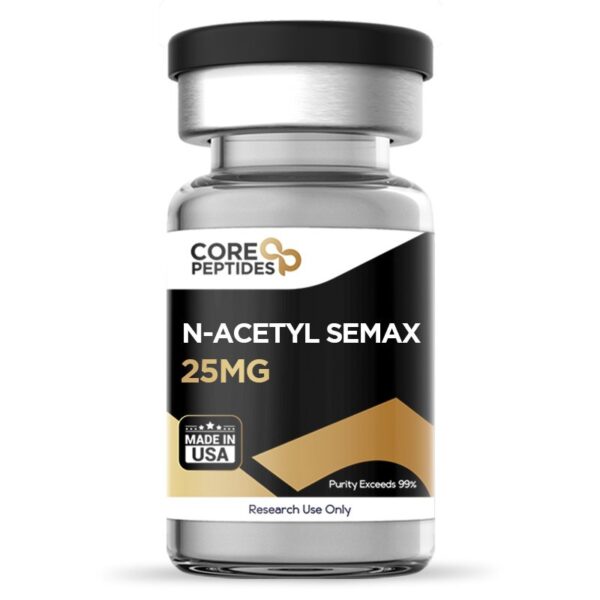
N-Acetyl Semax (25MG)
CHF 54.00
N-Acetyl Semax (Ac-Semax) is a synthetic acetylated heptapeptide with the sequence Ac-Met-Glu-His-Phe-Pro-Gly-Pro-OH (Ac-MEHFPGP). This research peptide is the N-terminally acetylated derivative of Semax, a nootropic and neuroprotective heptapeptide developed at the Institute of Molecular Genetics of the Russian Academy of Sciences. Semax itself is a stabilized analog of the ACTH(4-10) fragment, designed to retain cognitive and neurotrophic effects while eliminating cortisol-stimulating activity. The N-acetylation modification protects the peptide from aminopeptidase-mediated degradation, enhancing metabolic stability and potentially improving bioavailability. Researchers study N-Acetyl Semax for its effects on BDNF upregulation, neuroprotection, cognitive enhancement, and neurotrophic signaling. Buy N-Acetyl Semax in Switzerland from Core Peptides for your laboratory research needs.
What Is N-Acetyl Semax and Why Buy It for Research?
Buy N-Acetyl Semax in Switzerland for research into neurotrophic signaling, neuroprotection, and cognitive enhancement pathways. Specifically, N-Acetyl Semax (also known as Ac-Semax, Acetyl Semax, or N-Acetyl-ACTH(4-7)-PGP) is a synthetic acetylated heptapeptide with the sequence Ac-Met-Glu-His-Phe-Pro-Gly-Pro-OH (one-letter code: Ac-MEHFPGP). It is the N-terminally acetylated derivative of Semax, a nootropic and neuroprotective heptapeptide that the Institute of Molecular Genetics of the Russian Academy of Sciences developed.
Semax itself is a stabilized analog of the ACTH(4-10) fragment—the portion of adrenocorticotropic hormone responsible for cognitive and neurotrophic effects. Researchers deliberately truncated the hormone’s steroidogenic domain to eliminate cortisol-stimulating activity. Semax gained approval in Russia for the treatment of acute ischemic stroke (at 1% concentration) and cognitive enhancement (at 0.1% concentration), both administered intranasally. The N-acetyl modification involves covalent attachment of an acetyl group (CH3CO-) to the alpha-amino group of the N-terminal methionine residue. The peptide has a molecular weight of approximately 858.97 g/mol and the molecular formula C₃₇H₅₁N₉O₁₀S. The CAS number for N-Acetyl Semax is 2920938-90-3.
In scientific research, N-Acetyl Semax serves as a molecular tool for studying neurotrophic signaling pathways, neuroprotection, and cognitive enhancement. Furthermore, Core Peptides supplies N-Acetyl Semax as a lyophilized powder in a 25mg format exclusively for laboratory use. Therefore, researchers seeking to source this compound for their work will find it readily available when they buy N-Acetyl Semax in Switzerland.
N-Acetyl Semax Research Overview: Buy N-Acetyl Semax in Switzerland for Neurotrophic Studies
Centrally, research into N-Acetyl Semax has focused on its function as a stabilized analog of Semax with enhanced resistance to enzymatic degradation. The N-terminal acetylation protects the peptide from aminopeptidase-mediated cleavage, the primary route of catabolism for small peptides in plasma and at tissue surfaces. Unmodified Semax has a plasma half-life of only several minutes, necessitating frequent intranasal dosing. Consequently, researchers designed the acetylated form to extend this half-life, potentially improving CNS bioavailability and therapeutic convenience.
Researchers expect N-Acetyl Semax to mirror the pharmacological profile of Semax, as acetylation does not alter the peptide’s interaction with its biological targets. The pharmacological profile of Semax encompasses multiple domains: upregulation of brain-derived neurotrophic factor (BDNF) and nerve growth factor (NGF), neuroprotection against ischemic injury, enhancement of attention and memory, and modulation of dopaminergic, serotonergic, and cholinergic neurotransmission.
Furthermore, studies suggest that Semax may inhibit serum enkephalin-degrading enzymes, leading to increased levels of enkephalins by preventing their degradation. Enkephalins are endogenous opioids that play roles in nociception and stress response. Additionally, research indicates that Semax may increase striatal levels of 5-hydroxyindoleacetic acid (5-HIAA), a serotonin metabolite, suggesting a possible enhancement of serotonergic activity. Accordingly, researchers who buy N-Acetyl Semax in Switzerland from Core Peptides can support their investigations into neurotrophic signaling, neuroprotection, and cognitive enhancement.
How Does N-Acetyl Semax Work in Research?
Mechanistically, N-Acetyl Semax’s proposed action involves functioning as a multi-target neuroactive peptide that modulates neurotrophic, neurotransmitter, and neuroprotective pathways. The peptide operates through several interconnected mechanisms.
BDNF and Neurotrophic Factor Upregulation
The most extensively documented mechanism of Semax involves upregulation of neurotrophic factors, particularly brain-derived neurotrophic factor (BDNF). Semax potently upregulates BDNF in the hippocampus, contributing to synaptic plasticity, memory consolidation, and neuroprotection. Additionally, Semax upregulates nerve growth factor (NGF), further supporting neuronal survival and function. This BDNF-mediated neuroplasticity underlies the peptide’s nootropic effects, including enhanced memory consolidation, improved attention, and facilitated learning.
Dopaminergic and Serotonergic Modulation
Research suggests that Semax modulates dopaminergic and serotonergic neurotransmission. For example, studies have shown that Semax may increase striatal levels of 5-HIAA (a serotonin metabolite) by up to 180% after 4 hours, suggesting enhanced serotonergic activity. Notably, Semax does not appear to directly alter dopamine levels or its metabolites; however, it may modulate the dopaminergic system’s responsiveness, enhancing the action of dopaminergic agonists.
Enkephalinase Inhibition and Neuropeptide Regulation
Semax inhibits serum enkephalin-degrading enzymes, thereby elevating endogenous regulatory peptides like enkephalins. Consequently, this inhibition may lead to increased enkephalin levels, which can influence other neurotransmitter systems due to the complex interplay between the opioid system and neurotransmitters like dopamine and serotonin.
Neuroprotection and Synaptic Plasticity
Semax has demonstrated neuroprotective effects in models of ischemic stroke and Alzheimer’s disease. Studies have shown that Semax can modulate ischemia-induced gene-expression changes and reduce the number of amyloid inclusions in the cortex and hippocampus. Furthermore, the peptide influences intracellular calcium dynamics in rat brain neurons, contributing to its neuroprotective profile.
Why Is N-Acetyl Semax Studied in Switzerland?
Primarily, researchers study N-Acetyl Semax because it represents a well-characterized acetylated heptapeptide that enables investigation of neurotrophic signaling, neuroprotection, and cognitive enhancement. In fact, this compound offers a focused tool for studying the molecular mechanisms underlying neuroplasticity, ischemic injury, and cognitive function.
Research has demonstrated N-Acetyl Semax’s relevance across multiple domains. For example, researchers have studied the peptide for its potential to upregulate BDNF and NGF expression, promoting neuronal survival and synaptic plasticity. Additionally, studies have shown that Semax improves cognitive and emotional state in patients with cerebral ischemia and other neurological conditions. Furthermore, research demonstrates that Semax protects against ischemic injury and reduces amyloid plaque formation in Alzheimer’s disease models.
Moreover, investigators have examined N-Acetyl Semax for its neuroprotective potential and its ability to modulate gene expression in response to stress and ischemia. The peptide also exerts anti-stress effects by correcting gene expression patterns in the hippocampus following acute stress. Ultimately, researchers who buy N-Acetyl Semax in Switzerland gain access to a comprehensive research tool for investigating neurotrophic signaling, neuroprotection, and cognitive enhancement.
N-Acetyl Semax Research Areas in Laboratory Studies
| Research Area | Focus | Evidence Level |
|---|---|---|
| BDNF and Neurotrophic Signaling | BDNF upregulation, NGF modulation, synaptic plasticity, neurogenesis | Preclinical |
| Neuroprotection | Ischemic stroke, Alzheimer’s disease, neuroinflammation, oxidative stress | Preclinical / Clinical |
| Cognitive Enhancement | Memory consolidation, attention, learning, executive function | Preclinical / Clinical |
| Dopaminergic Modulation | Dopamine release, receptor sensitivity, locomotor activity | Preclinical |
| Serotonergic Neurotransmission | Serotonin metabolism, 5-HIAA levels, mood regulation | Preclinical |
| Enkephalinase Inhibition | Endogenous opioid regulation, stress response, nociception | Mechanistic / In Vitro |
| Gene Expression Modulation | Stress response genes, immune genes, neurosignaling pathways | Preclinical |
| Blood-Brain Barrier Permeability | PGP-mediated transport, lipid raft endocytosis, receptor-mediated transcytosis | Mechanistic |
N-Acetyl Semax Compared With Related Research Compounds
| Compound | Research Focus | Mechanism / Target | Key Difference |
|---|---|---|---|
| N-Acetyl Semax | Nootropic, neuroprotective, neurotrophic | BDNF/NGF upregulation, dopaminergic/serotonergic modulation | Acetylated heptapeptide; enhanced stability; N-terminal protection |
| Semax | Nootropic, neuroprotective, neurotrophic | BDNF/NGF upregulation, dopaminergic/serotonergic modulation | Parent heptapeptide; shorter half-life (several minutes); Russian-approved drug |
| N-Acetyl Semax Amidate | Nootropic, neuroprotective, neurotrophic | BDNF/NGF upregulation, dopaminergic/serotonergic modulation | Dual-modified (N-acetyl + C-amide); maximum enzymatic resistance |
| N-Acetyl Selank | Anxiolytic, nootropic, immunomodulatory | GABA-A allosteric modulation, BDNF upregulation, enkephalinase inhibition | Different peptide sequence; complementary mechanism; anxiolytic profile |
Comparatively, N-Acetyl Semax differs from its parent compound Semax in its enhanced stability and potentially improved bioavailability. On the one hand, Semax is the parent heptapeptide approved in Russia for ischemic stroke and cognitive enhancement, with a short half-life of several minutes. On the other hand, N-Acetyl Semax features N-terminal acetylation that protects the peptide from aminopeptidase degradation, extending its half-life and potentially allowing lower doses or less frequent administration. In contrast, N-Acetyl Semax Amidate is a dual-modified form (N-acetyl + C-terminal amidation) that offers maximum enzymatic resistance. N-Acetyl Selank is a different acetylated peptide with a primarily anxiolytic and immunomodulatory profile, and researchers frequently combine the two in comprehensive nootropic protocols due to their complementary mechanisms.
Research Applications for N-Acetyl Semax in Switzerland
Scientists have investigated N-Acetyl Semax across several research domains:
- Neurotrophic Signaling Research: Researchers use N-Acetyl Semax to study BDNF and NGF upregulation, synaptic plasticity, and neurogenesis pathways.
- Neuroprotection Studies: The peptide is employed to investigate ischemic stroke models, Alzheimer’s disease pathology, neuroinflammation, and oxidative stress protection.
- Cognitive Enhancement Research: Studies have examined N-Acetyl Semax’s effects on memory consolidation, attention, learning, and executive function.
- Dopaminergic Research: The peptide serves as a tool for studying dopamine release, receptor sensitivity, and locomotor activity.
- Serotonergic Research: Investigations have explored N-Acetyl Semax’s effects on serotonin metabolism and 5-HIAA levels.
- Gene Expression Studies: Research has examined N-Acetyl Semax’s modulation of stress response genes, immune genes, and neurosignaling pathways.
Evidently, researchers who buy N-Acetyl Semax in Switzerland gain a valuable addition to any laboratory toolkit focused on neurotrophic signaling, neuroprotection, and cognitive research.
N-Acetyl Semax Product Specifications
| Specification | Details |
|---|---|
| Product Name | N-Acetyl Semax (Ac-Semax) |
| Alternative Names | Ac-Semax, Acetyl Semax, N-Acetyl-ACTH(4-7)-PGP, Acetylated Semax |
| Amount | 25mg |
| Form | Lyophilized powder |
| Purity | Not verified (>99% reported by Core Peptides) |
| Amino Acid Sequence | Ac-Met-Glu-His-Phe-Pro-Gly-Pro-OH |
| Sequence (1-letter) | Ac-MEHFPGP |
| Peptide Length | 7 amino acids (heptapeptide) |
| Modification | N-terminal acetylation |
| Molecular Formula | C₃₇H₅₁N₉O₁₀S |
| Molecular Weight | 858.97 g/mol (approx.) |
| CAS Number | 2920938-90-3 |
| Parent Sequence Origin | ACTH(4-10) with C-terminal Pro-Gly-Pro extension |
| Research Category | Cognitive & Nootropic / Anti-Aging & Longevity |
| Research Use | Laboratory research use only |
| CoA | Available upon request (not verified) |
| Storage | Lyophilized powder should be stored desiccated at -20°C or below, protected from light |
| Solubility | Soluble in water and bacteriostatic water |
How to Evaluate N-Acetyl Semax Quality for Research
When sourcing N-Acetyl Semax peptide for laboratory research, researchers should consider several quality indicators:
- Identity Confirmation: Analytical techniques such as mass spectrometry should confirm the compound’s molecular weight (approximately 858.97 g/mol) and sequence (Ac-Met-Glu-His-Phe-Pro-Gly-Pro-OH).
- Purity Assessment: High-performance liquid chromatography (HPLC) should verify purity, with ≥98% considered standard for research-grade material.
- Acetylation Confirmation: Analytical methods should confirm the presence of the N-terminal acetyl group.
- Batch Traceability: Lot numbers and batch information enable researchers to track specific production runs.
- Certificate of Analysis: A CoA should accompany the product, detailing analytical testing results including HPLC purity and identity confirmation.
- Labeling Accuracy: Proper labeling should clearly indicate the product name, amount (25mg), sequence, molecular formula, CAS number, and storage recommendations.
- Storage Conditions: Appropriate storage at -20°C or below in desiccated, dark conditions helps maintain peptide stability.
Understanding the Certificate of Analysis
Typically, a Certificate of Analysis (CoA) accompanies research peptides and provides information about the specific batch’s analytical testing. For example, a CoA may include product identity confirmation, purity percentage as determined by HPLC, batch or lot number for traceability, analytical methods used (e.g., mass spectrometry, HPLC), and a physical description of the product.
Nevertheless, it is important to note that a CoA does not establish safety, efficacy, therapeutic effectiveness, or suitability for human use. Instead, it serves as a quality control document that helps researchers verify the identity and purity of the peptide they are using in their laboratory investigations.
Storage and Stability of N-Acetyl Semax
Core Peptides supplies N-Acetyl Semax as a lyophilized (freeze-dried) powder. To maintain stability and integrity:
- Store the lyophilized powder desiccated at -20°C or below for long-term storage
- Store at 4°C for short-term storage if frequent access is required
- Avoid repeated freeze-thaw cycles
- Weigh under dry conditions; the peptide is hygroscopic
- Reconstitute only immediately before use with appropriate sterile solvents (sterile water or bacteriostatic water)
- Inject solvent slowly against the inner wall of the vial; avoid vigorous agitation during dissolution
- Filter sterilize if required (e.g., 0.22 µm) immediately prior to use
- Aliquot and store reconstituted solutions at -20°C or below to minimize degradation
- Protect from light and moisture; prolonged exposure to light, elevated temperature, or aqueous environments may reduce stability
Frequently Asked Questions About Buying N-Acetyl Semax in Switzerland
What is N-Acetyl Semax?
Specifically, N-Acetyl Semax (Ac-Semax) is a synthetic acetylated heptapeptide with the sequence Ac-Met-Glu-His-Phe-Pro-Gly-Pro-OH. It is the N-terminally acetylated derivative of Semax, a nootropic and neuroprotective heptapeptide that the Institute of Molecular Genetics of the Russian Academy of Sciences developed.
What is N-Acetyl Semax researched for?
Primarily, researchers study N-Acetyl Semax for its role in neurotrophic signaling, neuroprotection, and cognitive enhancement. Studies have investigated its effects on BDNF upregulation, dopaminergic and serotonergic modulation, and neuroprotective mechanisms.
How does N-Acetyl Semax work?
Mechanistically, N-Acetyl Semax functions as a multi-target neuroactive peptide that upregulates BDNF and NGF expression, modulates dopaminergic and serotonergic neurotransmission, inhibits enkephalin-degrading enzymes, and exerts neuroprotective effects through multiple pathways.
What is the amino acid sequence of N-Acetyl Semax?
The amino acid sequence is Ac-Met-Glu-His-Phe-Pro-Gly-Pro-OH (one-letter code: Ac-MEHFPGP).
What is the molecular weight of N-Acetyl Semax?
The molecular weight is approximately 858.97 g/mol.
What is the molecular formula of N-Acetyl Semax?
The molecular formula is C₃₇H₅₁N₉O₁₀S.
What is the CAS number of N-Acetyl Semax?
The CAS number is 2920938-90-3.
Is N-Acetyl Semax synthetic?
Yes, N-Acetyl Semax is a synthetic peptide produced through solid-phase peptide synthesis with N-terminal acetylation modification.
How does N-Acetyl Semax differ from Semax?
N-Acetyl Semax features N-terminal acetylation that protects the peptide from aminopeptidase degradation, extending its half-life and potentially improving bioavailability. Semax is the parent heptapeptide approved in Russia for ischemic stroke and cognitive enhancement with a short half-life of several minutes.
What is the difference between N-Acetyl Semax and N-Acetyl Semax Amidate?
N-Acetyl Semax has only N-terminal acetylation. N-Acetyl Semax Amidate has both N-terminal acetylation and C-terminal amidation, providing dual protection against both aminopeptidases and carboxypeptidases for maximum enzymatic resistance.
What research exists on N-Acetyl Semax?
Research on N-Acetyl Semax is primarily extrapolated from the Semax literature, as the acetylated form has not been independently evaluated in published clinical trials. Semax has been studied in Russian clinical trials for ischemic stroke and cognitive enhancement. Studies have also demonstrated Semax’s neuroprotective effects in Alzheimer’s disease models and its ability to modulate gene expression in response to stress and ischemia.
Is N-Acetyl Semax approved as a medicine?
No. N-Acetyl Semax is not approved as a medicine, pharmaceutical, or therapeutic agent. The parent compound Semax is approved in Russia for acute ischemic stroke and cognitive enhancement.
Is N-Acetyl Semax intended for human use?
No. N-Acetyl Semax is intended for laboratory research use only and is not for human consumption, injection, or therapeutic application.
Where can I buy N-Acetyl Semax in Switzerland?
You can buy N-Acetyl Semax in Switzerland from Core Peptides, a trusted research peptide supplier serving the Swiss scientific community.
How should researchers evaluate N-Acetyl Semax quality?
Researchers should look for identity confirmation via mass spectrometry, purity data from HPLC, acetylation confirmation, batch traceability, and a Certificate of Analysis.
Related Research Compounds
Researchers interested in N-Acetyl Semax may also find the following related compounds relevant to their work:
- Semax — The parent heptapeptide from which N-Acetyl Semax is derived, researched for nootropic, neuroprotective, and neurotrophic effects.
- N-Acetyl Semax Amidate — A dual-modified derivative (N-acetyl + C-terminal amidation) with maximum enzymatic resistance for extended half-life research.
- N-Acetyl Selank — An acetylated heptapeptide with complementary anxiolytic and nootropic mechanisms, frequently combined with Semax in research protocols.
- Selank — The parent heptapeptide of N-Acetyl Selank, researched for anxiolytic, nootropic, and immunomodulatory effects.
Explore Cognitive & Nootropic
N-Acetyl Semax belongs to the Cognitive & Nootropic category of research compounds. Cognitive & Nootropic products are studied for their potential roles in cognitive enhancement, neuroprotection, and nervous system regulation. Generally, researchers who buy N-Acetyl Semax in Switzerland often pair it with related compounds in this category to explore complementary pathways in cognitive and neurotrophic research.
Explore Anti-Aging & Longevity
Researchers studying neuroprotection, age-related cognitive decline, and neurotrophic signaling may also find relevant compounds in the Anti-Aging & Longevity category. N-Acetyl Semax’s effects on BDNF upregulation and neuroprotection make it a valuable tool for investigating age-related cognitive decline and neurodegenerative conditions.
Further Research
For researchers seeking to deepen their understanding of N-Acetyl Semax and its research applications, the following areas may warrant further investigation:
- The relationship between N-Acetyl Semax-mediated BDNF upregulation and specific downstream effects on neuroplasticity and cognitive function
- Comparative studies between N-Acetyl Semax, Semax, and N-Acetyl Semax Amidate in various neuroprotection and cognitive models
- The potential role of N-Acetyl Semax in modulating dopaminergic and serotonergic systems in different brain regions
- Mechanistic studies on N-Acetyl Semax’s inhibition of enkephalin-degrading enzymes and its functional consequences for neuropeptide signaling
- Exploration of N-Acetyl Semax’s effects on different cell types and tissue systems beyond the central nervous system
Research Disclaimer
N-Acetyl Semax is a research peptide supplied for laboratory research use only. Researchers must not use it for human consumption, injection, or any form of therapeutic application. Moreover, this product is not a medicine, pharmaceutical, or medical device. Furthermore, Swissmedic, the FDA, EMA, or any other regulatory authority have not approved it for human use. Researchers should consult Swissmedic for applicable regulations and guidance on research peptide handling in Switzerland.
Generally, the information provided on this page is for educational and scientific reference purposes only. Therefore, it does not constitute medical advice, treatment recommendations, or dosing instructions. Ultimately, researchers bear the responsibility for ensuring that their use of this product complies with all applicable laws, regulations, and institutional guidelines.
Finally, all research involving peptides should be conducted by qualified personnel in appropriate laboratory settings with proper safety protocols.
Be the first to review “N-Acetyl Semax (25MG)”
You must be logged in to post a review.
Related products
Cognitive & Nootropic Peptides
Cognitive & Nootropic Peptides
Cognitive & Nootropic Peptides
Cognitive & Nootropic Peptides
Cognitive & Nootropic Peptides
Cognitive & Nootropic Peptides
Cognitive & Nootropic Peptides
Cognitive & Nootropic Peptides
Reviews
There are no reviews yet.