
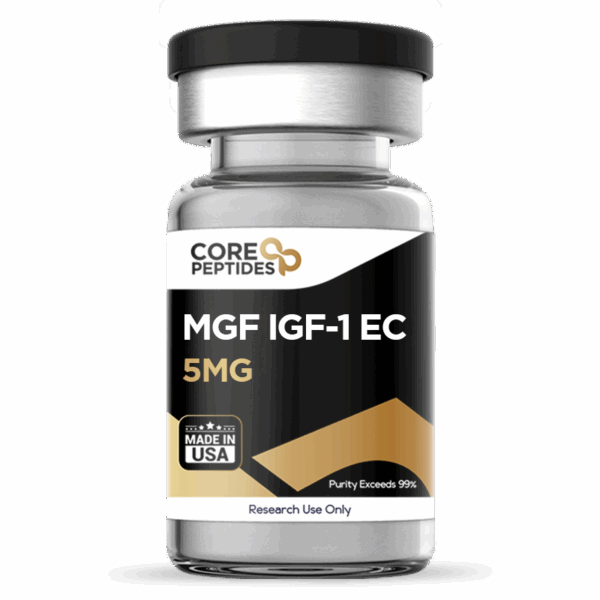
MGF IGF-1 EC (5MG)
CHF 130.50
MGF IGF-1 EC (Mechano Growth Factor, IGF-1Ec) is a synthetic 24-amino acid peptide corresponding to the unique C-terminal E-domain of the human insulin-like growth factor-1 Ec (IGF-1Ec) splice variant. This research peptide has the sequence H-Tyr-Gln-Pro-Pro-Ser-Thr-Asn-Lys-Asn-Thr-Lys-Ser-Gln-Arg-Arg-Lys-Gly-Ser-Thr-Phe-Glu-Glu-His-Lys-NH₂ (YQPPSTNKNTKSQRRKGSTFEEHK-NH₂). Unlike mature IGF-1, MGF IGF-1 EC acts as a local autocrine/paracrine factor that promotes satellite cell proliferation and muscle progenitor cell activation while inhibiting terminal differentiation. Researchers study MGF IGF-1 EC for its roles in muscle repair, tissue regeneration, and age-related muscle decline. Buy MGF IGF-1 EC in Switzerland from Core Peptides for your laboratory research needs.
What Is MGF IGF-1 EC and Why Buy It for Research?
Buy MGF IGF-1 EC in Switzerland for research into satellite cell activation, muscle repair, and tissue regeneration mechanisms. Specifically, MGF IGF-1 EC (also known as Mechano Growth Factor, IGF-1Ec, or MGF E-domain peptide) is a synthetic 24-amino acid linear peptide corresponding to the unique C-terminal E-domain of the human insulin-like growth factor-1 Ec (IGF-1Ec) splice variant. The peptide has the sequence H-Tyr-Gln-Pro-Pro-Ser-Thr-Asn-Lys-Asn-Thr-Lys-Ser-Gln-Arg-Arg-Lys-Gly-Ser-Thr-Phe-Glu-Glu-His-Lys-NH₂ (one-letter code: YQPPSTNKNTKSQRRKGSTFEEHK-NH₂).
Geoffrey Goldspink and colleagues at University College London first identified MGF as a muscle-specific splice variant of the IGF-1 gene that becomes markedly up-regulated in exercised or damaged muscle. Unlike the systemic liver-derived IGF-1, MGF IGF-1 EC is a local autocrine/paracrine factor expressed as a pulse following muscle damage and is involved in the activation of muscle satellite (stem) cells. The peptide has a molecular weight of approximately 2,848-2,867 Da and the molecular formula C₁₂₁H₂₀₀N₄₂O₃₉. The CAS number for MGF IGF-1 EC is 80214-83-1.
In scientific research, MGF IGF-1 EC serves as a molecular tool for studying satellite cell activation, muscle repair, and tissue regeneration pathways. Furthermore, Core Peptides supplies MGF IGF-1 EC as a lyophilized powder exclusively for laboratory use. Therefore, researchers seeking to source this compound for their work will find it readily available when they buy MGF IGF-1 EC in Switzerland.
MGF IGF-1 EC Research Overview: Buy MGF IGF-1 EC in Switzerland for Satellite Cell Studies
Centrally, research into MGF IGF-1 EC has focused on its function as a local growth factor that activates quiescent satellite cells and promotes muscle progenitor cell proliferation. MGF IGF-1 EC is the product of a unique muscle-specific splice variant of the IGF-1 gene. In humans, a 49-base pair insert from exon 5 of the IGF-1 gene causes a reading frame shift in the IGF-1Ec transcript, producing a completely different carboxy-terminal peptide sequence compared to the predominant IGF-1Ea isoform.
Unlike mature IGF-I, the distinct E domain of MGF IGF-1 EC inhibits terminal differentiation whilst increasing myoblast proliferation. Blocking the IGF-I receptor with a specific antibody indicated that the function of the MGF E domain is mediated via a different receptor. MGF IGF-1 EC does not bind to IGF-1 binding proteins, which are responsible for stabilization of IGF-1 in blood and in muscle.
Furthermore, a clear nuclear localization signal (NLS) “RRRK” within the Ec peptide has been identified. The peptide is characterized by a high basicity with four lysine residues and two arginine residues, giving it a strong net positive charge at physiological pH. Additionally, the proline-rich N-terminus (positions 3 and 4 are both proline residues) introduces a rigid kink in the peptide backbone that may be important for biological activity. Accordingly, researchers who buy MGF IGF-1 EC in Switzerland from Core Peptides can support their investigations into satellite cell activation, muscle repair, and tissue regeneration.
How Does MGF IGF-1 EC Work in Research?
Mechanistically, MGF IGF-1 EC’s proposed action involves functioning as a local autocrine/paracrine factor that activates quiescent satellite cells and promotes myoblast proliferation through pathways independent of the classical IGF-1 receptor. The peptide operates through several interconnected mechanisms.
Satellite Cell Activation
MGF IGF-1 EC is expressed as a pulse following muscle damage and is involved in the activation of muscle satellite (stem) cells. MGF IGF-1 EC is responsible for activating quiescent satellite cells, which proliferate to provide a pool of myogenic precursor cells for muscle repair. The peptide significantly increases the proliferative life span and delays senescence of satellite cells.
Myoblast Proliferation vs. Differentiation
Unlike mature IGF-I, the distinct E domain of MGF IGF-1 EC inhibits terminal differentiation whilst increasing myoblast proliferation. MGF IGF-1 EC increases cellular proliferation and inhibits terminal differentiation of myoblasts necessary for secondary myotube formation. This dual action allows MGF IGF-1 EC to expand the progenitor cell pool before IGF-1Ea drives differentiation.
Independent Receptor Signaling
Blocking the IGF-I receptor with a specific antibody indicated that the function of the MGF E domain is mediated via a different receptor. This suggests that MGF IGF-1 EC signals through a distinct pathway from mature IGF-1, contributing to its unique biological effects. Research indicates that the peptide fragment does not measurably induce IGF-1 receptor tyrosine phosphorylation, and does not activate insulin receptors.
ERK5-Mediated Signaling Pathway
MGF IGF-1 EC appears to achieve its effects by activating Erk5 and Erk1/2 while only weakly and transiently engaging Akt. This profile suggests potential implications of the peptide in studies aiming to dissect noncanonical, Erk5-centered pathways downstream of IGF-1-derived products, separate from the typical IGF-1–Akt proliferative axis. In cultured intestinal smooth muscle cells, the peptide may promote an increase in cell volume and total protein content, without stimulating DNA synthesis.
Why Is MGF IGF-1 EC Studied in Switzerland?
Primarily, researchers study MGF IGF-1 EC because it represents a well-characterized IGF-1 splice variant peptide that enables investigation of satellite cell activation, muscle repair, and tissue regeneration. In fact, this compound offers a focused tool for studying the molecular mechanisms underlying muscle adaptation, age-related muscle decline, and regenerative biology.
Research has demonstrated MGF IGF-1 EC’s relevance across multiple domains. MGF IGF-1 EC has been shown to significantly increase the proliferative life span and delay senescence of satellite cells isolated from neonatal and young adult muscle. The peptide has been investigated for its potential to combat age-related sarcopenia without the oncogenic side effects observed for IGF-1.
Furthermore, MGF IGF-1 EC has demonstrated neuroprotective effects in brain ischemia and has been studied for its ability to increase progenitor cells in ALS, dystrophic, and normal muscle. The peptide has also shown potential in preserving cardiac function during myocardial infarction. Additionally, MGF IGF-1 EC has been studied for its ability to activate Erk5-MEF2C-dependent transcriptional programs, supporting the study of smooth muscle-specific genes. Ultimately, researchers who buy MGF IGF-1 EC in Switzerland gain access to a comprehensive research tool for investigating satellite cell activation, muscle repair, neuroprotection, and tissue regeneration.
MGF IGF-1 EC Research Areas in Laboratory Studies
| Research Area | Focus | Evidence Level |
|---|---|---|
| Satellite Cell Activation | Quiescent satellite cell activation, progenitor cell pool expansion | Mechanistic / In Vitro / Ex Vivo |
| Muscle Repair and Regeneration | Myoblast proliferation, inhibition of differentiation, muscle hypertrophy | Preclinical |
| Aging and Sarcopenia | Age-related muscle decline, satellite cell senescence reversal | Preclinical |
| Neuroprotection | Brain ischemia, neuronal survival, CNS protection | Preclinical |
| Cardioprotection | Myocardial infarction, cardiac function preservation | Preclinical |
| Muscular Dystrophy Research | Progenitor cell increase in dystrophic muscle | Preclinical |
| ALS Research | Motor neuron disease, progenitor cell activation | Preclinical |
| Smooth Muscle Hypertrophy | Erk5-MEF2C signaling, smooth muscle gene expression | Mechanistic / In Vitro |
MGF IGF-1 EC Compared With Related Research Compounds
| Compound | Research Focus | Mechanism / Target | Key Difference |
|---|---|---|---|
| MGF IGF-1 EC | Satellite cell activation, myoblast proliferation, tissue repair | Independent receptor signaling, Erk5 pathway, local autocrine factor | 24-amino acid peptide; short half-life (~7 min); inhibits differentiation |
| PEG-MGF | Extended half-life MGF research | Same core peptide with PEG polymer | PEGylated form; extended half-life (hours); systemic distribution |
| Mature IGF-1 | Growth, metabolism, myogenic differentiation | IGF-1 receptor activation | 70-amino acid protein; systemic action; promotes differentiation |
| IGF-1Ea | Systemic growth hormone effects | IGF-1 receptor activation | Predominant IGF-1 isoform; different C-terminal sequence |
Comparatively, MGF IGF-1 EC differs from mature IGF-1 in its mechanism and biological effects. On the one hand, mature IGF-1 promotes myogenic differentiation through the classical IGF-1 receptor. On the other hand, MGF IGF-1 EC acts through a distinct receptor to promote satellite cell activation and myoblast proliferation while inhibiting differentiation. Furthermore, MGF IGF-1 EC has a very short half-life of approximately 5-7 minutes, reflecting its role as a brief local repair signal. In contrast, PEG-MGF is a modified form with an extended half-life for systemic research applications.
Research Applications for MGF IGF-1 EC in Switzerland
Scientists have investigated MGF IGF-1 EC across several research domains:
- Satellite Cell Research: Researchers use MGF IGF-1 EC to study satellite cell activation, proliferation, and the molecular mechanisms underlying muscle stem cell biology.
- Muscle Repair and Regeneration: The peptide is employed to investigate myoblast proliferation, inhibition of differentiation, and muscle tissue repair pathways.
- Aging and Sarcopenia Research: Studies have examined MGF IGF-1 EC’s ability to reverse age-related satellite cell senescence and combat age-related muscle decline.
- Neuroprotection Studies: MGF IGF-1 EC has been investigated for its protective effects in brain ischemia and neuronal survival models.
- Cardioprotection Research: The peptide has been studied for its potential to preserve cardiac function during myocardial infarction.
- Smooth Muscle Research: Studies have explored MGF IGF-1 EC’s ability to activate Erk5-MEF2C-dependent transcriptional programs and smooth muscle-specific genes.
Evidently, researchers who buy MGF IGF-1 EC in Switzerland gain a valuable addition to any laboratory toolkit focused on satellite cell biology, muscle repair, and tissue regeneration research.
MGF IGF-1 EC Product Specifications
| Specification | Details |
|---|---|
| Product Name | MGF IGF-1 EC (Mechano Growth Factor) |
| Alternative Names | IGF-1Ec E-domain peptide, Mechano Growth Factor E-domain, MGF-24aa-E peptide |
| Amount | 5mg |
| Form | Lyophilized powder |
| Purity | Not verified (>99% reported by some suppliers) |
| Amino Acid Sequence | H-Tyr-Gln-Pro-Pro-Ser-Thr-Asn-Lys-Asn-Thr-Lys-Ser-Gln-Arg-Arg-Lys-Gly-Ser-Thr-Phe-Glu-Glu-His-Lys-NH₂ |
| Sequence (1-letter) | YQPPSTNKNTKSQRRKGSTFEEHK-NH₂ |
| Peptide Length | 24 amino acids |
| Molecular Formula | C₁₂₁H₂₀₀N₄₂O₃₉ |
| Molecular Weight | 2,848-2,867 Da (varies by salt form) |
| CAS Number | 80214-83-1 |
| Half-Life | Approximately 5-7 minutes (unmodified) |
| Research Category | Muscle & Performance / Healing & Regeneration |
| Research Use | Laboratory research use only |
| CoA | Available upon request (not verified) |
| Storage | Lyophilized powder should be stored desiccated at -20°C or below, protected from light |
| Solubility | Soluble in water and bacteriostatic water |
How to Evaluate MGF IGF-1 EC Quality for Research
When sourcing MGF IGF-1 EC peptide for laboratory research, researchers should consider several quality indicators:
- Identity Confirmation: Analytical techniques such as mass spectrometry should confirm the compound’s molecular weight (approximately 2,848-2,867 Da) and sequence (H-Tyr-Gln-Pro-Pro-Ser-Thr-Asn-Lys-Asn-Thr-Lys-Ser-Gln-Arg-Arg-Lys-Gly-Ser-Thr-Phe-Glu-Glu-His-Lys-NH₂).
- Purity Assessment: High-performance liquid chromatography (HPLC) should verify purity, with ≥95% considered standard for research-grade material.
- Batch Traceability: Lot numbers and batch information enable researchers to track specific production runs.
- Certificate of Analysis: A CoA should accompany the product, detailing analytical testing results including HPLC purity and identity confirmation.
- Labeling Accuracy: Proper labeling should clearly indicate the product name, amount (5mg), sequence, molecular formula, CAS number, and storage recommendations.
- Storage Conditions: Appropriate storage at -20°C or below in desiccated, dark conditions helps maintain peptide stability.
Understanding the Certificate of Analysis
Typically, a Certificate of Analysis (CoA) accompanies research peptides and provides information about the specific batch’s analytical testing. For example, a CoA may include product identity confirmation, purity percentage as determined by HPLC, batch or lot number for traceability, analytical methods used (e.g., mass spectrometry, HPLC), and a physical description of the product.
Nevertheless, it is important to note that a CoA does not establish safety, efficacy, therapeutic effectiveness, or suitability for human use. Instead, it serves as a quality control document that helps researchers verify the identity and purity of the peptide they are using in their laboratory investigations.
Storage and Stability of MGF IGF-1 EC
Core Peptides supplies MGF IGF-1 EC as a lyophilized (freeze-dried) powder. To maintain stability and integrity:
- Store the lyophilized powder desiccated at -20°C or below for long-term storage
- Store at 4°C for short-term storage if frequent access is required
- Avoid repeated freeze-thaw cycles
- Weigh under dry conditions; the peptide is hygroscopic
- Reconstitute only immediately before use with appropriate sterile solvents (sterile water or bacteriostatic water)
- Inject solvent slowly against the inner wall of the vial; avoid vigorous agitation during dissolution
- Filter sterilize if required (e.g., 0.22 µm) immediately prior to use
- Once reconstituted, store at 2°C to 8°C for up to 20 days; do not freeze
- Protect from light and moisture
Frequently Asked Questions About Buying MGF IGF-1 EC in Switzerland
What is MGF IGF-1 EC?
Specifically, MGF IGF-1 EC (Mechano Growth Factor, IGF-1Ec) is a synthetic 24-amino acid peptide corresponding to the unique C-terminal E-domain of the human IGF-1Ec splice variant with the sequence YQPPSTNKNTKSQRRKGSTFEEHK-NH₂.
What is MGF IGF-1 EC researched for?
Primarily, researchers study MGF IGF-1 EC for its role in satellite cell activation, muscle repair, and tissue regeneration. Studies have investigated its effects on myoblast proliferation, inhibition of differentiation, neuroprotection, and age-related muscle decline.
How does MGF IGF-1 EC work?
Mechanistically, MGF IGF-1 EC functions as a local autocrine/paracrine factor that activates quiescent satellite cells and promotes myoblast proliferation through pathways independent of the classical IGF-1 receptor. It inhibits terminal differentiation while increasing the progenitor cell pool. The peptide activates Erk5 and Erk1/2 while only weakly engaging Akt.
What is the amino acid sequence of MGF IGF-1 EC?
The amino acid sequence is H-Tyr-Gln-Pro-Pro-Ser-Thr-Asn-Lys-Asn-Thr-Lys-Ser-Gln-Arg-Arg-Lys-Gly-Ser-Thr-Phe-Glu-Glu-His-Lys-NH₂ (one-letter code: YQPPSTNKNTKSQRRKGSTFEEHK-NH₂).
What is the molecular weight of MGF IGF-1 EC?
The molecular weight is approximately 2,848-2,867 Da (varies by salt form).
What is the molecular formula of MGF IGF-1 EC?
The molecular formula is C₁₂₁H₂₀₀N₄₂O₃₉.
What is the CAS number of MGF IGF-1 EC?
The CAS number is 80214-83-1.
What is the half-life of MGF IGF-1 EC?
MGF IGF-1 EC has a very short half-life of approximately 5-7 minutes, reflecting its role as a brief local repair signal.
How does MGF IGF-1 EC differ from mature IGF-1?
MGF IGF-1 EC is a 24-amino acid peptide that acts through a distinct receptor to promote satellite cell activation and myoblast proliferation while inhibiting differentiation. Mature IGF-1 is a 70-amino acid protein that promotes myogenic differentiation through the classical IGF-1 receptor. MGF IGF-1 EC does not measurably induce IGF-1 receptor tyrosine phosphorylation.
What research exists on MGF IGF-1 EC?
Research on MGF IGF-1 EC includes studies demonstrating satellite cell activation and myoblast proliferation, neuroprotective effects in brain ischemia, cardiac protection during myocardial infarction, and Erk5-MEF2C-dependent transcriptional programs in smooth muscle cells.
Is MGF IGF-1 EC approved as a medicine?
No. Regulatory authorities have not approved MGF IGF-1 EC as a medicine, pharmaceutical, or therapeutic agent. It is a research tool for laboratory use only.
Is MGF IGF-1 EC intended for human use?
No. MGF IGF-1 EC is intended for laboratory research use only and is not for human consumption, injection, or therapeutic application.
Where can I buy MGF IGF-1 EC in Switzerland?
You can buy MGF IGF-1 EC in Switzerland from Core Peptides, a trusted research peptide supplier serving the Swiss scientific community.
How should researchers evaluate MGF IGF-1 EC quality?
Researchers should look for identity confirmation via mass spectrometry, purity data from HPLC, batch traceability, and a Certificate of Analysis.
Related Research Compounds
Researchers interested in MGF IGF-1 EC may also find the following related compounds relevant to their work:
- PEG-MGF — The PEGylated form of MGF with extended half-life for systemic distribution research.
- IGF-1 (Mature) — The full-length 70-amino acid insulin-like growth factor-1 researched for growth, metabolism, and myogenic differentiation.
- BPC-157 — A peptide researched for tissue healing, gastrointestinal protection, and angiogenesis.
- TB-500 — A Thymosin Beta-4 fragment researched for tissue repair and wound healing.
Explore Muscle & Performance
MGF IGF-1 EC belongs to the Muscle & Performance category of research compounds. Muscle & Performance products are studied for their potential roles in muscle repair, satellite cell activation, and performance-related mechanisms. Generally, researchers who buy MGF IGF-1 EC in Switzerland often pair it with related compounds in this category to explore complementary pathways in muscle research and tissue regeneration.
Explore Healing & Regeneration
Researchers studying tissue repair, regeneration, and stem cell biology may also find relevant compounds in the Healing & Regeneration category. MGF IGF-1 EC’s effects on satellite cell activation and tissue repair make it a valuable tool for investigating regenerative biology and muscle healing.
Further Research
For researchers seeking to deepen their understanding of MGF IGF-1 EC and its research applications, the following areas may warrant further investigation:
- The relationship between MGF IGF-1 EC-mediated satellite cell activation and specific downstream signaling pathways in different muscle types
- Comparative studies between MGF IGF-1 EC and mature IGF-1 in various muscle repair and regeneration models
- The potential role of MGF IGF-1 EC in modulating age-related satellite cell senescence and sarcopenia
- Mechanistic studies on MGF IGF-1 EC’s interaction with its distinct receptor and the Erk5-MEF2C signaling pathway
- Exploration of MGF IGF-1 EC’s effects on different cell types and tissue systems beyond skeletal muscle
Research Disclaimer
MGF IGF-1 EC is a research peptide supplied for laboratory research use only. Researchers must not use it for human consumption, injection, or any form of therapeutic application. Moreover, this product is not a medicine, pharmaceutical, or medical device. Furthermore, Swissmedic, the FDA, EMA, or any other regulatory authority have not approved it for human use. Researchers should consult Swissmedic for applicable regulations and guidance on research peptide handling in Switzerland.
Generally, the information provided on this page is for educational and scientific reference purposes only. Therefore, it does not constitute medical advice, treatment recommendations, or dosing instructions. Ultimately, researchers bear the responsibility for ensuring that their use of this product complies with all applicable laws, regulations, and institutional guidelines.
Finally, all research involving peptides should be conducted by qualified personnel in appropriate laboratory settings with proper safety protocols.
Be the first to review “MGF IGF-1 EC (5MG)”
You must be logged in to post a review.
Related products
Muscle & Performance Peptides
Muscle & Performance Peptides
Muscle & Performance Peptides
Reviews
There are no reviews yet.