
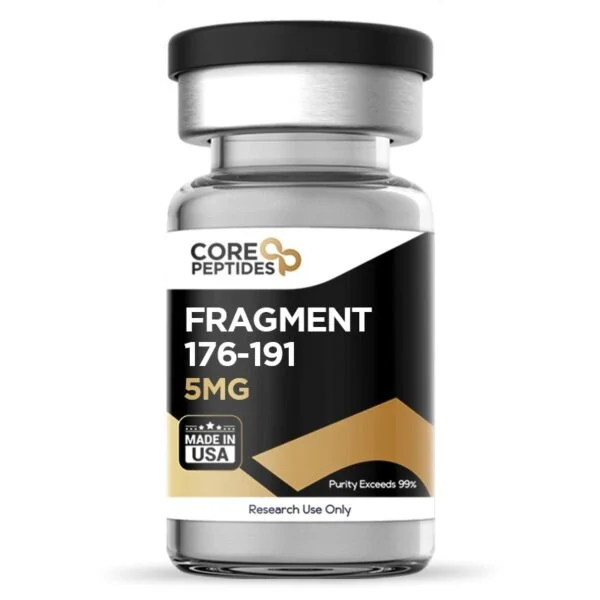
Fragment 176-191 (5MG)
CHF 39.60
Fragment 176-191 (HGH Fragment 176-191, hGH 176-191) is a synthetic 16-amino acid peptide corresponding to the C-terminal region of human growth hormone, specifically residues 176 through 191. This 5mg research peptide contains a stabilizing intramolecular disulfide bond between cysteine residues 7 and 14 and has been studied for its lipolytic properties stimulating fat breakdown and inhibiting fat formation without the growth-promoting or insulin-desensitizing effects of full-length growth hormone. Researchers investigating lipid metabolism, adipocyte signaling, and metabolic regulation may find Fragment 176-191 a valuable tool for laboratory investigation. Buy Fragment 176-191 5mg in Switzerland from Core Peptides for your research needs.
What Is Fragment 176-191 and Why Buy It for Research?
Buy Fragment 176-191 5mg in Switzerland for research into lipid metabolism, adipocyte signaling, and the lipolytic actions of growth hormone. Specifically, Fragment 176-191 (also known as HGH Fragment 176-191, hGH 176-191, or Growth Hormone Fragment) is a synthetic 16-amino acid peptide corresponding to the C-terminal region of human growth hormone, specifically residues 176 through 191 of the full 191-amino acid hGH molecule.
The peptide sequence is Tyr-Leu-Arg-Ile-Val-Gln-Cys-Arg-Ser-Val-Glu-Gly-Ser-Cys-Gly-Phe (YLRIVQCRSVEGSCGF), with a stabilizing intramolecular disulfide bond between the two cysteine residues (Cys7-Cys14, corresponding to Cys182-Cys189 in native hGH). Professor Frank M. Ng and colleagues at Monash University, Melbourne, Australia, identified this fragment as the minimal lipolytic domain of growth hormone through systematic structure-function mapping during the early 1990s.
The foundational 1993 finding demonstrated that the synthetic C-terminal peptide hGH(177-191) possessed antilipogenic activity identical to intact growth hormone when tested on isolated adipocytes, while completely lacking the growth-promoting and diabetogenic effects of the full hormone. In scientific research, Fragment 176-191 serves as a molecular tool for studying the lipolytic actions of growth hormone independently of its systemic growth effects. Furthermore, Core Peptides supplies Fragment 176-191 as a lyophilized powder in a 5mg format exclusively for laboratory use. Therefore, researchers seeking to source this compound for their work will find it readily available when they buy Fragment 176-191 5mg in Switzerland.
Fragment 176-191 Research Overview: Buy Fragment 176-191 5mg in Switzerland for Lipolysis Studies
Centrally, research into Fragment 176-191 has focused on its function as a lipolytic peptide that mimics the fat-burning effects of growth hormone without the systemic growth-promoting or insulin-desensitizing effects. Endogenously, human growth hormone stimulates lipolysis (the breakdown of stored fat into free fatty acids) and inhibits lipogenesis (the conversion of glucose into fat). Fragment 176-191 was specifically identified as the minimal C-terminal domain responsible for these metabolic effects.
This C-terminal fragment regulates fat metabolism without the adverse effects on blood sugar or growth associated with full-length hGH. Studies have shown that Fragment 176-191 stimulates lipolysis (the breakdown or destruction of fat) and inhibits lipogenesis (the transformation of nonfat food materials into body fat). Furthermore, Fragment 176-191 is more potent than full-length HGH in stimulating lipolysis and can inhibit the production of lipids such as fatty acids in the body. Natera, Jiang, and Ng (1994) extended these findings to in vivo models, demonstrating chronic weight loss in obese ob/ob mice.
Importantly, Fragment 176-191 works as part of HGH by mimicking the way natural HGH regulates human metabolism, but does not have adverse side effects on insulin sensitivity, blood glucose, cell proliferation, or muscle growth as whole-segment HGH. This selective action makes it a valuable research tool for studying lipid metabolism without the confounding effects of growth promotion. Accordingly, researchers who buy Fragment 176-191 5mg in Switzerland from Core Peptides can support their investigations into lipid metabolism, adipocyte signaling, and metabolic regulation.
How Does Fragment 176-191 Work in Research?
Mechanistically, Fragment 176-191’s proposed action involves functioning as a lipolytic peptide that interacts with adipocytes to modulate fat metabolism through the lipolytic domain of growth hormone.
Lipolysis Stimulation
Fragment 176-191 stimulates the breakdown of stored triglycerides into free fatty acids and glycerol—a process known as lipolysis. In isolated adipocyte studies, the synthetic C-terminal peptide hGH(177-191) demonstrated antilipogenic activity identical to intact growth hormone. The peptide appears to act directly at the level of fat cells to promote the mobilization of stored lipids.
Lipogenesis Inhibition
Fragment 176-191 inhibits lipogenesis—the formation of fatty acids and other lipids in the body. By blocking the conversion of nonfat food materials into body fat, the peptide helps maintain metabolic balance. This dual action—stimulating fat breakdown while inhibiting fat formation—makes Fragment 176-191 a focused tool for studying lipid metabolism.
Selective Metabolic Action
Unlike full-length growth hormone, Fragment 176-191 does not adversely affect insulin sensitivity or blood glucose levels. It also lacks the growth-promoting and cell-proliferative effects of intact hGH. This selectivity is thought to arise from the separation of the lipolytic domain (located in the C-terminal region) from the growth-promoting domains of the full-length hormone.
Structural Features
The peptide contains a stabilizing intramolecular disulfide bond between the two cysteine residues (Cys7-Cys14 in the fragment, corresponding to Cys182-Cys189 in native hGH). This disulfide bond establishes a loop within the C-terminal region and contributes to the peptide’s biological activity.
Why Is Fragment 176-191 Studied in Switzerland?
Primarily, researchers study Fragment 176-191 because it represents a well-characterized C-terminal hGH fragment that enables investigation of lipid metabolism, lipolysis, and adipocyte signaling without the complications of full-length growth hormone signaling. In fact, this peptide offers a focused tool for studying the molecular mechanisms underlying fat breakdown, fat formation inhibition, and metabolic homeostasis.
Research has demonstrated Fragment 176-191’s relevance across multiple domains. In isolated adipocyte studies, the peptide demonstrated antilipogenic activity identical to intact growth hormone. In vivo studies in obese ob/ob mice demonstrated chronic weight loss. The peptide has been shown to be more potent than full-length HGH in stimulating lipolysis.
Furthermore, recent research has explored Fragment 176-191’s potential beyond metabolic regulation. A 2022 study published in Drug Design, Development and Therapy demonstrated that hGH Fragment 176-191 peptide enhances the toxicity of doxorubicin-loaded chitosan nanoparticles against MCF-7 breast cancer cells. Molecular docking simulations depicted that the hGH fragment 176-191 peptide binds with high affinity to Ki-67, MiB protein, and estrogen receptor. This suggests potential research applications in oncology. Ultimately, researchers who buy Fragment 176-191 5mg in Switzerland gain access to a versatile research tool for investigating lipid metabolism, adipocyte signaling, and emerging applications in cancer research.
Fragment 176-191 Research Areas in Laboratory Studies
| Research Area | Focus | Evidence Level |
|---|---|---|
| Lipid Metabolism | Lipolysis stimulation, lipogenesis inhibition, fat oxidation | Mechanistic / In Vitro / In Vivo |
| Adipocyte Signaling | Fat breakdown, adipocyte function, lipid mobilization | Mechanistic / In Vitro |
| Metabolic Regulation | Weight regulation, obesity models, metabolic homeostasis | Animal / Preclinical |
| Oncology Research | Ki-67 binding, doxorubicin enhancement, breast cancer models | In Vitro |
| Growth Hormone Biology | C-terminal fragment function, lipolytic domain characterization | Mechanistic |
| Receptor Binding Studies | Estrogen receptor, MiB protein, Ki-67 interactions | Mechanistic / In Silico |
Fragment 176-191 Compared With Related Research Compounds
| Compound | Research Focus | Mechanism / Target | Key Difference |
|---|---|---|---|
| Fragment 176-191 (hGH 176-191) | Lipid metabolism, lipolysis, metabolic regulation | C-terminal hGH fragment; lipolytic domain | 16-amino acid native sequence; no human clinical trials |
| AOD-9604 | Lipid metabolism, lipolysis, obesity research | Modified hGH 176-191 with N-terminal Tyr substitution | Tyrosine-modified N-terminus; improved stability; human clinical trials |
| Full-Length hGH | Growth, metabolism, IGF-1 signaling | GH receptor activation | 191 amino acids; stimulates IGF-1 and growth |
| hGH 177-191 (AOD-9401) | Lipid metabolism, antilipogenic activity | C-terminal hGH fragment (177-191) | 15-amino acid fragment; established functional context |
Comparatively, Fragment 176-191 differs from AOD-9604 in its amino acid composition and research history. On the one hand, Fragment 176-191 is the native 16-amino acid C-terminal sequence (YLRIVQCRSVEGSCGF). On the other hand, AOD-9604 consists of the same core 176-191 sequence but with an N-terminal tyrosine residue substituted for the native leucine at position 176, making it a 16-residue peptide with a modified N-terminus (Tyr-hGH 177-191). This single amino acid modification was introduced to improve peptide stability and oral bioavailability. Critically, all six human clinical trials (over 890 participants total) were conducted exclusively with the AOD-9604 (tyrosine-modified) form. The unmodified HGH Fragment 176-191 has never been tested in human clinical trials.
Research Applications for Fragment 176-191 in Switzerland
Scientists have investigated Fragment 176-191 across several research domains:
- Lipid Metabolism Research: Researchers use Fragment 176-191 to study lipolysis stimulation, lipogenesis inhibition, and the molecular mechanisms underlying fat oxidation.
- Adipocyte Biology: Investigations have explored Fragment 176-191’s effects on adipocyte signaling, lipid mobilization, and adipose tissue regulation.
- Metabolic Research: The peptide serves as a tool for studying energy homeostasis, metabolic adaptation, and obesity-related pathways in preclinical models.
- Oncology Research: Studies have investigated Fragment 176-191’s binding to Ki-67, MiB protein, and estrogen receptor, as well as its ability to enhance doxorubicin toxicity in breast cancer models.
- Growth Hormone Biology: The compound is used to characterize the lipolytic domain of hGH and understand fragment-specific functions.
- Receptor Binding Studies: Molecular docking simulations have examined Fragment 176-191’s interactions with Ki-67, MiB protein, and estrogen receptor.
Evidently, researchers who buy Fragment 176-191 5mg in Switzerland gain a valuable addition to any laboratory toolkit focused on lipid metabolism, adipocyte research, and metabolic regulation.
Fragment 176-191 Product Specifications
| Specification | Details |
|---|---|
| Product Name | Fragment 176-191 (HGH Fragment 176-191) |
| Alternative Names | hGH 176-191, HGH Fragment 176-191, Growth Hormone Fragment 176-191, hGH(176-191) |
| Amount | 5mg |
| Form | Lyophilized powder |
| Purity | Not verified |
| Amino Acid Sequence | H-Tyr-Leu-Arg-Ile-Val-Gln-Cys-Arg-Ser-Val-Glu-Gly-Ser-Cys-Gly-Phe-OH |
| Sequence (1-letter) | YLRIVQCRSVEGSCGF |
| Peptide Length | 16 amino acids |
| Disulfide Bridge | Cys7-Cys14 (intramolecular) |
| Molecular Formula | C₇₈H₁₂₅N₂₃O₂₃S₂ |
| Molecular Weight | 1,815-1,817 Da (free base) |
| CAS Number | 66004-57-7 (free base) |
| Half-Life | IV: ~3 minutes (pig); in vitro plasma: ~4 minutes (rat) |
| Research Category | Weight Management & Metabolism / Muscle & Performance |
| Research Use | Laboratory research use only |
| CoA | Available upon request (not verified) |
| Storage | Lyophilized powder should be stored desiccated at -20°C or below |
| Solubility | Soluble in water and aqueous solutions |
How to Evaluate Fragment 176-191 Quality for Research
When sourcing Fragment 176-191 peptide for laboratory research, researchers should consider several quality indicators:
- Identity Confirmation: Analytical techniques such as mass spectrometry should confirm the compound’s molecular weight (~1,815-1,817 Da) and sequence (H-Tyr-Leu-Arg-Ile-Val-Gln-Cys-Arg-Ser-Val-Glu-Gly-Ser-Cys-Gly-Phe-OH).
- Disulfide Bridge Confirmation: Analytical methods should confirm the presence of the intramolecular disulfide bond between cysteine residues 7 and 14.
- Purity Assessment: High-performance liquid chromatography (HPLC) can provide information about peptide purity.
- Batch Traceability: Lot numbers and batch information enable researchers to track specific production runs.
- Certificate of Analysis: A CoA should accompany the product, detailing analytical testing results.
- Labeling Accuracy: Proper labeling should clearly indicate the product name, amount, sequence, and storage recommendations.
- Storage Conditions: Appropriate storage at -20°C or below in desiccated conditions helps maintain peptide stability.
Understanding the Certificate of Analysis
Typically, a Certificate of Analysis (CoA) accompanies research peptides and provides information about the specific batch’s analytical testing. For example, a CoA may include product identity confirmation, purity percentage as determined by HPLC, batch or lot number for traceability, analytical methods used (e.g., mass spectrometry, HPLC), and a physical description of the product.
Nevertheless, it is important to note that a CoA does not establish safety, efficacy, therapeutic effectiveness, or suitability for human use. Instead, it serves as a quality control document that helps researchers verify the identity and purity of the peptide they are using in their laboratory investigations.
Storage and Stability of Fragment 176-191
Core Peptides supplies Fragment 176-191 as a lyophilized (freeze-dried) powder. To maintain stability and integrity:
- Store the lyophilized powder desiccated at -20°C or below for long-term storage
- Store at 4°C for short-term storage if frequent access is required
- Avoid repeated freeze-thaw cycles
- Weigh under dry conditions; the peptide is hygroscopic
- Reconstitute only immediately before use with appropriate sterile solvents
- Inject solvent slowly against the inner wall of the vial; avoid vigorous agitation during dissolution
- Filter sterilize if required (e.g., 0.22 µm) immediately prior to use
- Aliquot and store reconstituted solutions at -20°C or below to minimize degradation
- Protect from light and moisture
Frequently Asked Questions About Buying Fragment 176-191 5mg in Switzerland
What is Fragment 176-191?
Specifically, Fragment 176-191 (HGH Fragment 176-191) is a synthetic 16-amino acid peptide corresponding to the C-terminal region of human growth hormone, specifically residues 176 through 191 of the full 191-amino acid hGH molecule.
What is Fragment 176-191 researched for?
Primarily, researchers study Fragment 176-191 for its role as a lipolytic peptide that stimulates fat breakdown and inhibits fat formation. Studies have investigated its effects on lipid metabolism, adipocyte signaling, and metabolic regulation, as well as emerging applications in oncology research.
How does Fragment 176-191 work?
Mechanistically, Fragment 176-191 functions as the lipolytic domain of growth hormone, stimulating lipolysis and inhibiting lipogenesis in adipocytes without the growth-promoting or insulin-desensitizing effects of full-length hGH.
What is the amino acid sequence of Fragment 176-191?
The amino acid sequence is H-Tyr-Leu-Arg-Ile-Val-Gln-Cys-Arg-Ser-Val-Glu-Gly-Ser-Cys-Gly-Phe-OH (one-letter code: YLRIVQCRSVEGSCGF).
What is the molecular weight of Fragment 176-191?
The molecular weight is approximately 1,815-1,817 Da (free base).
What is the molecular formula of Fragment 176-191?
The molecular formula is C₇₈H₁₂₅N₂₃O₂₃S₂.
What is the CAS number of Fragment 176-191?
The CAS number is 66004-57-7 (free base).
How does Fragment 176-191 differ from AOD-9604?
Fragment 176-191 is the native 16-amino acid C-terminal sequence (YLRIVQCRSVEGSCGF). AOD-9604 consists of the same core sequence but with an N-terminal tyrosine substituted for the native leucine at position 176 (Tyr-hGH 177-191). All human clinical trials were conducted with AOD-9604, not the unmodified Fragment 176-191.
What research exists on Fragment 176-191?
Research on Fragment 176-191 includes foundational studies by Ng and colleagues (1993-1994) demonstrating antilipogenic activity and chronic weight loss in obese mice, a 2022 study showing enhancement of doxorubicin toxicity in breast cancer cells, and molecular docking studies demonstrating binding to Ki-67, MiB protein, and estrogen receptor.
Is Fragment 176-191 approved as a medicine?
No. Regulatory authorities have not approved Fragment 176-191 as a medicine, pharmaceutical, or therapeutic agent. It is a research tool for laboratory use only.
Is Fragment 176-191 intended for human use?
No. Fragment 176-191 is intended for laboratory research use only and is not for human consumption, injection, or therapeutic application.
Where can I buy Fragment 176-191 5mg in Switzerland?
You can buy Fragment 176-191 5mg in Switzerland from Core Peptides, a trusted research peptide supplier serving the Swiss scientific community.
How should researchers evaluate Fragment 176-191 quality?
Researchers should look for identity confirmation via mass spectrometry, purity data from HPLC, disulfide bridge confirmation, batch traceability, and a Certificate of Analysis.
Related Research Compounds
Researchers interested in Fragment 176-191 may also find the following related compounds relevant to their work:
- AOD-9604 — The tyrosine-modified derivative of Fragment 176-191, researched for lipolysis, metabolic regulation, and weight management.
- Full-Length Human Growth Hormone — The parent molecule from which Fragment 176-191 is derived, researched for growth, metabolism, and IGF-1 signaling.
- BPC-157 — A peptide researched for tissue healing, gastrointestinal health, and angiogenesis.
- TB-500 — A Thymosin Beta 4 fragment researched for tissue repair and wound healing.
Explore Weight Management & Metabolism
Fragment 176-191 belongs to the Weight Management & Metabolism category of research compounds. Weight Management & Metabolism products are studied for their potential roles in metabolic regulation, lipid metabolism, and energy homeostasis. Generally, researchers who buy Fragment 176-191 5mg in Switzerland often pair it with related compounds in this category to explore complementary pathways in metabolic research and adipocyte biology.
Explore Muscle & Performance
Researchers studying metabolic adaptation, exercise physiology, and performance-related mechanisms may also find relevant compounds in the Muscle & Performance category. Fragment 176-191’s effects on lipid metabolism and energy utilization make it a valuable tool for investigating muscle metabolism and performance-related pathways.
Further Research
For researchers seeking to deepen their understanding of Fragment 176-191 and its research applications, the following areas may warrant further investigation:
- The relationship between Fragment 176-191-mediated lipolysis and specific downstream signaling pathways in adipocytes
- Comparative studies between Fragment 176-191 and AOD-9604 in various metabolic and physiological models
- The potential role of Fragment 176-191 in modulating Ki-67, estrogen receptor, and MiB protein interactions
- Mechanistic studies on Fragment 176-191’s interaction with adipocyte receptors and signaling pathways
- Exploration of Fragment 176-191’s effects on different tissue systems beyond adipose tissue
Research Disclaimer
Researchers must not use it for human consumption, injection, or any form of therapeutic application. Moreover, this product is not a medicine, pharmaceutical, or medical device. Furthermore, Swissmedic, the FDA, EMA, or any other regulatory authority have not approved it for human use. Researchers should consult Swissmedic for applicable regulations and guidance on research peptide handling in Switzerland.
Generally, the information provided on this page is for educational and scientific reference purposes only. Therefore, it does not constitute medical advice, treatment recommendations, or dosing instructions. Ultimately, researchers bear the responsibility for ensuring that their use of this product complies with all applicable laws, regulations, and institutional guidelines.
Be the first to review “Fragment 176-191 (5MG)”
You must be logged in to post a review.
Related products
Growth Hormone Peptides
Growth Hormone Blends
Growth Hormone Blends
Growth Hormone Blends

Growth Hormone Blends
Growth Hormone Peptides
Growth Hormone Blends
Growth Hormone Blends
Tesamorelin & CJC-1295 (Mod GRF 1-29) & Ipamorelin Blend (12MG)
Reviews
There are no reviews yet.