
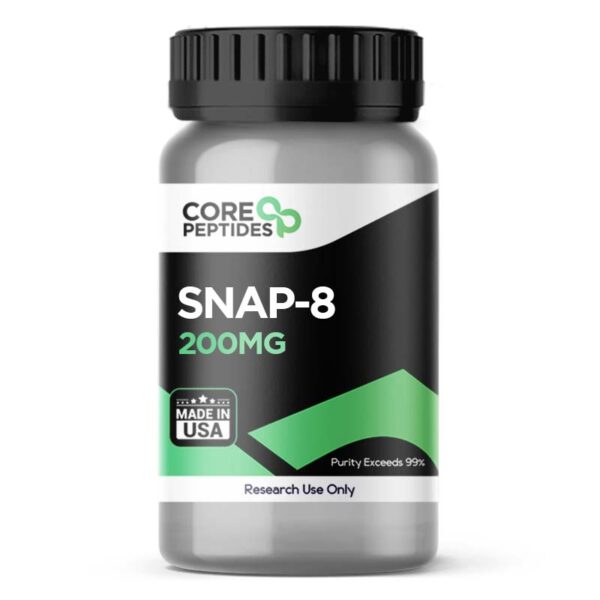
SNAP-8 (200MG)
CHF 158.40
SNAP-8 (Acetyl Octapeptide-3) is a synthetic octapeptide with the sequence Ac-Glu-Glu-Met-Gln-Arg-Arg-Ala-Asp-NH2 (Ac-EEMQRRAD-NH2). It functions as a competitive inhibitor of the SNARE complex by mimicking the N-terminal domain of SNAP-25, thereby modulating synaptic vesicle fusion and neurotransmitter release. Researchers investigate SNAP-8 for its effects on SNARE complex assembly, synaptic vesicle dynamics, and calcium-dependent exocytosis in preclinical models. Available for laboratory research purposes only. Buy SNAP-8 in Switzerland from Core Peptides, a trusted research peptide supplier.
What Is SNAP-8?
SNAP-8, also known as Acetyl Octapeptide-3, is a synthetic octapeptide with the amino acid sequence Ac-Glu-Glu-Met-Gln-Arg-Arg-Ala-Asp-NH2 (Ac-EEMQRRAD-NH2). It belongs to a class of peptide-based compounds designed to mimic the N-terminal domain of the synaptosomal-associated protein of 25 kDa (SNAP-25). SNAP-25 is a core component of the SNARE (Soluble N-ethylmaleimide-sensitive factor Attachment Protein Receptor) complex, which plays a critical role in the docking and fusion of synaptic vesicles with the presynaptic membrane during neurotransmitter release.
As an octapeptide—a peptide composed of eight amino acids—SNAP-8 features N-terminal acetylation and C-terminal amidation, which enhance its stability and resistance to enzymatic degradation. Researchers developed SNAP-8 as an extended analog of Argireline (Acetyl Hexapeptide-8), incorporating two additional amino acids (Ala-Asp) to potentially improve its efficacy and stability. For those looking to buy SNAP-8 in Switzerland, Core Peptides offers high-quality research-grade material for laboratory applications.
SNAP-8 Research Overview
SNAP-8 has attracted research interest as a tool for investigating synaptic vesicle dynamics, SNARE complex assembly, and neurotransmitter release. The peptide’s design—an octapeptide mimicking the N-terminus of SNAP-25—enables it to compete with the endogenous protein for binding sites within the SNARE complex. This competitive inhibition mechanism positions SNAP-8 as a valuable compound for studying the molecular basis of synaptic transmission and exocytosis.
Research interest in SNAP-8 centers on its ability to interfere with SNARE complex formation. By competing with SNAP-25, SNAP-8 may destabilize the SNARE complex, potentially modulating the release of neurotransmitters such as acetylcholine. Consequently, SNAP-8 has generated interest as a research tool for investigating SNARE complex biology, synaptic vesicle trafficking, and calcium-dependent exocytosis.
When researchers choose to buy SNAP-8 in Switzerland for laboratory studies, they gain access to a compound that may help elucidate mechanisms of synaptic transmission, vesicle fusion, and neurotransmitter regulation at the molecular level.
How Does SNAP-8 Work?
SNAP-8 exerts its biological effects through competitive inhibition of SNARE complex assembly. The peptide’s mechanism involves several interconnected steps.
Mimicry of SNAP-25 N-Terminal Domain
SNAP-8 is structurally identical to the N-terminal sequence of SNAP-25 (residues 12-19), allowing it to compete with the endogenous protein for binding sites within the SNARE complex. SNAP-25 is a key component of the SNARE complex, which mediates the docking and fusion of synaptic vesicles with the presynaptic membrane.
Competitive Inhibition of SNARE Complex Assembly
By competing with SNAP-25 for its position in the SNARE complex, SNAP-8 modulates the formation of the complex. If the SNARE complex is slightly destabilized, vesicles cannot release neurotransmitters as efficiently, thereby attenuating muscle contraction.
Interaction with Synaptotagmin 1
Molecular docking experiments suggest that SNAP-8 may bind to the C2A–C2B interface of Synaptotagmin 1 (Syt1), a calcium sensor crucial for regulating neurotransmitter release. This interaction, primarily driven by hydrophobic contacts, may interfere with Synaptotagmin 1’s ability to respond to calcium signals, potentially disrupting normal neurotransmission.
Modulation of Neurotransmitter Release
Through these mechanisms, SNAP-8 may reduce the release of acetylcholine at the neuromuscular junction. Acetylcholine is a neurotransmitter involved in stimulating muscle contractions; its reduced release may therefore lead to decreased muscle activity.
Researchers who buy SNAP-8 in Switzerland for research purposes can investigate these mechanisms across diverse experimental models of synaptic transmission and SNARE complex biology.
Why Is SNAP-8 Studied?
Researchers study SNAP-8 primarily for its potential relevance to SNARE complex biology, synaptic vesicle dynamics, and neurotransmitter release. The peptide’s ability to competitively inhibit SNAP-25 in the SNARE complex makes it a valuable tool for understanding the molecular basis of synaptic transmission and exocytosis.
SNAP-8 serves as a second-generation improvement of its predecessor Argireline (Acetyl Hexapeptide-8), with two additional amino acids that may improve its stability and efficacy. This extended structure enables researchers to investigate structure-activity relationships within the SNARE complex and explore the effects of peptide length on competitive inhibition.
Moreover, researchers study SNAP-8 in the context of synaptic vesicle trafficking and calcium-dependent exocytosis. Investigations suggest that SNAP-8 might be utilized in experimental frameworks to explore how vesicle release frequency, timing, and amplitude are regulated.
Researchers who buy SNAP-8 in Switzerland from Core Peptides can incorporate this peptide into their studies on SNARE complex biology, synaptic transmission, vesicle trafficking, and neurotransmitter release.
SNAP-8 Research Areas
| Research Area | Description |
|---|---|
| SNARE Complex Assembly | Investigating SNAP-8’s competitive inhibition of SNAP-25 in SNARE complex formation |
| Synaptic Vesicle Dynamics | Studying SNAP-8’s effects on vesicle docking, fusion, and neurotransmitter release |
| Neurotransmitter Release | Examining SNAP-8’s modulation of acetylcholine and other neurotransmitter release |
| Calcium-Dependent Exocytosis | Exploring SNAP-8’s interaction with Synaptotagmin 1 and calcium signaling |
| Synaptic Transmission | Investigating SNAP-8’s effects on neuromuscular junction signaling |
| Vesicle Trafficking | Preclinical research into SNAP-8’s effects on intracellular trafficking pathways |
| Structure-Activity Relationships | Examining the role of peptide length in SNARE complex inhibition |
| Exocytosis Regulation | Exploring SNAP-8’s potential to modulate vesicle release frequency and timing |
Scientific Research on SNAP-8
Researchers have conducted scientific studies on SNAP-8 in both in vitro and preclinical settings, deriving evidence from molecular docking experiments, cell cultures, and clinical research. The peptide originates from the Argireline research program and represents an extended analog with potential improvements in stability and efficacy.
In Vitro and Molecular Evidence
Molecular docking experiments have suggested that SNAP-8 may bind to the C2A–C2B interface of Synaptotagmin 1 (Syt1), primarily driven by hydrophobic contacts. This binding site suggests a plausible mechanism for inhibitory action on Syt1, potentially interfering with its ability to respond to calcium signals.
In vitro studies have demonstrated that SNAP-8, as a mimic of the N-terminal end of SNAP-25, competes with SNAP-25 for a position in the SNARE complex, thereby modulating its formation. The peptide’s sequence—identical to the N-terminal domain of SNAP-25—enables this competitive inhibition.
Preclinical and Clinical Studies
In a 2021 double-blind, randomized clinical trial, 55 research models with Fitzpatrick skin type I to VI were exposed to either a peptide serum containing SNAP-8 or a control compound twice daily for 12 weeks. Short-term peptide impact was measured 15 minutes after exposure, and long-term impact was measured at weeks 4, 8, and 12.
Research has also explored SNAP-8’s potential to modulate vesicle release frequency, timing, and amplitude in experimental frameworks. Investigations suggest that SNAP-8 might be utilized to explore how exocytosis, neurotransmitter release analogue systems, and intracellular trafficking pathways are regulated.
Nevertheless, researchers should note that SNAP-8 is supplied for laboratory research purposes only. Scientists who buy SNAP-8 in Switzerland should remain aware of these evidence considerations.
SNAP-8 Compared With Related Peptides
| Peptide | Relationship to SNAP-8 | Key Differences |
|---|---|---|
| Argireline (Acetyl Hexapeptide-8) | Predecessor; SNAP-8 is an extended analog | Argireline has 6 amino acids (Ac-EEMQRR-NH2); SNAP-8 has 8 amino acids (Ac-EEMQRRAD-NH2) with enhanced stability |
| Acetyl Hexapeptide-3 | Alternative designation for Argireline | Same 6-amino acid sequence; SNAP-8 is the extended 8-amino acid version |
| Leuphasyl (Pentapeptide-18) | Both studied for neuromodulation | Leuphasyl is an enkephalin analog targeting opioid receptors; SNAP-8 targets the SNARE complex |
| Botulinum Toxin | Both modulate acetylcholine release | Botulinum toxin enzymatically cleaves SNARE proteins; SNAP-8 competitively inhibits SNARE assembly |
| SNAP-25 | Endogenous protein; SNAP-8 is a synthetic mimic | SNAP-25 is a 206-amino acid protein; SNAP-8 is an 8-amino acid fragment |
Research Applications
Researchers utilize SNAP-8 in a variety of laboratory research applications, primarily in the fields of neuroscience, cell biology, and synaptic transmission. Key research applications include:
- SNARE Complex Assembly Studies: Investigating SNAP-8’s competitive inhibition of SNAP-25 in SNARE complex formation
- Synaptic Vesicle Dynamics Research: Studying SNAP-8’s effects on vesicle docking, fusion, and neurotransmitter release
- Neurotransmitter Release Studies: Examining SNAP-8’s modulation of acetylcholine and other neurotransmitter release
- Calcium-Dependent Exocytosis Research: Exploring SNAP-8’s interaction with Synaptotagmin 1 and calcium signaling
- Synaptic Transmission Studies: Investigating SNAP-8’s effects on neuromuscular junction signaling
- Vesicle Trafficking Research: Preclinical research into SNAP-8’s effects on intracellular trafficking pathways
- Structure-Activity Relationship Studies: Examining the role of peptide length in SNARE complex inhibition
- Exocytosis Regulation Studies: Exploring SNAP-8’s potential to modulate vesicle release frequency and timing
Researchers who buy SNAP-8 in Switzerland can incorporate this peptide into their experimental protocols across these diverse research areas.
SNAP-8 Product Specifications
| Specification | Detail |
|---|---|
| Product Name | SNAP-8 (Acetyl Octapeptide-3) |
| Amount | 200mg |
| Form | Lyophilized powder |
| Sequence (One-Letter) | Ac-EEMQRRAD-NH2 |
| Sequence (Three-Letter) | Ac-Glu-Glu-Met-Gln-Arg-Arg-Ala-Asp-NH2 |
| Molecular Formula | C41H70N16O16S |
| Molecular Weight | Approximately 1,075.16 g/mol |
| CAS Number | 868844-74-0 |
| N-Terminal Modification | Acetylation |
| C-Terminal Modification | Amidation |
| Synonyms | Acetyl Octapeptide-3, Acetyl Glutamyl Heptapeptide-3, Synaptosomal-associated protein 8 |
| Mechanism | Competitive inhibition of SNAP-25 in SNARE complex; SNARE complex destabilization |
| Research Category | Skin, Hair & Beauty Peptides |
| Purity | >99% (HPLC) |
| Storage | Store desiccated at -20°C, protected from light |
How to Evaluate SNAP-8 Quality
When sourcing SNAP-8 for research purposes, researchers should consider several quality indicators. A reliable SNAP-8 peptide supplier should provide:
- Identity Confirmation: Analytical verification that the peptide matches the expected octapeptide sequence (Ac-Glu-Glu-Met-Gln-Arg-Arg-Ala-Asp-NH2) and molecular weight (approximately 1,075.16 g/mol)
- Purity Analysis: Documentation of purity through methods such as HPLC – research grade typically provides >99% purity
- N-Terminal Acetylation Confirmation: Verification of the acetylated N-terminus, which contributes to peptide stability
- C-Terminal Amidation Confirmation: Verification of the amidated C-terminus
- Batch Information: Clear lot numbers and batch traceability
- Certificate of Analysis (CoA): Documentation of analytical testing results
- Appearance: White to off-white lyophilized powder
Researchers looking to buy SNAP-8 in Switzerland should seek suppliers who provide comprehensive documentation and quality assurance. Core Peptides remains committed to supporting research with properly documented products.
Understanding the Certificate of Analysis
A Certificate of Analysis (CoA) provides analytical data for a specific batch of a research peptide. For SNAP-8 research, a CoA typically includes:
- Identity Confirmation: Mass spectrometry confirming the peptide’s identity
- Purity Assessment: HPLC chromatograms showing the purity of the peptide
- Batch/Lot Information: Unique identifiers for traceability
- Analytical Methods: Description of the testing methods used
Importantly, researchers should understand that a CoA demonstrates the chemical identity and purity of a peptide but does not establish safety, efficacy, therapeutic effectiveness, or suitability for human use. The CoA serves as a quality control document for research purposes only.
Storage and Stability
Proper storage of research peptides is essential for maintaining their integrity and stability. For SNAP-8, researchers should refer to the product documentation provided with their order for specific storage recommendations.
General best practices for peptide storage include keeping the lyophilized peptide desiccated, protected from light, and stored at -20°C or below. The N-terminal acetylation and C-terminal amidation contribute to enhanced stability and resistance to enzymatic degradation. For specific temperature requirements and reconstitution protocols, consult the applicable product documentation or contact Core Peptides for the applicable storage specifications.
Research Considerations
Researchers incorporating SNAP-8 into their studies should be aware of several important considerations:
- Evidence Limitations: SNAP-8 has been studied in molecular docking experiments, in vitro assays, and clinical research. However, researchers should note that the peptide is supplied for laboratory research purposes only.
- Experimental Status: Researchers consider SNAP-8 a well-characterized compound, but findings should be interpreted within the context of ongoing research.
- Model Differences: Results from molecular docking, cell cultures, and clinical studies may not translate directly to all experimental outcomes.
- Regulatory Status: SNAP-8 is not FDA-approved and is intended for laboratory research use only.
- Quality Considerations: Researchers should verify the quality and identity of their SNAP-8 through appropriate analytical methods.
- Mechanistic Context: SNAP-8’s proposed mechanisms involve SNARE complex inhibition, Synaptotagmin 1 interaction, and neurotransmitter release modulation. Researchers should consider appropriate experimental approaches to investigate these pathways.
- Selectivity Profile: SNAP-8 is a more extended analog of Argireline with potentially improved stability and efficacy, which may influence research design considerations.
Researchers who buy SNAP-8 in Switzerland should ensure their studies include appropriate controls and interpret findings with scientific rigor.
Frequently Asked Questions About SNAP-8
What is SNAP-8?
SNAP-8 (Acetyl Octapeptide-3) is a synthetic octapeptide with the sequence Ac-Glu-Glu-Met-Gln-Arg-Arg-Ala-Asp-NH2 that mimics the N-terminal domain of SNAP-25 and competitively inhibits SNARE complex assembly.
What is SNAP-8 researched for?
Researchers primarily investigate SNAP-8 for its effects on SNARE complex assembly, synaptic vesicle dynamics, neurotransmitter release modulation, and calcium-dependent exocytosis.
What is the amino acid sequence of SNAP-8?
The amino acid sequence of SNAP-8 is Ac-Glu-Glu-Met-Gln-Arg-Arg-Ala-Asp-NH2 (Ac-EEMQRRAD-NH2).
What is the molecular weight of SNAP-8?
The molecular weight of SNAP-8 is approximately 1,075.16 g/mol.
What is the CAS number for SNAP-8?
The CAS number for SNAP-8 is 868844-74-0.
What is the mechanism of action for SNAP-8?
SNAP-8 competitively inhibits SNAP-25 in the SNARE complex, destabilizing SNARE complex assembly and potentially modulating neurotransmitter release.
How does SNAP-8 differ from Argireline?
SNAP-8 is an extended analog of Argireline (Acetyl Hexapeptide-8) with two additional amino acids (Ala-Asp) that may improve stability and efficacy.
Does SNAP-8 interact with Synaptotagmin 1?
Molecular docking experiments suggest that SNAP-8 may bind to the C2A–C2B interface of Synaptotagmin 1, potentially interfering with calcium signaling.
Can I buy SNAP-8 in Switzerland?
Yes, researchers can buy SNAP-8 in Switzerland from Core Peptides for laboratory research purposes.
What is the primary research category for SNAP-8?
SNAP-8 belongs to the Skin, Hair & Beauty Peptides category, with secondary relevance to Cellular Research & Signaling research.
What related peptides are studied alongside SNAP-8?
Related peptides include Argireline (Acetyl Hexapeptide-8), Leuphasyl, and other SNARE-targeting peptides.
What is the purity of Core Peptides’ SNAP-8?
Core Peptides provides SNAP-8 with a purity of >99% as verified by HPLC analysis.
How should SNAP-8 be stored?
SNAP-8 should be stored lyophilized, desiccated, protected from light, at -20°C or below.
Is SNAP-8 soluble in water?
Yes, SNAP-8 is soluble in water and buffered aqueous solutions.
Related Research Peptides
Researchers interested in SNAP-8 may also find the following related peptides relevant to their work:
- Argireline (Acetyl Hexapeptide-8) – The predecessor compound; a 6-amino acid SNARE-targeting peptide
- Leuphasyl (Pentapeptide-18) – An enkephalin analog studied for neuromodulation
- Acetyl Hexapeptide-3 – Another designation for Argireline
- BPC-157 – A peptide studied for healing and tissue repair
- GHK-Cu – A copper peptide studied for cellular research
For a comprehensive selection of research peptides in Switzerland, explore the Core Peptides catalog.
Explore Skin, Hair & Beauty Peptides
SNAP-8 is part of our Skin, Hair & Beauty Peptides category, which features a range of research peptides investigated for their effects on cellular signaling, tissue biology, and neuromodulation. Browse our selection to find the right peptides for your laboratory research.
Explore Related Research Categories
Researchers may also find the following related categories relevant to SNAP-8 research:
- Cellular Research & Signaling – Peptides studied for cellular signaling and SNARE complex biology
- Cognitive & Nootropic Peptides – Peptides studied for neurological and synaptic research
- Anti-Aging & Longevity – Peptides investigated for age-related research applications
Further Research
Researchers interested in learning more about SNAP-8 and related peptides should consult the primary scientific literature. Key areas of investigation include SNARE complex biology, synaptic vesicle dynamics, neurotransmitter release, and calcium-dependent exocytosis. The PubMed database is an excellent resource for accessing peer-reviewed research articles on these topics.
Research Disclaimer
Core Peptides supplies SNAP-8 as a research peptide for laboratory research purposes only. All information provided is for educational and scientific reference purposes only and does not constitute medical advice. Researchers are responsible for ensuring compliance with all applicable laws and regulations governing the use of research peptides in their jurisdiction, including Switzerland.
Soyez le premier à laisser votre avis sur “SNAP-8 (200MG)”
Vous devez être connecté pour publier un avis.
Produits similaires
Skin, Hair & Beauty Peptides
Skin, Hair & Beauty Peptides
Skin, Hair & Beauty Peptides

Skin, Hair & Beauty Peptides
Skin, Hair & Beauty Peptides
Skin, Hair & Beauty Peptides
Skin, Hair & Beauty Peptides
Skin, Hair & Beauty Peptides
Avis
Il n’y a pas encore d’avis.